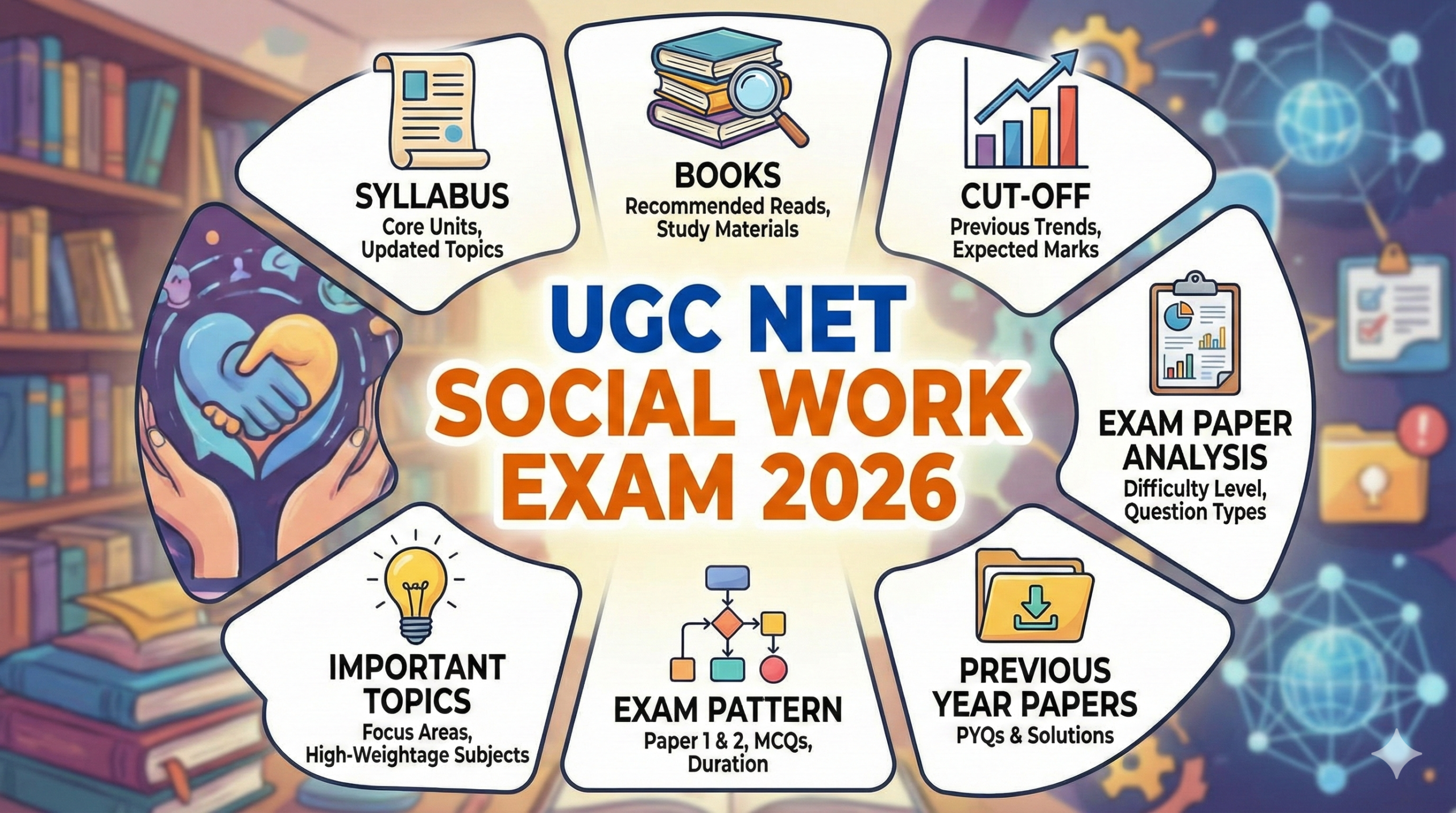
UGC NET Social Work Exam 2026 Syllabus,Books,Cut-off,Exam Paper Anyalsis Previous year question Paper,Exam Pattern,Important Topic
The UGC NET Social Work Exam 2026 is a highly competitive national-level examination conducted to determine eligibility for Assistant Professor and Junior Research Fellowship (JRF) in Social Work across Indian universities and colleges. With increasing competition and evolving exam trends, aspirants must have a thorough understanding of the latest syllabus, exam pattern, recommended books, previous year question papers, cut-off trends, and detailed exam paper analysis to prepare effectively.
This article provides a comprehensive and updated guide for UGC NET Social Work 2026, covering the complete syllabus, unit-wise important topics, best reference books, previous year questions (PYQs), expected cut-off, and exam pattern. It also includes a focused analysis of past exam papers to help candidates understand question trends, difficulty levels, and high-weightage areas. Whether you are a first-time aspirant or a repeat candidate, this guide aims to serve as a one-stop resource for strategic and result-oriented preparation for the UGC NET Social Work examination.
Table of Contents
Overview of UGC NET Social Work Exam 2026
| Particulars | Details |
|---|---|
| Exam Name | UGC NET Social Work Exam 2026 |
| Conducting Body | National Testing Agency (NTA) |
| Governing Authority | University Grants Commission (UGC) |
| Purpose of Exam | Eligibility for Assistant Professor and Junior Research Fellowship (JRF) |
| Exam Level | National Level |
| Exam Frequency | Twice a year (June & December cycles) |
| Mode of Examination | Computer Based Test (CBT) |
| Medium of Paper | English & Hindi |
| Total Papers | Two (Paper I & Paper II) |
| Paper I | Teaching & Research Aptitude (Common for all subjects) |
| Paper II | Social Work (Subject-specific) |
| Total Questions | 150 MCQs |
| Total Marks | 300 Marks |
| Exam Duration | 3 Hours (180 Minutes) |
| Marking Scheme | +2 for each correct answer |
| Negative Marking | ❌ No negative marking |
| Eligibility Outcome | Assistant Professor only OR Assistant Professor + JRF |
| Official Website | nta.ac.in / ugcnet.nta.nic.in |
UGC NET Social Work Syllabus (Unit-wise – Complete & Detailed Table)
| Unit No. & Unit Name | Complete Topics Covered |
|---|---|
| Unit I – Nature and Development of Social Work | Social Work: definition, scope, principles, nature, goals, process; historical development of professional social work in the UK, USA, and India; social reform and professional social work—contributions of 19th and 20th century social reformers in India; social work as a profession in India—values, competencies, and code of ethics; theories for social work practice; changing context of social work practice—emerging perspectives, trends, and challenges; social work practice in various settings—family, child and youth welfare, industry, older persons, persons with disabilities, environment, women welfare, healthcare, and disaster management. |
| Unit II – Society, Human Behavior and Communities | Sociological concepts—social structure, institutions, groups, socialization, social control, and social change; approaches to the study of society—functionalist, conflict/dialectical, structuralism, and post-modernism; social systems and stratification—family and religion, Marxist, functionalist, and Weberian approaches; human behavior—normal and abnormal behavior, determinants, life-span perspective of human development, developmental tasks and hazards from prenatal to adulthood; theories of personality—psychoanalytic, behavioral, and humanistic theories; social psychology—social perception, attitude formation, change and measurement, communication, collective behavior theories; types of communities—rural, urban, tribal, virtual; vulnerable groups—women, children, aged, Dalits; caste and class and their characteristics. |
| Unit III – Social Work with Individuals and Groups | Social case work concepts—social roles, social functioning, need assessment, adaptation, person-in-environment, principles and components; approaches to case work—diagnostic, functional, problem-solving, task-centered, radical approaches; case work process and techniques—phases, intervention techniques, interviewing principles, and recording; social group work—definition, characteristics, functions, group structure, classification, formation, identity, diversity, marginalization; group work process and dynamics—principles, determinants, leadership theories, decision-making, problem-solving; group development—stages, skills, techniques, group climate, communication, programme media, recording, monitoring, evaluation; practice sites—children, correctional, health, women, persons with disabilities, older persons, oppressed groups, religious minorities, LGBTQ+ and socio-economically disadvantaged groups. |
| Unit IV – Social Work with Communities and Social Action | Community organization—concept, scope, definition, history in India, UK, USA; role of community-based organizations; human and social capital; process of community organization—steps, methods, principles, skills, assumptions, record maintenance, NGO involvement; approaches and models of community organization; leadership development, partnerships, coalitions; social action—concept, history, social action as a method of social work; models of social action—Paulo Freire’s conscientization, Saul Alinsky, ideology, liberation theology; social movements—origin, nature, types, theories, new social movements; social movements and change—movement analysis, ideology, leadership, structure, outcomes; ideologies of Gandhi, Martin Luther King Jr., and Frantz Fanon. |
| Unit V – Research in Social Work: Quantitative and Qualitative Approaches | Quantitative research—meaning, nature, scope of social science and social work research; steps—problem formulation, literature review, objectives, hypotheses, research design, sampling, data sources, tools, processing, analysis, report writing, referencing and citation; statistical concepts—descriptive and inferential statistics, parametric and non-parametric tests. Qualitative research—meaning, tenets, comparison with quantitative research; qualitative designs—field study, case study, focus group discussion, narratives, observation, theoretic research; qualitative data analysis and report writing. Mixed methods research—components and procedures for integrating quantitative and qualitative approaches. |
| Unit VI – Administration, Welfare and Development Services | Social welfare administration—meaning, history, principles, nature, types of organizations; distinction between social welfare, public administration, and social security administration; registration of welfare agencies—societies, trusts, non-profit organizations, challenges; structure of welfare administration—government and non-government organizations; components—planning, coordination, recruitment, training, documentation, budgeting, monitoring, evaluation, networking, public relations; administrative strategies—decision-making, communication, role functioning, sustainability; fundraising and resource mobilization—grant-in-aid, financial administration, social marketing models. |
| Unit VII – Social Policy, Planning and Social Development | Social policy—concept, goals, scope, models, Indian context; historical evolution of social policies; implementation for marginalized and vulnerable groups; policy formulation—determinants, steps, approaches, political influence; social planning—concept, objectives, scope, models, social and economic planning, planning in India; five-year plans—role in social change, factors influencing planning, role of NITI Aayog; social development—concept, models, theories, positive and negative dimensions, Indian context; sustainable development—concept, strategies, issues, SDGs, human development index, indicators for policies and programmes. |
| Unit VIII – Indian Constitution, Social Justice, Human Rights and Social Work Practice | Indian Constitution—features, preamble, directive principles, articles; social justice—concept, history, dimensions, manifestations, social justice as a core value of social work; social justice and leadership—empowerment, community building, technology, planning change, policy implications; instruments of social justice—legal system, advocacy, civil society, statutory bodies; human rights—concept, history, declarations, treaties, conventions, protection systems, Indian context; human rights and social work—ethics, feminist and culturally sensitive practice, work with diverse groups; human rights violations—social work interventions, activism, role of UNHCR, NHRC, and international agencies. |
| Unit IX – Areas of Social Work Practice I | Medical and psychiatric social work—concept, evolution, roles and responsibilities; mental health—normal and abnormal behavior, epidemiology, etiology, schizophrenia, mood, neurotic, stress-related, somatoform disorders, child and adolescent mental health, mental health legislations; aging—psychological and sociological theories, needs and problems of older persons, rights and interventions; persons with disabilities—models, disability movement, welfare to rights approach, legislation, interventions; gender and development—gender disparity, feminization of poverty, gender-based violence, safeguards, interventions; labour welfare and HRM—labour welfare theories, legislations, HRM concepts, HRD, performance management, CSR, corporate governance; personnel management and industrial relations—models, globalization, ILO, collective bargaining, manpower planning, organizational behavior and development. |
| Unit X – Areas of Social Work Practice II | Social defence—concept, philosophy, children in need of care and protection, juveniles in conflict with law, street and working children, probation and parole; legislations—Juvenile Justice Act, Immoral Traffic Prevention Act, Probation of Offenders Act, Beggary Prevention Act, NDPS Act, Prison Act, criminal justice system; social work with families—family stages, patterns, dynamics, models (Circumplex, McMaster, Structural); child development—concept, philosophy, status of children in India; child policies and programmes—constitutional provisions, national and international frameworks, UNCRC, adoption, foster care, child marriage, female foeticide; environment and social work—human rights perspective, environmental movements, interventions; disaster management—concepts, types of disasters, impact, pre- and post-disaster social work interventions. |
Unit Wise Important Topics
| Unit No. & Name | Most Important Topics (High-Yield) | PYQ Trend (How Questions Are Asked) | Years / NET Cycles Asked |
|---|---|---|---|
| Unit I – Nature & Development of Social Work | Definition, scope & principles of social work; social work as a profession; professional values & ethics; Indian social reformers; theories of social work; emerging trends | Conceptual MCQs on principles & values, match-the-following on reformers, theory-based questions | 2017, 2018, 2019, 2021, 2022, 2023 |
| Unit II – Society, Human Behavior & Communities | Sociological concepts; social stratification (Marx, Weber); theories of personality; life-span development stages; caste & class; types of communities | Application-based questions on development stages, comparison of stratification theories, concept clarity | 2018, 2019, 2020, 2022, 2023, 2024 |
| Unit III – Social Work with Individuals & Groups | Case work concepts & principles; diagnostic vs functional approach; task-centered approach; phases of case work; group dynamics; leadership theories; stages of group development | Very high repetition of approaches, principles of interviewing, group stages & leadership styles | 2016, 2017, 2018, 2020, 2022, 2023, 2024 |
| Unit IV – Community Organization & Social Action | Community organization models; role of NGOs/CBOs; social action; Paulo Freire conscientization; Saul Alinsky model; social movements | Analytical questions on models, ideology-based questions, thinker–concept matching | 2017, 2019, 2021, 2022, 2023 |
| Unit V – Research in Social Work | Research steps; hypothesis & variables; sampling methods; research designs; quantitative vs qualitative research; statistics (t-test, chi-square); mixed methods | Highest scoring unit; numerical/statistical MCQs; conceptual clarity questions | 2016–2024 (asked in every cycle) |
| Unit VI – Administration, Welfare & Development Services | Principles of social welfare administration; public vs social welfare administration; planning & budgeting; monitoring & evaluation; fundraising | Conceptual + statement-based questions on administration principles and budgeting types | 2018, 2019, 2021, 2022, 2024 |
| Unit VII – Social Policy, Planning & Social Development | Social policy models; policy formulation process; social planning; Five-Year Plans; role of NITI Aayog; sustainable development; HDI & SDGs | Assertion–reason and analytical MCQs on policy & planning, HDI indicators | 2017, 2018, 2020, 2021, 2023, 2024 |
| Unit VIII – Indian Constitution, Social Justice & Human Rights | Preamble & DPSPs; social justice as core value; legal instruments; human rights declarations; NHRC; rights-based social work | Direct conceptual MCQs and application-based questions on human rights & justice | 2016, 2018, 2019, 2021, 2022, 2023 |
| Unit IX – Areas of Practice I | Medical & psychiatric social work; mental health disorders; aging theories; disability models; gender & development; labour welfare; CSR | Case-based and factual questions on mental health, aging, disability, CSR | 2017, 2019, 2020, 2022, 2023, 2024 |
| Unit X – Areas of Practice II | Juvenile justice system; probation & parole; family models; child rights & UNCRC; environment & social work; disaster management | Law-oriented MCQs and application-based questions on JJ Act, family models, disaster phases | 2018, 2019, 2021, 2022, 2023 |
UGC NET Social Work Cut -off 2024 to 2025
| Exam Cycle | Category | Assistant Professor (AP) | JRF | Difference (JRF − AP) |
|---|---|---|---|---|
| December 2024 | UR / General | 180 | 202 | 22 |
| OBC-NCL | 166 | 192 | 26 | |
| EWS | 164 | 196 | 32 | |
| SC | 158 | 186 | 28 | |
| ST | 152 | 176 | 24 | |
| June 2025 | UR / General | 180 | 206 | 26 |
| OBC-NCL | 166 | 198 | 32 | |
| EWS | 164 | 200 | 36 | |
| SC | 154 | 186 | 32 | |
| ST | 150 | 178 | 28 | |
| December 2025 | UR / General | 184 | 210 | 26 |
| OBC-NCL | 170 | 202 | 32 | |
| EWS | 168 | 198 | 30 | |
| SC | 160 | 188 | 28 | |
| ST | 148 | 180 | 32 |
📊 Approximate Unit-Wise Distribution (Based on Past NET Question Patterns)
| Unit No. | Unit Name | Approx. Questions per Paper (100 total) |
|---|---|---|
| Unit I | Nature & Development of Social Work | 9–11 |
| Unit II | Society, Human Behavior & Communities | 9–11 |
| Unit III | Social Work with Individuals & Groups | 10–12 |
| Unit IV | Community Organization & Social Action | 9–11 |
| Unit V | Research in Social Work | 10–13 |
| Unit VI | Administration, Welfare & Development | 8–10 |
| Unit VII | Social Policy, Planning & Development | 8–10 |
| Unit VIII | Indian Constitution, Social Justice & Human Rights | 8–10 |
| Unit IX | Areas of Practice I (Medical, Mental Health, Gender, etc.) | 8–10 |
| Unit X | Areas of Practice II (Juvenile Justice, Child Rights, Disaster, etc.) | 8–10 |
📚 UGC NET Social Work – Detailed Book Table (Unit-wise)
| Unit | Book Name & Author | Publication (Publisher) | Year (Edition) | Approx. Price (INR) |
|---|---|---|---|---|
| Unit I – Nature & Development of Social Work | Social Work: An Empowering Profession – DuBois & Miley | Pearson | 2019 (Latest) | ₹950–1150 |
| Theory & Practice of Social Work – Ved Singh | Sage Publications | 2017 (Latest) | ₹750–900 | |
| Unit II – Society, Human Behavior & Communities | Social Problems in India – Ram Ahuja | Rawat Publications | 2022 (Latest) | ₹750–950 |
| Indian Society – M. N. Srinivas | Macmillan / Routledge | Classic (2009) | ₹650–800 | |
| Unit III – Social Work with Individuals & Groups | Social Casework: A Problem Solving Process – Helen Harris Perlman | Univ. of Chicago Press | 2018 (Reprint) | ₹1200–1400 |
| Group Work: Practice & Skills – Toseland & Rivas | Pearson | 2015 (Latest) | ₹1100–1300 | |
| Unit IV – Community Organization & Social Action | Community Organization & Social Action – Ralph W. White | Pearson | 2014 (Latest) | ₹900–1100 |
| Pedagogy of the Oppressed – Paulo Freire | Bloomsbury / Continuum | 2018 (One Edition) | ₹450–600 | |
| Unit V – Research in Social Work | Research Methodology – C. R. Kothari | New Age International | 2019 (4th Ed) | ₹450–600 |
| Research Methods in Social Work – Chawla & Sondhi | Vikas Publishing | 2019 (Latest) | ₹800–1000 | |
| Unit VI – Administration, Welfare & Development Services | Social Welfare Administration – S. K. Mangal | Vivek Publication | 2018 (Latest) | ₹600–750 |
| Public Administration – Avasthi & Maheshwari | Lakshmi Narain Agarwal | 2019 (Latest) | ₹650–850 | |
| Unit VII – Social Policy, Planning & Social Development | Social Policy and Social Development in India – Kulkarni & Gokhale | Himalaya Publishing | 2019 | ₹650–800 |
| Indian Economy – Ramesh Singh | McGraw Hill | 2021 (Latest) | ₹750–900 | |
| Unit VIII – Indian Constitution, Social Justice & Human Rights | Introduction to the Constitution of India – D. D. Basu | LexisNexis | 2019 (22nd Ed) | ₹1050–1300 |
| Human Rights in India – Paras Diwan | Deep & Deep Publications | 2020 (Latest) | ₹600–800 | |
| Unit IX – Areas of Practice I | Medical & Psychiatric Social Work – Francis J. Turner | Cengage / Thomson | 2017 Edition | ₹900–1100 |
| Labour Welfare & Industrial Relations – Mamoria & Gankar | Himalaya Publishing | 2020 (Latest) | ₹700–900 | |
| Unit X – Areas of Practice II | Juvenile Justice in India – Ved Kumari | Oxford University Press | 2019 | ₹900–1100 |
| Disaster Management – Dr. Satish Kumar | McGraw Hill / Wiley | 2021 (Latest) | ₹650–850 |
Recommended products
-
UGC NET Social Work Solved Previous year Question Paper II Best Book II 8 Year 2018 to 2025 II With Detail Solutions II 8 Year PYQ II By Diwakar Education Publication
Original price was: ₹500.00.₹450.00Current price is: ₹450.00. -
UGC NET Social Work II Hindi Medium Book II Solved Previous Year Paper II PYQ 2018 to 2024 II With Detail Solution
Original price was: ₹700.00.₹480.00Current price is: ₹480.00.
✅ UGC NET Social Work – Eligibility Criteria
A. Educational Qualification & Marks
| Criteria | Details (Official & Correct) |
|---|---|
| Minimum Qualification | Master’s Degree (Postgraduate) or equivalent from a UGC-recognized university |
| General / UR / EWS | Minimum 55% marks in Master’s degree |
| OBC-NCL / SC / ST / PwD / Third Gender | Minimum 50% marks in Master’s degree |
| Final Year PG Students | Eligible provisionally (must complete PG with required marks within prescribed time) |
| Private / Distance PG Degree | Valid only if recognised by UGC |
| Number of Attempts | No limit |
| Validity of NET (AP) | Lifetime |
| Validity of JRF | 3 years from date of award |
B. Age Criteria
| Purpose | Age Limit |
|---|---|
| Junior Research Fellowship (JRF) | Maximum 31 years |
| Assistant Professor | No upper age limit |
| Age Relaxation (JRF) | 5 years for OBC-NCL / SC / ST / PwD / Third Gender; 3 years for women |
C. Relevant Postgraduate Subjects Eligible for UGC NET Social Work
Candidates must select “Social Work” as the NET subject, but their postgraduate degree can be in Social Work or closely related Social Science disciplines.
| Category | Postgraduate Subjects Accepted |
|---|---|
| Directly Relevant (Fully Eligible) | Master of Social Work (MSW), MA Social Work, MSW (Medical / Psychiatric / HR / Community Development), MA Social Welfare |
| Closely Related & Commonly Accepted | Sociology, Psychology, Applied Psychology, Human Development, Social Sciences |
| Allied / Interdisciplinary Subjects | Rural Development, Development Studies, Anthropology, Gender Studies, Population Studies, Criminology |
| Policy / Welfare-oriented Subjects | Social Policy, Public Administration (with welfare focus), Labour & Social Welfare |
| Important Note | Candidates should preferably choose the subject of their PG specialization; eligibility is verified during admission/recruitment |
UGC NET Social Work Exam Pattern 2026 –
Total Number of Questions in UGC NET
- UGC NET 2026 will have a total of 150 multiple-choice questions.
- Paper 1 will have 50 questions and Paper 2 will have 100 questions.
- There is No Restriction to moving to and fro among the Papers.
- All the questions are compulsory to attempt.
- you will get 2 marks for each correct response
- If a question is found to be incorrect/ambiguous during the critical challenge, only those candidates who have attempted the question and chosen one of the correct answers would be given credit. Only for dropped question(s), if any, marks will be given to all the candidates.
The table below shows the exam pattern of UGC NET Paper 1 and Paper 2:
| Particulars | UGC NET Paper-I Overview | UGC NET Paper-II [Social Work] Overview |
| Exam mode | Online | Online |
| Exam duration | 3 hours (180 minutes) | |
| Type of paper | Common for all candidates | Subject-specific questions |
| Total questions | 50 | 100 |
| Type of questions | MCQs; 4 options with only 1 correct option | MCQs; 4 options with only 1 correct option |
| Total marks | 100 | 200 |
| Marking scheme | 2 marks for the correct answer 0 for an incorrect answer | 2 marks for the correct answer 0 for an incorrect answer |
| Language of paper | English and Hindi | English & Hindi |
UGC NET Marking Scheme 2026
- A uniform marking scheme is followed in the exam i.e. for both Paper 1 and 2, each correct answer will fetch you 2 marks.
- As per the revised exam pattern of the UGC NET exam, there is no negative marking for incorrect answers.
- Hence, instead of skipping a question, one can use their calculated guess and mark the answer.
The updated marking scheme of UGC NET is given below:
| Type of Answer | Marks Allotted |
|---|---|
| Correct Answer | 2 marks |
| Incorrect Answer | 0 mark |
| No Answer | 0 mark |
Go through the exam pattern of the UGC NET Library Science Paper 1 syllabus mentioned below:
| Topics | Questions | Marks |
| Part I: Teaching Aptitude | 5 | 10 |
| Part II: Research Aptitude | 5 | 10 |
| Part III: Reading Comprehension | 5 | 10 |
| Part IV: Communication | 5 | 10 |
| Part V: Reasoning (including Maths) | 5 | 10 |
| Part VI: Logical Reasoning | 5 | 10 |
| Part VII: Data Interpretation | 5 | 10 |
| Part VIII: Information & Communication Technology (ICT) | 5 | 10 |
| Part IX: People & Environment | 5 | 10 |
| Part X: Higher Education System: Governance, Polity & Administration | 5 | 10 |
| Total | 50 | 100 |
📅 UGC NET Social Work – Study Plan
A. 6-Month Detailed Study Plan (Ideal for First-Time Aspirants)
| Month | Units to Cover (Paper II – Social Work) | Focus Areas |
|---|---|---|
| Month 1 | Unit I – Nature & Development of Social Work Unit II – Society, Human Behaviour & Communities | Concepts, evolution, Indian context, thinkers |
| Month 2 | Unit III – Social Work Methods I Unit IV – Social Work Methods II | Case work, group work, community organization, social action |
| Month 3 | Unit V – Social Welfare Administration Unit VI – Social Policy & Planning | Indian welfare system, policies, governance |
| Month 4 | Unit VII – Research in Social Work Unit VIII – Statistics & Data Analysis | Research methods, sampling, tools, interpretation |
| Month 5 | Unit IX – Areas of Social Work Practice Unit X – Work with Individuals & Families | Health, education, gender, child welfare |
| Month 6 | Unit XI – Work with Groups & Communities Unit XII – Social Work & Social Development | Environment, NGOs, CSR, sustainable development + Full Revision |
📌 Parallel Task (Every Month):
- Paper I preparation (Teaching Aptitude, Research Aptitude, Reasoning)
- Previous Year Questions (PYQs)
- Short notes & diagrams
B. 3-Month Fast-Track Study Plan (For Repeaters)
| Month | Strategy |
|---|---|
| Month 1 | High-weight Units: I, III, IV, V, VI |
| Month 2 | Research + Statistics (VII & VIII) + Practice Areas (IX, X) |
| Month 3 | Low-weight Units + Full Revision + Mock Tests |
C. Last 30-Day Revision Plan
| Days | Task |
|---|---|
| 1–10 | Revise Units I–VI (core theory + thinkers + acts) |
| 11–20 | Revise Units VII–XII + research formulas |
| 21–25 | Solve PYQs (last 10–12 years) |
| 26–30 | Full mocks + weak-area revision |
🎯 UGC NET Social Work – Smart Preparation Tips
1️⃣ Focus on High-Weight Units
📌 Units I, III, IV, V, VI, and VII consistently produce maximum questions.
2️⃣ PYQs Are Non-Negotiable
✔ At least 60–70% questions are conceptually repeated.
✔ Prepare unit-wise PYQs from 2012 onwards.
3️⃣ Use Comparative & Analytical Notes
- Thinkers vs Thinkers
- Indian vs Western Models
- Acts vs Policies
- Welfare vs Development approaches
4️⃣ Research & Statistics = Scoring Area
✔ Learn definitions, tools, sampling methods
✔ Practice numerical/statistical interpretation questions
5️⃣ Integrate Paper I Daily
| Paper I Area | Time / Day |
|---|---|
| Teaching & Research Aptitude | 30 min |
| Reasoning & DI | 30 min |
| Reading Comprehension | 15 min |
UGC NET Social Work Previous Year Question Paper
The UGC NET Social Work examination assesses a candidate’s grasp of core concepts, application of social work theories, and understanding of contemporary issues in the field. By solving previous year papers, aspirants can:
- Identify important and frequently repeated topics
- Understand the distribution of questions across different units
- Improve time management and accuracy
- Evaluate strengths and weaknesses
- Get a real feel of the exam environment
| Previous year Question Paper | Link to Download |
|---|---|
| UGC NET Social Work Solved Paper 2015 | Click Here |
| UGC NET Social Work Solved Paper 2016 | Click Here |
| UGC NET Social Work Solved Paper 2017 | Click Here |
| UGC NET Social Work Solved Paper 2018 | Click Here |
| UGC NET Social Work Solved Paper 2019 | Click Here |
| UGC NET Social Work Solved Paper 2020 | Click Here |
| UGC NET Social Work Solved Paper 2021 | Click Here |
| UGC NET Social Work Solved Paper 2022 | Click Here |
| UGC NET Social Work Solved Paper 2023 | Click Here |
| UGC NET Social Work Solved Paper 2024 | Click Here |
| UGC NET Social Work Solved Paper 2026 | Click Here |
❓ UGC NET Social Work – Frequently Asked Questions (FAQs)
1. What is UGC NET Social Work?
UGC NET Social Work is a national-level eligibility test to determine candidates’ eligibility for Assistant Professor and Junior Research Fellowship (JRF) in the subject of Social Work at Indian universities and colleges.
2. Is a postgraduate degree mandatory for UGC NET Social Work?
Yes. A Master’s degree (Postgraduate) from a UGC-recognized university is mandatory.
- General / UR / EWS: Minimum 55%
- OBC-NCL / SC / ST / PwD: Minimum 50%
3. Can final-year postgraduate students apply?
Yes. Final-year or result-awaited PG students can apply provisionally, but they must complete the degree with the required marks within the stipulated time.
4. Which postgraduate subjects are eligible for UGC NET Social Work?
Eligible PG subjects include:
- Direct: MSW, MA Social Work, Social Welfare
- Related: Sociology, Psychology, Human Development, Social Sciences
- Allied: Rural Development, Development Studies, Anthropology, Gender Studies
👉 Candidates must choose “Social Work” as the NET subject while applying.
5. Can Sociology or Psychology students appear for Social Work NET?
Yes, candidates with PG degrees in Sociology, Psychology, or allied social sciences can appear for the Social Work paper, provided they meet the eligibility criteria and choose Social Work as their NET subject.
6. Is there any age limit for UGC NET Social Work?
- JRF: Maximum 31 years (age relaxation as per rules)
- Assistant Professor: No upper age limit
7. How many papers are there in UGC NET Social Work?
There are two papers:
- Paper I: Teaching & Research Aptitude (General)
- Paper II: Social Work (Subject-specific)
Both papers are conducted in a single session.
8. What is the exam pattern for Social Work (Paper II)?
- Questions: 100 MCQs
- Marks: 200
- Duration: 3 hours (combined for both papers)
- Negative Marking: ❌ No
9. Is there any limit on the number of attempts?
No. There is no restriction on the number of attempts for UGC NET Social Work.
10. What is the validity of the UGC NET certificate?
- Assistant Professor: Lifetime validity
- JRF: Valid for 3 years from the date of award
11. Are previous year questions important for preparation?
Yes. Very important.
Around 60–70% of questions are conceptually repeated. Solving PYQs from the last 10–12 years is strongly recommended.
12. Which units are most important for Social Work NET?
High-weight units usually include:
- Nature & Development of Social Work
- Social Work Methods (Case work, Group work, Community organization)
- Social Welfare Administration
- Social Policy & Planning
- Research in Social Work
13. Is Paper I compulsory for Social Work candidates?
Yes. Paper I is mandatory for all subjects, including Social Work, and plays a crucial role in final selection.
14. Can I qualify JRF and Assistant Professor both?
Yes. If your score meets the JRF cut-off, you are automatically eligible for Assistant Professor as well.
15. Is UGC NET Social Work tough to crack?
The exam is conceptual and analytical, not difficult if:
- Syllabus is covered systematically
- PYQs are practiced
- Regular revision and mock tests are done
With the right strategy, JRF is achievable.