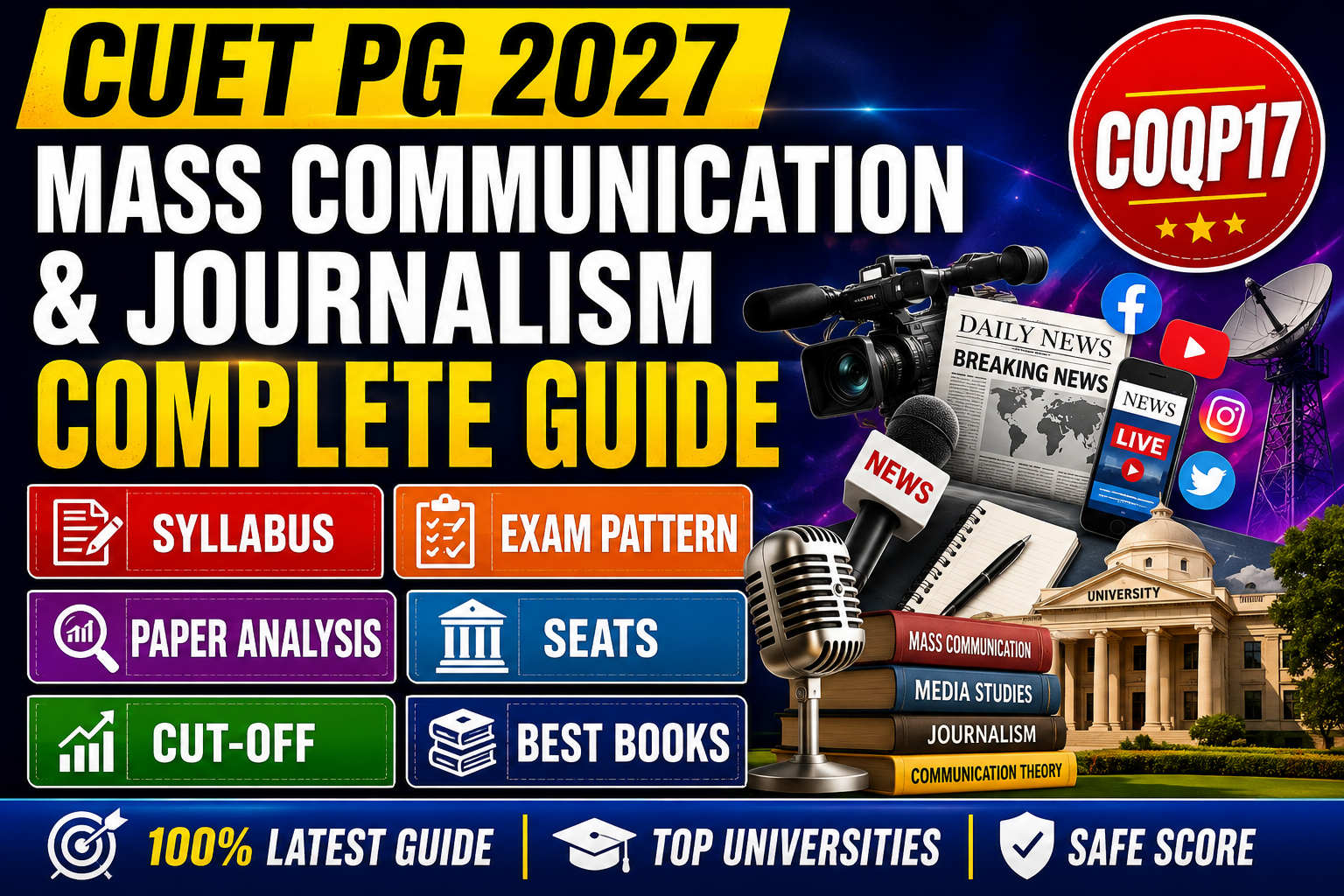
CUET PG Mass Communication & Journalism 2027 Complete Guide, Syllabus, Exam Pattern, Paper Analysis, Seats, Cut-off & Books
If you are planning to pursue MA in Mass Communication, Journalism, Media Studies, Digital Media, or Communication, then CUET PG Mass Communication & Journalism (COQP17) is one of the most important entrance examinations. Through this examination, candidates can secure admission to various Central, State, Deemed, and participating universities across India This complete guide covers the CUET PG Mass Communication & Journalism 2027 syllabus, exam pattern, paper analysis, participating universities, expected cut-off, seat availability, preparation strategy, and the best books.
Latest Update: As of now, NTA has not announced any major change in the CUET PG Mass Communication & Journalism syllabus. Candidates should continue preparing according to the latest official COQP17 syllabus.
Table of Contents
CUET PG Mass Communication & Journalism 2027 Highlights
| Particular | Details |
|---|---|
| Exam Name | CUET PG 2027 |
| Subject | Mass Communication & Journalism |
| Subject Code | COQP17 |
| Conducting Authority | National Testing Agency (NTA) |
| Exam Mode | Computer Based Test (CBT) |
| Duration | 90 Minutes |
| Total Questions | 75 Questions |
| Maximum Marks | 300 |
| Question Type | Multiple Choice Questions (MCQs) |
| Marking Scheme | +4 for Correct, -1 for Incorrect |
| Medium | English & Hindi (where applicable) |
| Admission Level | Postgraduate (MA/MJMC/Media Studies etc.) |
What is CUET PG COQP17?
COQP17 is the common entrance test for admission into postgraduate programmes such as:
- MA Mass Communication
- MA Journalism
- MA Convergent Journalism
- MA Digital Media
- MA Media Studies
- MA Communication Studies
- MA Broadcast Journalism
- MA New Media
- MA Development Communication
CUET PG Mass Communication & Journalism 2027 Syllabus
The syllabus mainly tests conceptual understanding of journalism, media studies, communication theories, current affairs, and media practices.
CUET PG Mass Communication & Journalism (COQP17) 2027: Detailed Topic-wise Syllabus
The official CUET PG COQP17 syllabus is broad and conceptual. The table below expands each unit into the most important topics that candidates should prepare. This is useful for planning a complete study schedule and ensuring no major area is missed.
| Unit | Official Syllabus | Important Topics to Cover |
|---|---|---|
| Unit 1 | General Awareness of the Indian Political and Economic Environment | Constitution of India, Preamble, Fundamental Rights & Duties, Directive Principles, Parliament, President, Prime Minister, Supreme Court, Election Commission, Political Parties, Panchayati Raj, Union Budget, Economic Survey, Five-Year Plans (historical), NITI Aayog, RBI, SEBI, GDP, Inflation, Fiscal & Monetary Policy, Banking System, Unemployment, Poverty, Government Schemes, Digital India, Make in India, Startup India, Skill India, Union Ministries, Public Sector |
| Unit 2 | International Developments (Political and Entertainment) | United Nations (UN), UNESCO, WHO, UNICEF, IMF, World Bank, WTO, G20, BRICS, SAARC, ASEAN, European Union, NATO, International Relations, Global Conflicts, Climate Change Conferences (COP), International Summits, International Awards, Nobel Prize, Oscar Awards, Grammy Awards, Cannes Film Festival, Emmy Awards, International Film Festivals, Global Entertainment Industry, International News Agencies (Reuters, AP, AFP), International Broadcasting Organizations (BBC, CNN, Al Jazeera), Global Media Trends |
| Unit 3 | Awareness of Current Public Issues | National Current Affairs, International Current Affairs, Government Policies, New Bills & Acts, Supreme Court Judgments, Elections, Environment & Climate Change, Disaster Management, Health Issues, COVID-19 Lessons, Digital Privacy, Cyber Security, Artificial Intelligence, Fake News, Fact Checking, Social Media Issues, Women Empowerment, Education Policy (NEP), Sports Events, Awards & Honours, Science & Technology, Space |
| Unit 4 | Indian History and Social Science | Ancient India, Medieval India, Modern Indian History, Freedom Movement, Important Revolts, Constitutional Development, Social Reform Movements, Indian National Congress, Important Leaders, Indian Culture, Art & Architecture, Literature, Religion, Sociology Basics, Social Institutions, Caste System, Gender Studies, Social Change, Population Studies, Urbanization, Globalization, Tribal Society, Rural Development, Social Justice, Human Rights, Education System, Demographic Trends |
| Unit 5 | Information Communication Technologies (ICT) and its Application in Media Industry | Computer Fundamentals, Internet Basics, World Wide Web, Search Engines, Social Media Platforms, Email Communication, Digital Communication, Mobile Journalism (MoJo), Artificial Intelligence in Media, Data Journalism, Multimedia Journalism, Content Management Systems (CMS), Blogging, Podcasting, OTT Platforms, YouTube Journalism, Cloud Computing, Big Data, Cyber Security, Information Security, Digital Ethics, E-Governance, Digital Marketing, Search Engine Optimization (SEO), Social Media Marketing (SMM), Google Analytics, Media Software, Audio & Video Editing Basics |
| Unit 6 | Mass Media and Society | Communication Process, Types of Communication, Communication Models (Lasswell, Shannon-Weaver, Berlo, Schramm), Mass Communication Theories, Journalism Principles, News Values, Reporting, Editing, Print Media, Radio Journalism, Television Journalism, Digital Journalism, Advertising, Public Relations, Corporate Communication, Development Communication, Media Ethics, Press Council of India, Right to Information (RTI), Freedom of Press, Defamation, Copyright Act, IT Act, Media Laws, Media Ownership, Media Regulation, Public Opinion, Agenda Setting Theory, Uses & Gratification Theory, Cultivation Theory, Spiral of Silence, Gatekeeping Theory, Social Responsibility Theory, Media Effects, Audience Research, Communication Research Methods, Sampling, Content Analysis, TRP, BARC, Press Information Bureau (PIB) |
Top University Seats for MA Journalism
| Central University | Programme | Approx. Seats |
|---|---|---|
| University of Delhi | MA Journalism [DSJ] | 60 |
| Banaras Hindu University | MA Mass Communication | 46 |
| Central University of South Bihar | MA Mass Communication | 30 |
| Central University of Karnataka | MA Mass Communication & Journalism | 30 |
| Central University of Punjab | MA Journalism & Mass Communication | 30 |
| Mahatma Gandhi Central University | MA Journalism & Mass Communication | 30 |
| Guru Ghasidas Vishwavidyalaya | MA Journalism & Mass Communication | 30 |
| Dr. Harisingh Gour Vishwavidyalaya | MA Mass Communication | 30 |
| Babasaheb Bhimrao Ambedkar University | MA Journalism & Mass Communication | 30 |
| Central University of Jharkhand | MA Mass Communication | 30 |
Most Important Topics (High-Weightage)
Based on previous CUET PG papers, these topics should receive extra attention:
| Priority | Topics |
|---|---|
| ⭐⭐⭐⭐⭐ | Communication Models & Theories |
| ⭐⭐⭐⭐⭐ | Current Affairs (Last 12 Months) |
| ⭐⭐⭐⭐⭐ | Indian Constitution & Polity |
| ⭐⭐⭐⭐⭐ | Media Laws & Ethics |
| ⭐⭐⭐⭐ | Journalism Basics (Reporting, Editing, News Values) |
| ⭐⭐⭐⭐ | ICT & Digital Media |
| ⭐⭐⭐⭐ | Social Media & Digital Journalism |
| ⭐⭐⭐⭐ | International Organizations (UN, UNESCO, WTO, IMF, World Bank) |
| ⭐⭐⭐⭐ | Government Schemes & Indian Economy |
| ⭐⭐⭐⭐ | Public Relations & Advertising |
| ⭐⭐⭐ | Indian Freedom Movement |
| ⭐⭐⭐ | Research Methodology |
| ⭐⭐⭐ | Film & Entertainment Industry |
| ⭐⭐⭐ | News Agencies & Broadcasting |
| ⭐⭐⭐ | Media Industry Developments |
CUET PG Mass Communication & Journalism (COQP17) 2026 Chapter-wise Analysis
| Unit | Syllabus | (2026) |
|---|---|---|
| Unit 1 | General Awareness of Indian Political & Economic Environment | 12 |
| Unit 2 | International Developments (Political & Entertainment) | 13 |
| Unit 3 | Awareness of Current Public Issues | 15 |
| Unit 4 | Indian History & Social Science | 10 |
| Unit 5 | ICT and its Application in Media Industry | 10 |
| Unit 6 | Mass Media & Society | 15 |
Cut-off Through CUET PG Top University Journalism
| University | Programme | General (UR) | OBC-NCL | EWS | SC | ST |
|---|---|---|---|---|---|---|
| University of Delhi | M.A. Journalism | 225–240 | 210–225 | 210–220 | 185–200 | 175–190 |
| Banaras Hindu University | M.A. Mass Communication | 212 (Round 1 Minimum, Non-BHU Quota) | 187 | 192 | 167 | 129 |
| Guru Ghasidas Vishwavidyalaya | M.A. Journalism & Mass Communication | 185–205 | 175–190 | 175–190 | 155–170 | 145–160 |
| Babasaheb Bhimrao Ambedkar University | M.A. Journalism & Mass Communication | 190–210 | 180–195 | 180–195 | 160–175 | 150–165 |
| Central University of South Bihar | M.A. Mass Communication | 180–200 | 170–185 | 170–185 | 150–165 | 140–155 |
| Central University of Karnataka | M.A. Mass Communication & Journalism | 175–195 | 165–180 | 165–180 | 145–160 | 135–150 |
| Mahatma Gandhi Central University | M.A. Journalism & Mass Communication | 175–195 | 165–180 | 165–180 | 145–160 | 135–150 |
| Dr. Harisingh Gour Vishwavidyalaya | M.A. Mass Communication | 170–190 | 160–175 | 160–175 | 140–155 | 130–145 |
Category-wise Safe Score Analysis
| Category | Excellent Score | Safe Score (Top Universities) | Good Score (Most Central Universities) |
|---|---|---|---|
| General (UR) | 235+ | 220–230 | 190–210 |
| OBC-NCL | 220+ | 205–215 | 180–195 |
| EWS | 220+ | 205–215 | 180–195 |
| SC | 195+ | 180–190 | 155–170 |
| ST | 180+ | 165–175 | 145–160 |
| PwBD | 170+ | 150–165 | 130–145 |
CUET PG Mass Communication Paper Analysis (Previous Trends)
Based on recent examinations and candidate feedback:
| Section | Difficulty |
|---|---|
| Journalism | Moderate |
| Communication Theory | Moderate |
| Current Affairs | Moderate to Difficult |
| Media Laws | Moderate |
| Advertising | Easy to Moderate |
| Public Relations | Moderate |
| Digital Media | Moderate |
| Research Methodology | Moderate |
| Overall | Moderate |
Many candidates reported that the 2026 paper included a noticeable number of current affairs, media awareness, and interdisciplinary questions, making it tougher than expected despite syllabus-based preparation.
Books for CUET PG Mass Communication 2027
| Book | Why Recommended |
|---|---|
| Mass Communication in India – Keval J. Kumar | Complete concepts |
| Journalism for Beginners | Reporting & Editing |
| Introduction to Mass Communication | Communication theories |
| Public Relations by J. V. Vilanilam | PR concepts |
| Advertising Management | Advertising fundamentals |
| Media Laws & Ethics | Legal aspects |
| Communication Research Methods | Research methodology |
| Previous Year Question Papers | Pattern understanding |
| Mock Test Series | Speed & accuracy |
Recommended Books
-
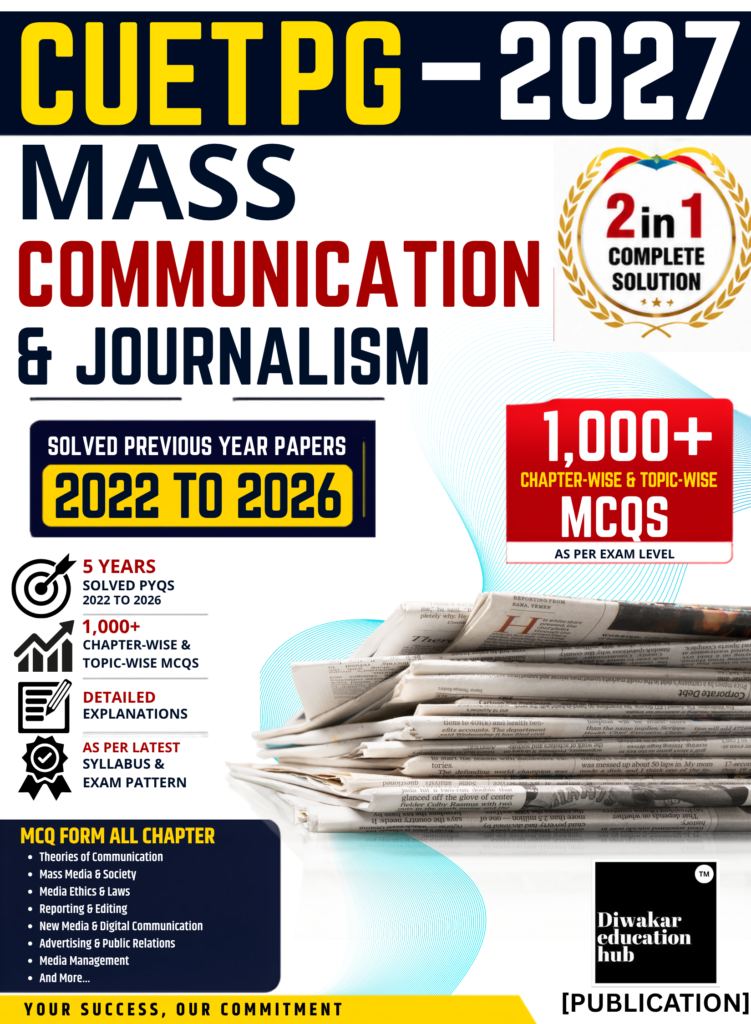
CUET PG Mass Communication & Journalism 2027 Book Solved Previous Year Paper 2022 to 2026 With 1000 Chapter & Topic Wise Questions
Original price was: ₹600.00.₹480.00Current price is: ₹480.00.
90-Day Preparation Strategy
Month 1
- Complete the full syllabus.
- Make concise notes.
- Read daily current affairs focused on media.
Month 2
- Solve previous year question papers.
- Revise communication theories and media laws.
- Practice topic-wise MCQs.
Month 3
- Attempt full-length mock tests.
- Revise weak topics.
- Focus on current affairs and factual revision.
Preparation Tips
- Read newspapers daily.
- Stay updated with media industry developments.
- Revise communication models regularly.
- Practice previous year papers.
- Attempt weekly mock tests.
- Improve speed and accuracy.
- Prepare short notes for media laws, theories, and current affairs.
Frequently Asked Questions (FAQs)
Is there any change in the CUET PG Mass Communication syllabus for 2027?
As of now, NTA has not announced any major changes to the COQP17 syllabus.
What is the total number of questions?
There are 75 MCQs carrying a total of 300 marks.
Is there negative marking?
Yes. 1 mark is deducted for every incorrect answer.
Which universities accept COQP17 scores?
Many Central and participating universities, including Delhi University, BHU, Babasaheb Bhimrao Ambedkar University, Mahatma Gandhi Central University, Guru Ghasidas Vishwavidyalaya, and several others, use CUET PG scores for admissions.
Which section carries the highest weightage?
Communication theories, journalism basics, current affairs, media laws, digital media, and advertising generally account for a significant share of questions.