
CUET PG Pharmacy [SCQP23] Syllabus, Books, Exam Pattern, Seats, Question Paper [PYQ], Exam Anaylsis Cut-off &Eligiblity Criteria 2026 Vs GPAT
If you are planning a career in Pharmacy through postgraduate entrance exams, then CUET PG Pharmacy (SCQP23) 2026 has emerged as a strong alternative to GPAT. With many central universities now admitting students through CUET PG, pharmacy aspirants are actively comparing CUET PG Pharmacy vs GPAT in terms of syllabus, exam pattern, difficulty level, cut-off, and career scope. This article provides a complete, SEO-friendly guide covering the CUET PG Pharmacy (SCQP23) syllabus, best books, exam pattern, eligibility criteria, previous year question papers (PYQs), exam analysis, expected cut-off, and seat availability in Delhi University and Jawaharlal Nehru University.Additionally, a detailed comparison between CUET PG Pharmacy 2026 and GPAT is included to help students decide which exam aligns better with their academic background, preparation strategy, and admission goals. Whether you are a B.Pharm graduate targeting M.Pharm, Pharmaceutical Sciences, or interdisciplinary research programs, this article will serve as a one-stop resource for CUET PG Pharmacy 2026 preparation and decision-making.
Table of Contents
💊 CUET PG Pharmacy [SCQP23] Exam 2026 – Detailed Overview
| Particulars | Details |
|---|---|
| Exam Name | CUET PG Pharmacy [SCQP23] Exam 2026 |
| Conducting Body | National Testing Agency (NTA) |
| Exam Level | National-level Entrance Test |
| Purpose | Admission to M.Pharm / M.Sc. Pharmaceutical Sciences / Allied Pharmacy Programs in Central, State & Deemed Universities |
| Mode of Exam | Computer-Based Test (CBT) – Online |
| Exam Duration | 90 Minutes |
| Total Questions | 75 Questions |
| Total Marks | 300 Marks |
| Marking Scheme | +4 for each correct answer; −1 for each incorrect answer |
| Medium of Exam | English only |
| Question Type | Multiple Choice Questions (MCQs) |
| Eligibility Criteria | Bachelor’s degree in Pharmacy (B.Pharm) or equivalent with minimum 50–55% marks (relaxation for reserved categories as per university norms) |
| Frequency of Exam | Once a year |
| Official Website | cuet.nta.nic.in |
CUET-PG PHARMACY SYLLABUS – CHAPTER-WISE SUMMARY
| Subject | Part (Roman) | Chapter Names (Only) |
|---|---|---|
| Pharmaceutics | I | Introduction to Pharmaceutics |
| II | Physical Pharmacy | |
| III | Pharmaceutical Engineering | |
| IV | Dispensing, Community & Hospital Pharmacy | |
| V | Dosage Form Design | |
| VI | Cosmetic Technology | |
| VII | Pharmaceutical Technology – I | |
| VIII | Pharmaceutical Technology – II | |
| IX | Packaging Technology | |
| X | Biopharmaceutics & Pharmacokinetics | |
| Pharmaceutical Chemistry | I | Organic Chemistry – I |
| II | Inorganic Chemistry | |
| III | Organic Chemistry – II | |
| IV | Biochemistry | |
| V | Medicinal Chemistry – I | |
| VI | Medicinal Chemistry – II | |
| VII | Medicinal Chemistry – III | |
| Pharmaceutical Analysis | I | Quantitative & Volumetric Analysis |
| II | Instrumental Analysis | |
| III | — | |
| IV | Quality Assurance | |
| Pharmacognosy | I | General Pharmacognosy & Crude Drugs |
| II | Glycosides, Enzymes, Plant Products | |
| III | Alkaloids, Chromatography & Traditional Systems | |
| Pharmacology | I | General & Peripheral Pharmacology |
| II | CNS, Endocrine & Haematological Pharmacology | |
| III | Chemotherapy & Systemic Pharmacology | |
| IV | Clinical Pharmacology & Toxicology | |
| Anatomy & Physiology | I | Human Anatomy & Health Education – I |
| II | Human Anatomy & Health Education – II | |
| Pharmaceutical Microbiology | I | Microbiology |
| Pharmaceutical Biotechnology | I | Biotechnology |
| Pharmaceutical Jurisprudence & Ethics | I | Pharmaceutical Laws & Ethics |
| Industrial Pharmacy & Management | I | Industrial Management & Accountancy |
| Drug Design | I | Drug Design & Development |
| Sales & Marketing | I | Pharmaceutical Sales & Marketing |
| Food Science & Technology | I | Food Science & Technology |
| Advance Mathematics | I | Mathematics & Biostatistics |
Check Complete Syllabus – Click Here
CUET PG Pharmacy Eligibility Criteria and Seats Matrix of Central Universities
| Central University | Program (Pharmacy) | Approx Seats | Notes |
|---|---|---|---|
| Central University of Punjab | M.Pharm (Pharmacy) | 45 | Largest M.Pharm intake among CUs; seats via |
| Central University of Rajasthan | M.Pharm (Pharmaceutical Chemistry) | 10 | CUET-PG seat matrix shows 10 seats. |
| M.Pharm (Pharmaceutics) | 10 | CUET-PG seat matrix shows 10 seats. | |
| Central University of South Bihar (CUSB) | M.Pharm (Pharmaceutics) | 15 | Total M.Pharm seats ~15; includes Pharmacology & Pharmaceutics. |
| M.Pharm (Pharmacology) | 15 | Combined total ~30 seats across specializations. | |
| Central University of Haryana | M.Pharm (Pharmacognosy) | 6 | Small intake; combined with Pharmacology totals ~18. |
| M.Pharm (Pharmacology) | 12 | CUET-PG seat matrix shows 12 seats. |
These 33 colleges/universities are currently listed as accepting CUET PG scores for M.Pharm admissions in 2026.
📊 CUET PG 2025 M.Pharm Cut-off (Central Universities)
| University | Specialisation | General (Round 1 Closing Marks) |
|---|---|---|
| Central University of South Bihar (CUSB) | M.Pharm Pharmacology | 117 marks (General) |
| M.Pharm Pharmaceutics | 112 marks (General) | |
| Central University of Punjab (CUP) | M.Pharm Pharmacology | 134 marks (General) |
| M.Pharm Pharmaceutical Chemistry | 112 marks (General) | |
| M.Pharm Pharmacognosy | 81 marks (General) | |
| Central University of Rajasthan (CURAJ) | M.Pharm Pharmaceutics | 115 marks (General) |
| M.Pharm Pharmacology | 114 marks (General) | |
| M.Pharm Pharmaceutical Chemistry | 99 marks (General) |
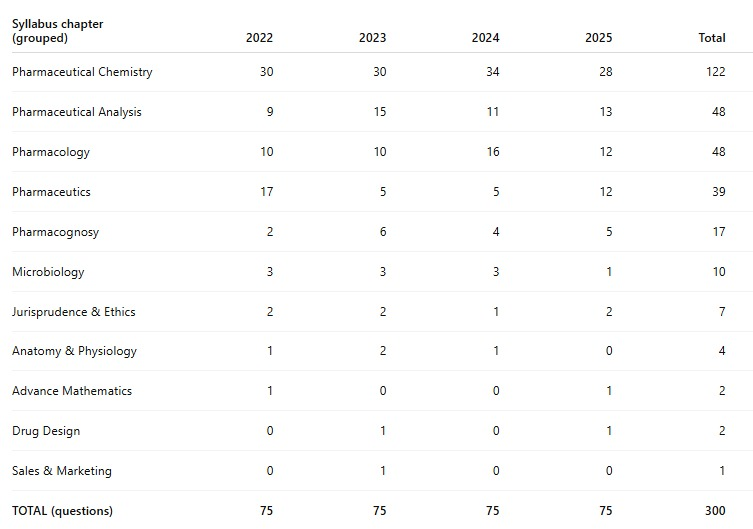
CUET PG Pharmacy Paper Analysis 2022 to 2025
📚 CUET-PG Pharmacy – Standard Reference Books
| S. No. | Book Name | Author(s) |
|---|---|---|
| 1 | Complete Companion for GPAT and Other Competitive Examinations in Pharmacy | Umang H. Shah, N.K. Seth, Gohil & Baser |
| 2 | Aulton’s Pharmaceutics: The Design and Manufacture of Medicines | Michael E. Aulton, Kevin Taylor |
| 3 | The Theory and Practice of Industrial Pharmacy | Lachman, Lieberman, Kanig |
| 4 | Physical Pharmacy | Patrick J. Sinko |
| 5 | Foye’s Principles of Medicinal Chemistry | Lemke, Williams, Roche |
| 6 | Organic Chemistry | Morrison & Boyd |
| 7 | Vogel’s Textbook of Quantitative Chemical Analysis | G.H. Jeffery et al. |
| 8 | Essentials of Medical Pharmacology | K.D. Tripathi |
| 9 | Goodman & Gilman’s The Pharmacological Basis of Therapeutics | Brunton, Hilal-Dandan, Knollmann |
| 10 | Basic and Clinical Pharmacology | Bertram G. Katzung |
| 11 | Textbook of Pharmacognosy | C.K. Kokate, A.P. Purohit, S.B. Gokhale |
| 12 | Trease and Evans Pharmacognosy | William C. Evans |
| 13 | Quantitative Pharmaceutical Analysis | A.H. Beckett, J.B. Stenlake |
| 14 | Introduction to Spectroscopy | Donald L. Pavia et al. |
| 15 | Human Anatomy and Physiology | Ross & Wilson |
| 16 | Lehninger Principles of Biochemistry | Nelson & Cox |
| 17 | Pharmaceutical Jurisprudence | B.M. Mithal |
Recommended products
-
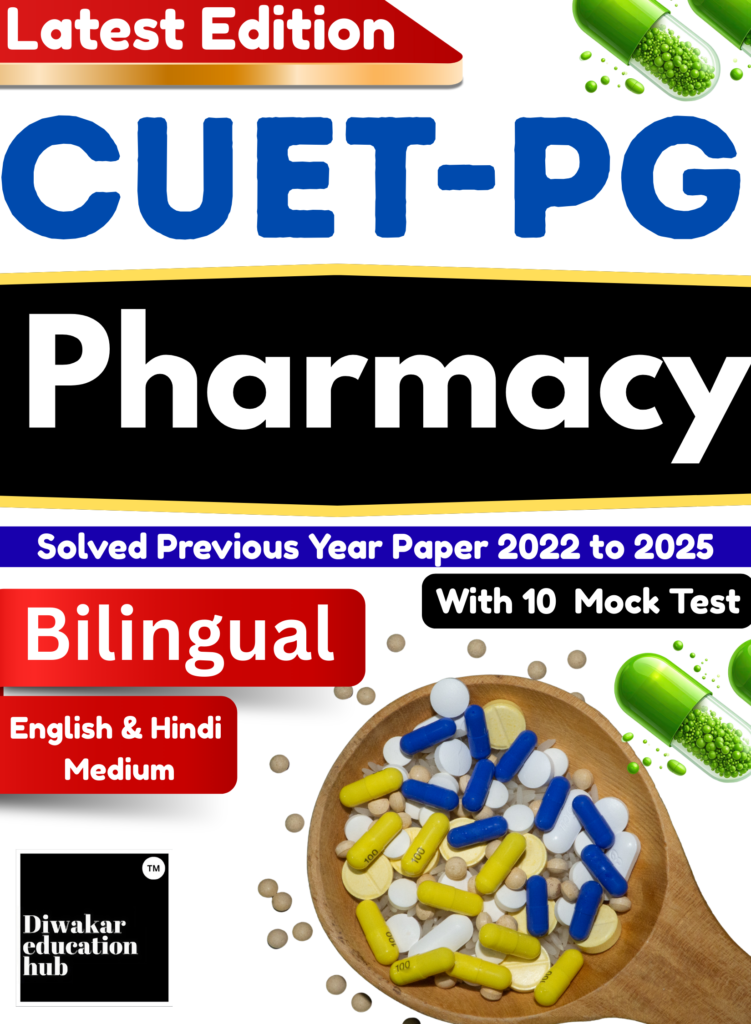
CUET PG Pharmacy Book 2026 Solved Previous Year Paper with 10 Mock Test Bilingual Both English & Hindi Medium As Per Latest Syllabus
Original price was: ₹800.00.₹450.00Current price is: ₹450.00.
📊 CUET-PG vs GPAT vs NIPER JEE (Pharmacy PG Exams Comparison)
| Feature | CUET-PG (Pharmacy) | GPAT | NIPER JEE |
|---|---|---|---|
| Conducting Body | National Testing Agency | National Testing Agency | National Institute of Pharmaceutical Education and Research |
| Exam Purpose | PG admission in Central Universities | PG admission + Scholarships | Admission to NIPER institutes |
| Courses Offered | M.Pharm | M.Pharm | M.Pharm, MS (Pharm), M.Tech (Pharm) |
| Institutes Covered | Central & Participating Universities | AICTE-approved colleges | Only NIPERs (Mohali, Hyderabad, Ahmedabad, etc.) |
| Exam Mode | CBT | CBT | CBT |
| Questions | 75 MCQs | 125 MCQs | 200 MCQs |
| Duration | 90 Minute | 3 hours | 2 hours |
| Marking Scheme | +4 / –1 | +4 / –1 | +1 / –0.25 |
| Syllabus Level | B.Pharm | B.Pharm (deep & numerical) | B.Pharm + research orientation |
| Difficulty Level | Moderate | Moderate–High | High |
| Scholarship | ❌ No | ✅ GPAT stipend | ✅ NIPER fellowship |
| Counselling | University-wise | Central + Institute level | Centralized |
| Competition | Medium | Very High | Extremely High |
📌 CUET-PG Pharmacy – Frequently Asked Questions (FAQs)
1️⃣ What is CUET-PG Pharmacy?
CUET-PG Pharmacy is a national-level entrance exam conducted for admission to M.Pharm and other PG pharmacy programs in Central Universities and participating institutions in India.
2️⃣ Who is eligible for CUET-PG Pharmacy?
- Candidates must have B.Pharm degree
- Minimum 50–55% marks (relaxation for SC/ST/OBC/PwD as per rules)
- Final-year B.Pharm students can also apply
3️⃣ Is CUET-PG mandatory for M.Pharm admission?
✅ Yes, for Central Universities and CUET-participating universities
❌ No, for private universities or institutes conducting their own exams
4️⃣ Which M.Pharm specializations are offered through CUET-PG?
Common specializations include:
- Pharmaceutics
- Pharmacology
- Pharmacognosy
- Pharmaceutical Chemistry
- Pharmaceutical Analysis
- Industrial Pharmacy
- Clinical Pharmacy (limited universities)
5️⃣ What is the exam code for CUET-PG Pharmacy?
SCQP23 is the official subject code for Pharmacy in CUET-PG.
6️⃣ What is the exam pattern?
- 100 MCQs
- 4 marks for correct answer
- –1 mark for wrong answer
- Duration: 2 hours
- Mode: Computer Based Test (CBT)
7️⃣ What subjects are asked in CUET-PG Pharmacy?
Questions come from:
- Pharmaceutics
- Pharmaceutical Chemistry
- Pharmacology
- Pharmacognosy
- Pharmaceutical Analysis
- Basic Biochemistry, Microbiology, Jurisprudence
8️⃣ Is CUET-PG syllabus same as GPAT?
🔹 Largely similar, but:
- CUET-PG focuses more on conceptual + theory-based questions
- GPAT is more numerical & competitive
👉 GPAT preparation books are useful for CUET-PG.
9️⃣ What is a good score in CUET-PG Pharmacy?
- 250–300+ → Top Central Universities
- 200–250 → Good chances in most universities
- 150–200 → Limited options
(Cutoff varies every year)
🔟 How many universities accept CUET-PG Pharmacy?
Usually 20–30+ Central & State Universities (number varies every year).
1️⃣1️⃣ Is counselling centralized?
❌ No single counselling.
- Each Central University conducts its own counselling
- You must apply separately after results
1️⃣2️⃣ Can I apply to multiple universities?
✅ Yes, using the same CUET-PG score you can apply to multiple universities
1️⃣3️⃣ Is there any age limit?
❌ No age limit for CUET-PG Pharmacy.
1️⃣4️⃣ Are NCERT books enough?
❌ No. You need B.Pharm standard textbooks and MCQ practice books.
1️⃣5️⃣ How many attempts are allowed?
✅ Unlimited attempts (as long as eligibility criteria are met).
