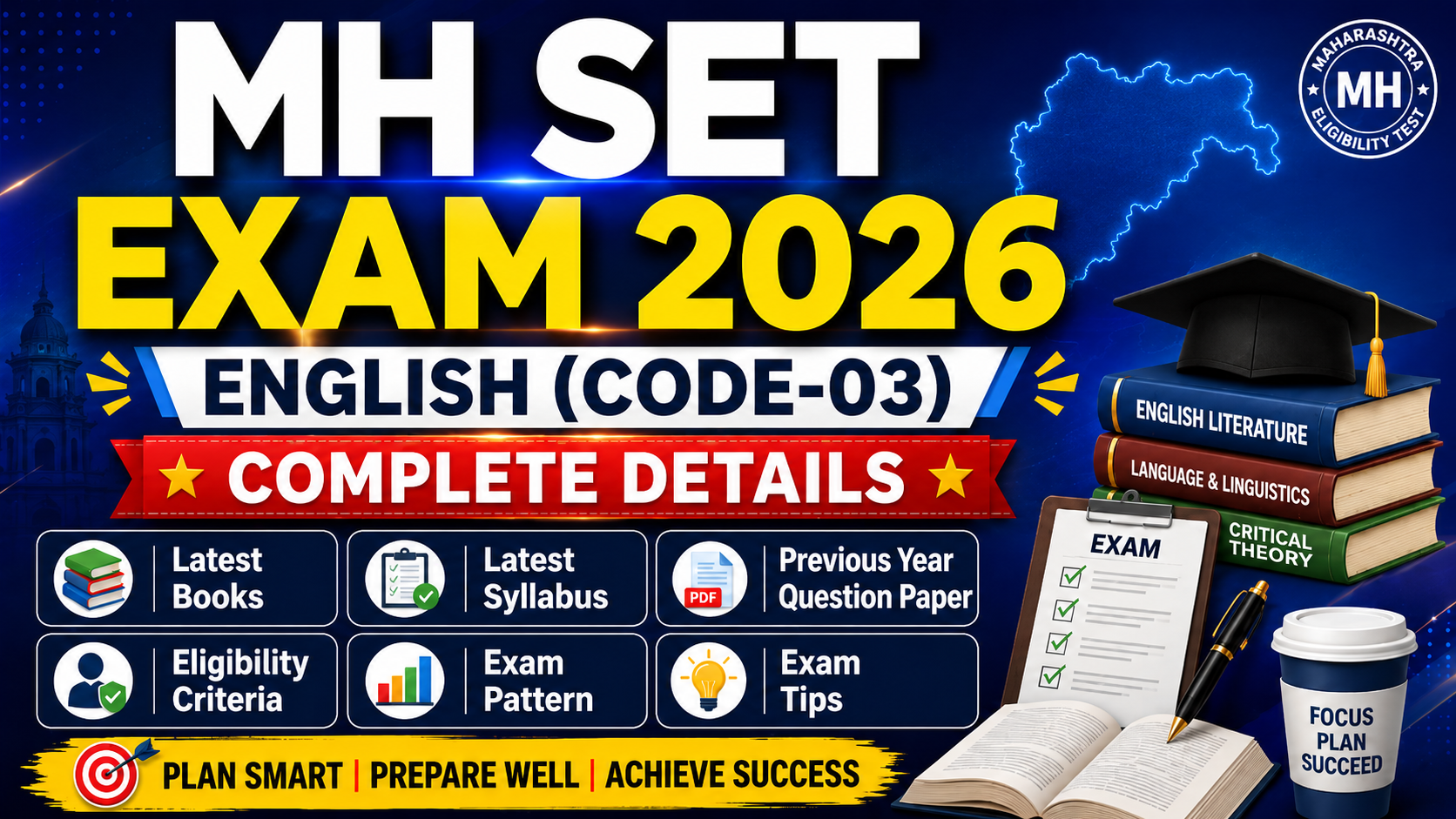
MH SET Exam 2026 English Code-03 Latest Books, Latest Syllabus, Previous Year Question Paper, Eligibility Criteria, Exam Pattern & Exam Tips [Complete Details]
MH SET, or Maharashtra Pradesh State Eligibility Test, is conducted by the Savitribai Phule Pune University, Pune to determine eligibility for the post of Assistant Professor in colleges and universities of Maharashtra .
Candidates who want to build a teaching career in English Literature can appear for MH SET English. The exam includes two papers: Paper 1, which is common for all candidates, and Paper 2, which is subject-specific.
Important note: You mentioned English Code-03, but candidates should always verify the official subject code from the latest MHSET notification, admit card, and application form, because subject codes may vary across different documents or websites.
MH SET English 2026: Quick Overview
| Particular | Details |
|---|---|
| Exam Name | MH SET English 2026 |
| Full Form | Maharashtra State Eligibility Test |
| Conducting Body | Savitribai Phule Pune University, Pune |
| Exam Purpose | Eligibility for Assistant Professor |
| Subject | English |
| States Covered | Maharashtra and Goa |
| Exam Date | 26 July 2026, Sunday |
| Application Mode | Online |
| Application Start Date | 2 June 2026, 11:00 AM |
| Last Date Without Late Fee | 16 June 2026, 6:00 PM |
| Late Fee Application Window | 17 June to 19 June 2026 |
| Exam Mode | Offline / Pen-and-paper OMR mode |
| Papers | Paper I and Paper II |
| Paper I | General Teaching and Research Aptitude |
| Paper II | English subject paper |
| Total Questions | 150 |
| Total Marks | 300 |
| Negative Marking | No negative marking |
| Official Website | setexam.unipune.ac.in |
Table of Contents
MH SET English Eligibility Criteria 2026
Candidates must fulfill the eligibility conditions before applying for MP SET English.
Educational Qualification
The candidate should have a Postgraduate degree in English or a related subject from a recognized university.
Usually, the required marks are:
| Category | Minimum Marks in Postgraduation |
|---|---|
| General / Unreserved / EWS | 55% |
| SC / ST / OBC / PwD | 50% |
Candidates appearing in the final year or final semester of their postgraduate degree may also apply, but their eligibility will be considered final only after they complete the degree with the required percentage.
Age Limit
There is generally no upper age limit for MH SET because it is an eligibility test. Candidates can apply if they meet the educational qualification requirements.
Domicile Requirement
MH SET is mainly useful for candidates who want eligibility for Assistant Professor posts in Maharashtra Candidates should check the latest official notification for domicile-related benefits, reservation rules, and category relaxation.
MH SET English Exam Pattern 2026
MH SET consists of two papers. Both papers are compulsory.
| Paper | Subject | Questions | Marks |
|---|---|---|---|
| Paper 1 | General Paper on Teaching and Research Aptitude | 50 | 100 |
| Paper 2 | English | 100 | 200 |
| Total | Paper 1 + Paper 2 | 150 | 300 |
Each question generally carries 2 marks. The exam is objective type and candidates have to choose the correct answer from the given options.
Paper 1
Paper 1 is common for all subjects. It tests the candidate’s general teaching and research aptitude.
Paper 2
Paper 2 is based on the selected subject. For English candidates, Paper 2 includes English Literature, Literary Criticism, Literary Theory, Linguistics, Cultural Studies, Research Methods, and related areas.
MH SET English Syllabus 2026
The MH SET English syllabus is broadly based on the UGC NET English syllabus. Candidates should always download the latest syllabus from the official website before starting preparation.
MH SET Paper 1 Syllabus
Paper 1 includes the following major topics:
1. Teaching Aptitude
This section checks the candidate’s understanding of teaching methods and classroom processes.
Important topics include:
Teaching objectives, learner characteristics, teaching methods, teaching aids, classroom communication, evaluation system, and teaching-learning process.
2. Research Aptitude
This section tests basic research understanding.
Important topics include:
Meaning and types of research, research methods, hypothesis, sampling, research ethics, thesis writing, citation, plagiarism, and report writing.
3. Comprehension
Candidates are given a passage and questions based on it. This section checks reading ability, inference, vocabulary, and understanding of the main idea.
4. Communication
Important topics include:
Types of communication, verbal and non-verbal communication, barriers to communication, classroom communication, mass media, and effective communication.
5. Mathematical Reasoning and Aptitude
Important topics include:
Number series, percentage, ratio and proportion, average, profit and loss, time and work, speed and distance, simple and compound interest.
6. Logical Reasoning
Important topics include:
Syllogism, analogy, coding-decoding, statement and conclusion, statement and assumption, blood relation, direction sense, and logical arguments.
7. Data Interpretation
Questions are based on tables, graphs, charts, and data sets. Candidates should practice percentage, average, ratio, and comparison-based questions.
8. Information and Communication Technology [ICT]
Important topics include:
Computer basics, internet, email, digital learning, online education platforms, ICT in teaching, cybersecurity, and e-governance.
9. People, Development and Environment
Important topics include:
Environment, pollution, climate change, sustainable development, natural resources, disaster management, population, and environmental policies.
10. Higher Education System
Important topics include:
Indian higher education system, universities, colleges, regulatory bodies, value education, professional education, skill education, and recent education policies.
MH SET English Paper 2 Syllabus
| Unit | Official Unit | Topics to Covered |
|---|---|---|
| Unit 1 | Drama | Greek Drama: Sophocles, Euripides; Elizabethan Drama: Shakespeare, Marlowe, Ben Jonson; Jacobean/Restoration Comedy; Comedy of Manners; Modern Drama: Ibsen, Shaw, Synge, Beckett, Pinter; Indian English Drama: Girish Karnad, Vijay Tendulkar, Mahesh Dattani; important terms: tragedy, comedy, tragic flaw, catharsis, soliloquy, aside, absurd theatre |
| Unit 2 | Poetry | Chaucer, Spenser, Shakespeare Sonnets, Metaphysical poets: Donne, Herbert, Marvell; Milton; Neoclassical poetry: Pope, Dryden; Romantic poets: Wordsworth, Coleridge, Shelley, Keats, Byron; Victorian poets: Tennyson, Browning, Arnold; Modern poetry: Yeats, Eliot, Auden, Dylan Thomas; Indian English poetry: Toru Dutt, Tagore, Aurobindo, Nissim Ezekiel, Kamala Das; forms: sonnet, ode, elegy, epic, dramatic monologue, ballad |
| Unit 3 | Fiction and Short Story | Rise of Novel; Defoe, Richardson, Fielding, Sterne; Jane Austen, Dickens, Brontë sisters, George Eliot, Hardy; Modern novel: Conrad, Woolf, Joyce, Lawrence, Forster; Postmodern fiction; Short story: Poe, Chekhov, Mansfield, Joyce; Indian English fiction: R.K. Narayan, Mulk Raj Anand, Raja Rao, Anita Desai, Rushdie, Arundhati Roy; terms: realism, stream of consciousness, bildungsroman, picaresque, epistolary novel, metafiction |
| Unit 4 | Non-Fictional Prose | Bacon’s essays; Addison and Steele; Johnson; Lamb, Hazlitt, De Quincey; Carlyle, Ruskin, Arnold; Orwell, Virginia Woolf, E.M. Forster; autobiographies, biographies, travel writing, letters, diaries, speeches; Indian non-fiction: Gandhi, Nehru, Ambedkar, Tagore; prose style, rhetoric, argument, satire, irony |
| Unit 5 | Language: Basic Concepts, Theories and Pedagogy; English in Use | Phonetics and phonology: vowels, consonants, IPA, stress, intonation; morphology, syntax, semantics, pragmatics; language acquisition: behaviorism, mentalism, Chomsky, Krashen; ELT methods: Grammar Translation, Direct Method, Audio-Lingual, Communicative Language Teaching; error analysis, contrastive analysis; grammar usage, discourse analysis, stylistics |
| Unit 6 | English in India: History, Evolution and Futures | Introduction of English in India; Macaulay’s Minute, Wood’s Despatch; Indian English, Indianization of English; English as second language; English and education policy; bilingualism, multilingualism; English in media, administration, higher education; Indian English Literature: history, phases, major authors; Dalit, tribal, women’s writing in India |
| Unit 7 | Cultural Studies | Culture and ideology; popular culture, mass culture, media studies; race, gender, caste, class; identity politics; nation and nationalism; diaspora, migration; subaltern studies; postcolonial culture; feminism and culture; important thinkers: Raymond Williams, Stuart Hall, Gramsci, Althusser, Foucault, Said, Homi Bhabha, Spivak |
| Unit 8 | Literary Criticism | Classical criticism: Plato, Aristotle, Horace, Longinus; Renaissance criticism: Sidney; Neoclassical criticism: Dryden, Pope, Johnson; Romantic criticism: Wordsworth, Coleridge, Shelley; Victorian criticism: Arnold; Modern criticism: T.S. Eliot, I.A. Richards, F.R. Leavis; New Criticism; key concepts: mimesis, catharsis, sublime, objective correlative, tradition, touchstone method |
| Unit 9 | Literary Theory Post World War II | Structuralism: Saussure, Levi-Strauss; Post-structuralism: Derrida, Barthes, Foucault; Psychoanalysis: Freud, Lacan; Marxism: Marx, Lukács, Althusser, Eagleton; Feminism: Woolf, Beauvoir, Elaine Showalter, Judith Butler; Reader-response theory; New Historicism; Postcolonial theory: Said, Bhabha, Spivak; Ecocriticism; Queer theory; narratology |
| Unit 10 | Research Methods and Materials in English | Research types: qualitative, quantitative, mixed; research problem, hypothesis, objectives; primary and secondary sources; literature review; research design; citation and referencing: MLA, APA basics; plagiarism, ethics, copyright; bibliography, footnotes, endnotes; archives, digital humanities, databases; dissertation/thesis writing; literary research methods |
MH SET English Previous Year Question Papers
Previous Year Question Papers [PYQ] are very important for understanding the real exam pattern. Candidates should solve MH SET English previous year papers to understand the type, level, and frequency of questions.
| Year | Download Link |
|---|---|
| 2025 | Click Here |
| 2024 | Click Here |
| 2023 | Click Here |
| 2022 | Click Here |
| 2021 | Click Here |
| 2020 | Click Here |
| 2019 | Click Here |
| 2018 | Click Here |
| 2017 | Click Here |
| 2016 | Click Here |
Why PYQs Are Important
PYQs help candidates understand:
The actual question pattern, frequently asked topics, difficulty level, time management, important authors and works, and repeated areas from Paper 1 and Paper 2.
How to Use PYQs
Candidates should first solve previous year papers without a timer to understand the question style. After that, they should solve papers within the actual exam time limit. After every paper, candidates should prepare an error notebook and write down incorrect questions with explanations.
Important PYQ Areas for English
Based on the general pattern of SET/NET English exams, questions are often asked from:
Shakespeare, Romantic poets, Victorian novelists, modern poetry, Indian English literature, literary criticism, literary theory, linguistics, cultural studies, and research methodology.
Candidates should download official previous year papers and answer keys from MPPSC or trusted exam preparation sources.
Best Books for MH SET English 2026
Choosing the right books is very important because the English syllabus is large. Candidates should avoid reading too many books and focus on standard sources.
Best Books for MH SET Paper 1
| Book Name | Best For |
|---|---|
| Trueman’s UGC NET/SET General Paper 1 | Complete Paper 1 preparation |
| NTA UGC NET Paper 1 by Arihant | Theory and practice |
| UGC NET/JRF/SLET General Paper 1 by KVS Madaan | Teaching and Research Aptitude |
| Pearson UGC NET Paper 1 | Concept clarity |
| Previous Year Solved Papers | Practice and revision |
Best Books for MH SET English Paper 2
| Book Name | Author | Best For |
|---|---|---|
| A Glossary of Literary Terms | M.H. Abrams | Literary terms and criticism |
| A History of English Literature | Edward Albert | British literature overview |
| History of English Literature | W.J. Long | Literary history |
| Indian Writing in English | K.R. Srinivasa Iyengar | Indian English literature |
| Beginning Theory | Peter Barry | Literary theory basics |
| Literary Theory: An Introduction | Terry Eagleton | Advanced literary theory |
| Contemporary Literary and Cultural Theory | Pramod K. Nayar | Literary and cultural theory |
| An Introduction to English Linguistics | Various authors | Linguistics basics |
| Objective English Literature for UGC NET/SET | Various publishers | MCQ practice |
| Previous Year Solved Papers of UGC NET/SET English | Various publishers | Exam-oriented preparation |
Recommended Book
-
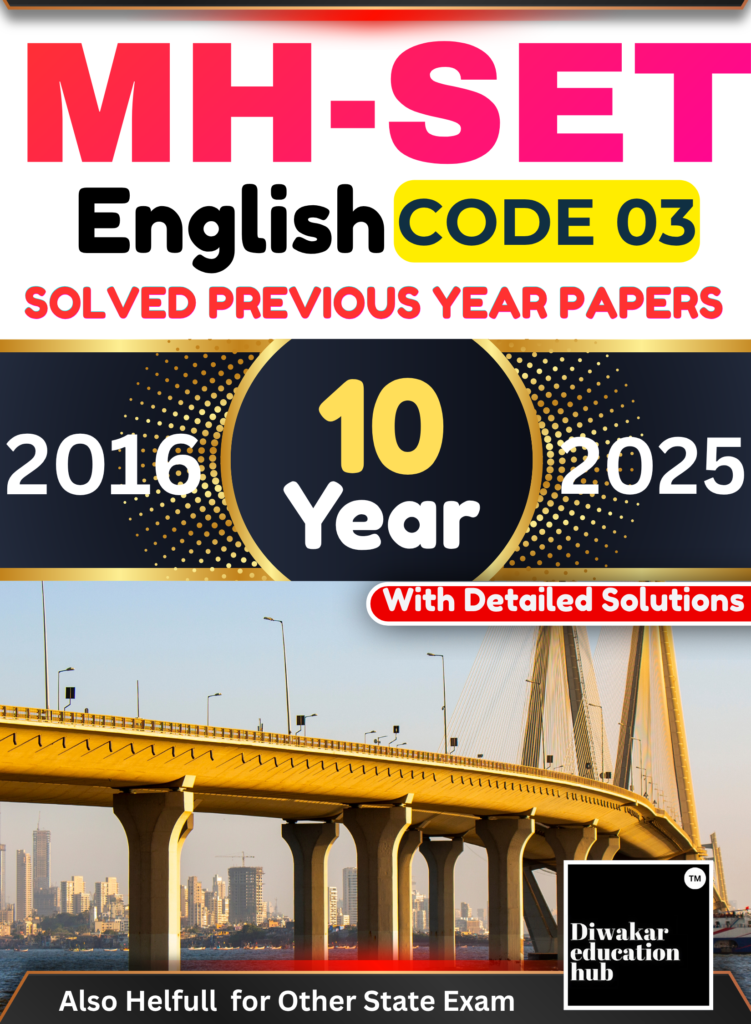
MH SET English Code 03 Book 2026 Solved Previous Year Paper 2016 to 2025 With Detail Solution
Original price was: ₹500.00.₹399.00Current price is: ₹399.00.
MH SET English Cut-off 2023, 2024, 2025
| Year | General / Open | SC | ST | OBC / NCL |
|---|---|---|---|---|
| 2023 | 54.00% | 43.33% | 48.67% | 48.00% |
| 2024 | 57.33% | 50.67% | 46.67% | 51.33% |
| 2025 | 58.67% | 49.33% | 46.00% | 52.00% |
MH SET English 2025 Paper Analysis
| Unit | Syllabus Unit | Questions |
|---|---|---|
| Unit I | Drama | 12 |
| Unit II | Poetry | 10 |
| Unit III | Fiction and Short Story | 11 |
| Unit IV | Non-Fictional Prose | 8 |
| Unit V | Language | 12 |
| Unit VI | English in India | 15 |
| Unit VII | Cultural Studies | 10 |
| Unit VIII | Literary Criticism | 1 |
| Unit IX | Literary Theory post World War II | 16 |
| Unit X | Research Methods | 5 |
Subject-Wise Preparation Strategy for MH SET English
Paper 1 Strategy
Paper 1 can improve your overall score if prepared properly. Candidates should focus on Teaching Aptitude, Research Aptitude, ICT, Communication, Higher Education, and Data Interpretation. These topics are scoring and can be revised quickly.
Practice at least 25 to 30 Paper 1 questions daily. For Data Interpretation and Mathematical Reasoning, revise basic formulas and solve short practice sets regularly.
Paper 2 Strategy
Paper 2 carries 200 marks, so it should be the main focus of preparation. Start with literary history and then move to major authors, works, criticism, theory, and linguistics.
Make short notes for:
Authors and works, publication years, literary movements, literary terms, important theorists, major critical essays, Indian English writers, and linguistic concepts.
90-Day Study Plan for MH SET English 2026
Days 1 to 30: Foundation Stage
In the first month, focus on basic concepts and literary history. Study Paper 1 topics such as Teaching Aptitude, Research Aptitude, Communication, and ICT. For Paper 2, complete British literary history, drama, poetry, and fiction.
Days 31 to 60: Advanced Stage
In the second month, study literary criticism, literary theory, Indian English Literature, American Literature, Linguistics, and Cultural Studies. Start solving previous year questions regularly.
Days 61 to 75: Practice Stage
During this phase, solve MCQs daily. Attempt subject-wise tests and revise your weak areas. Practice Paper 1 and Paper 2 together to improve accuracy.
Days 76 to 90: Revision Stage
In the final stage, revise short notes, authors and works, literary periods, theories, and important facts. Attempt full-length mock tests. Avoid starting new books in the last few days.
Important Topics for MH SET English 2026
High-Priority Topics
Shakespeare, Milton, Romantic Poetry, Victorian Novel, Modern Poetry, Modern Drama, Indian English Fiction, Indian English Poetry, Literary Criticism, Literary Theory, Linguistics, and Cultural Studies.
Scoring Topics
Literary terms, authors and works, chronology, Indian English Literature, Paper 1 Teaching Aptitude, Research Aptitude, ICT, Higher Education, and Data Interpretation.
Difficult but Important Topics
Deconstruction, post-structuralism, psychoanalysis, postcolonial theory, cultural materialism, new historicism, phonetics, phonology, and research methodology.
MH SET English Exam Tips
Candidates should revise regularly instead of reading new material again and again. English Literature has many factual areas, so repeated revision is necessary.
Before the exam, prepare short notes for literary periods, authors, works, movements, theories, and critics. Practice mock tests to improve speed and accuracy.
On exam day, reach the exam center before reporting time. Carry admit card, valid photo ID, and required documents. Fill the OMR sheet carefully, especially roll number, booklet code, and subject code.
Since there is usually no negative marking, candidates should attempt all questions after careful reading.
Common Mistakes to Avoid
Many candidates read too many books but do not revise. This is a major mistake. MP SET English requires repeated revision.
Another common mistake is ignoring Paper 1. Paper 1 has 100 marks and can make a big difference in the final score.
Candidates should also avoid depending only on summaries. For important writers and works, they should know themes, characters, publication years, movements, and critical importance.
Final Preparation Tips
Prepare a realistic timetable and follow it consistently. Give more time to Paper 2, but do not ignore Paper 1. Solve previous year papers and mock tests regularly.
Use one standard book for literary history, one book for literary theory, one book for criticism, and one MCQ/PYQ book. Make your own notes because self-made notes are the most useful during final revision.
FAQs on MH SET Exam 2026 English
MH SET Exam 2026 FAQ
Q1. When will the MH SET 2026 exam be held?
The MH SET 2026 exam will be held on Sunday, 26 July 2026.
Q2. Who conducts MH SET?
MH SET is conducted by Savitribai Phule Pune University (SPPU), Pune for Maharashtra and Goa.
Q3. When does the MH SET 2026 application form start?
The online application form starts on 2 June 2026 at 11:00 AM.
Q4. What is the last date to apply without late fee?
The last date to apply with regular fee is 16 June 2026 up to 6:00 PM.
Q5. What is the late fee application window?
Candidates can apply with late fee from 17 June 2026 at 11:00 AM to 19 June 2026 up to 6:00 PM.
Q6. What is the official website?
The official website is setexam.unipune.ac.in.
Q7. For which states is MH SET conducted?
MH SET is conducted for Maharashtra and Goa.
Q8. What is the purpose of MH SET?
MH SET is conducted to determine eligibility for the post of Assistant Professor in universities and colleges of Maharashtra and Goa.
Q9. In which mode will the exam be conducted?
The exam is generally conducted in offline mode using OMR sheets, unless the official notification states otherwise.
Q10. How many papers are there in MH SET?
There are two papers:
- Paper I: General Teaching and Research Aptitude
- Paper II: Subject-specific paper
Q11. Is there negative marking in MH SET?
No, MH SET usually has no negative marking.
Q12. Where can candidates download the syllabus?
Candidates can download the syllabus from the official MH SET website: setexam.unipune.ac.in.se