
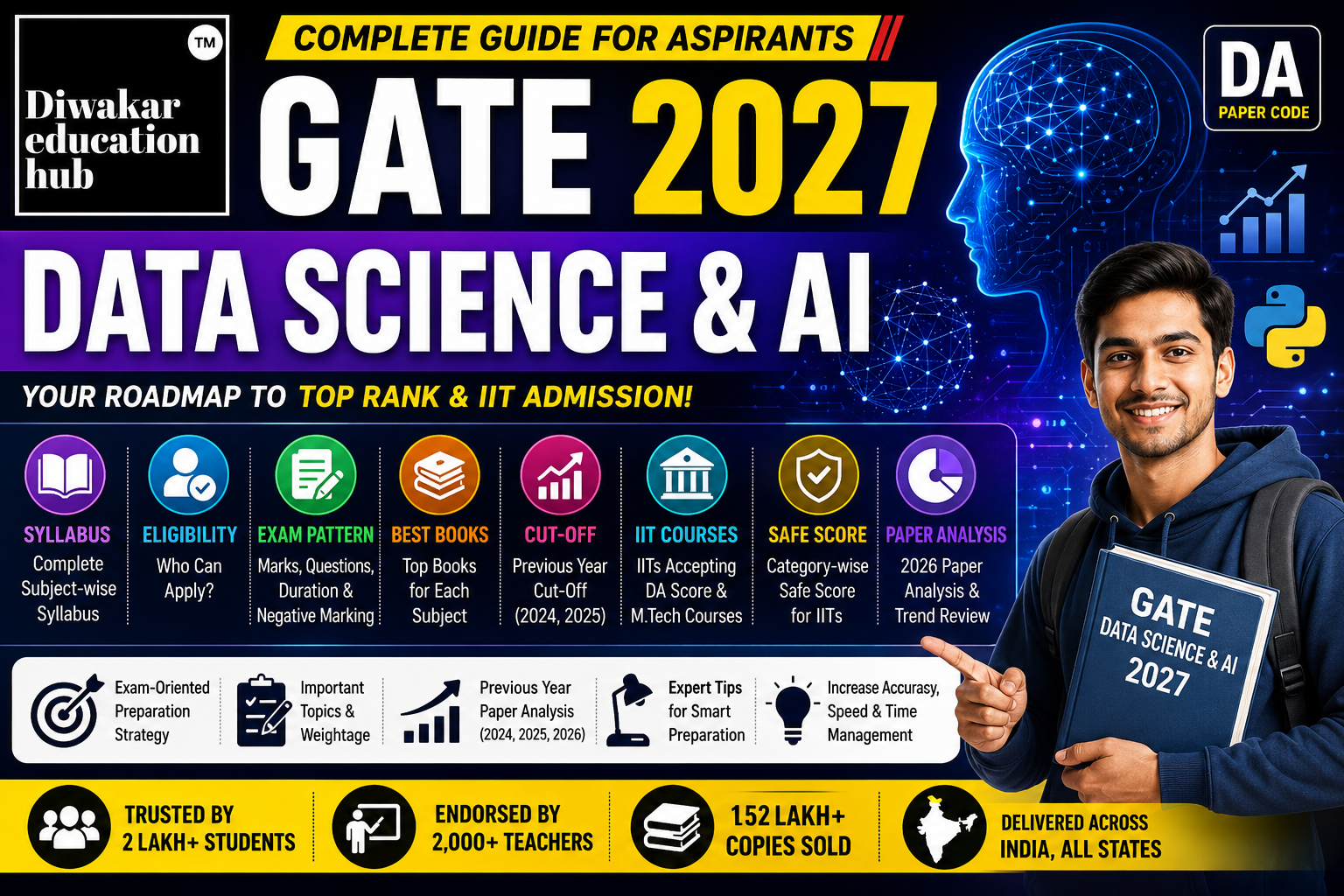
GATE Data Science & AI 2027: Syllabus, Eligibility, Exam Pattern, Books, Cut-Off, IIT Courses, Safe Score & Paper Analysis
The Graduate Aptitude Test in Engineering (GATE) is India’s most prestigious national-level entrance examination for admission to M.Tech, MS, PhD, and recruitment in Public Sector Undertakings (PSUs). Among the newest and fastest-growing papers is Data Science & Artificial Intelligence (DA), introduced to meet the increasing demand for professionals in AI, Machine Learning, Big Data, and Analytics With the rapid expansion of Artificial Intelligence across industries, the GATE DA paper has become one of the most sought-after choices for engineering and science graduates. A good GATE score can help candidates secure admission to premier institutes such as IITs, IISc, IIITs, and NITs, while also opening doors to high-paying careers in the technology sector.This guide covers everything you need to know about GATE Data Science & AI 2027, including the latest syllabus, eligibility criteria, exam pattern, preparation books, expected cut-offs, IIT admissions, safe scores, and career opportunities.
Table of Contents
What is GATE Data Science & Artificial Intelligence (DA)?
The GATE DA paper is specifically designed for students interested in Artificial Intelligence, Machine Learning, Data Science, Statistical Analysis, Data Engineering, and Intelligent Systems. The examination evaluates candidates on mathematics, programming, databases, machine learning, and artificial intelligence fundamentals.The paper is ideal for students from Computer Science, Information Technology, Mathematics, Statistics, Electronics, and related disciplines.
GATE Data Science & AI 2027 Eligibility Criteria
Candidates can appear for GATE DA if they are:
- Third-year or higher undergraduate students
- B.E./B.Tech graduates
- B.Sc. graduates (eligible disciplines)
- M.Sc. students
- MCA students
- M.Tech students
- Integrated Master’s students
- Engineering graduates from recognized universities
Age Limit
There is no age limit for appearing in the GATE examination.
Number of Attempts
There is no restriction on the number of attempts.
GATE Data Science & AI 2027 Exam Pattern
| Particular | Details |
|---|---|
| Examination Mode | Computer Based Test (CBT) |
| Duration | 3 Hours |
| Total Questions | 65 |
| Maximum Marks | 100 |
| General Aptitude | 15 Marks |
| Core Subject | 85 Marks |
| Question Types | MCQ, MSQ & NAT |
| Negative Marking | Only for MCQs |
GATE Data Science & AI 2027 Syllabus
| Unit | Section | Complete Topics Covered |
|---|---|---|
| 1. Probability and Statistics | Counting | Permutations, Combinations |
| Probability | Probability Axioms, Sample Space, Events, Independent Events, Mutually Exclusive Events, Marginal Probability, Conditional Probability, Joint Probability, Bayes’ Theorem | |
| Statistical Measures | Conditional Expectation, Conditional Variance, Mean, Median, Mode, Standard Deviation, Correlation, Covariance | |
| Random Variables | Random Variables, Discrete Random Variables, Continuous Random Variables | |
| Probability Functions | Probability Mass Function (PMF), Probability Density Function (PDF), Conditional PDF, Cumulative Distribution Function (CDF) | |
| Probability Distributions | Uniform Distribution, Bernoulli Distribution, Binomial Distribution, Exponential Distribution, Poisson Distribution, Normal Distribution, Standard Normal Distribution, t-Distribution, Chi-Squared Distribution | |
| Statistical Inference | Central Limit Theorem (CLT), Confidence Interval, Z-Test, t-Test, Chi-Squared Test | |
| 2. Linear Algebra | Vector Spaces | Vector Space, Subspaces, Linear Dependence, Linear Independence |
| Matrices | Matrices, Projection Matrix, Orthogonal Matrix, Idempotent Matrix, Partition Matrix, Properties of Matrices | |
| Linear Systems | Systems of Linear Equations, Solutions of Linear Equations, Gaussian Elimination | |
| Matrix Concepts | Determinant, Rank, Nullity, Projections, Quadratic Forms | |
| Eigen Concepts | Eigenvalues, Eigenvectors | |
| Matrix Factorization | LU Decomposition, Singular Value Decomposition (SVD) | |
| 3. Calculus and Optimization | Single Variable Calculus | Functions of a Single Variable, Limit, Continuity, Differentiability |
| Series | Taylor Series | |
| Optimization | Maxima, Minima, Optimization Involving a Single Variable | |
| 4. Programming, Data Structures and Algorithms | Programming | Programming in Python |
| Data Structures | Stacks, Queues, Linked Lists, Trees, Hash Tables | |
| Searching Algorithms | Linear Search, Binary Search | |
| Sorting Algorithms | Selection Sort, Bubble Sort, Insertion Sort | |
| Divide and Conquer | Merge Sort, Quick Sort | |
| Graph Theory | Introduction to Graph Theory | |
| Graph Algorithms | Graph Traversals, Shortest Path Algorithms | |
| 5. Database Management and Warehousing | Database Models | ER Model, Relational Model |
| Database Query Languages | Relational Algebra, Tuple Calculus, SQL | |
| Database Design | Integrity Constraints, Normal Forms | |
| Database Storage | File Organization, Indexing | |
| Data Processing | Data Types, Normalization, Discretization, Sampling, Compression | |
| Data Warehousing | Data Warehouse Modelling, Schema for Multidimensional Data Models, Concept Hierarchies, Measures, Categorization, Computations | |
| 6. Machine Learning | Supervised Learning | Regression Problems, Classification Problems, Simple Linear Regression, Multiple Linear Regression, Ridge Regression, Logistic Regression, k-Nearest Neighbour (k-NN), Naïve Bayes Classifier, Linear Discriminant Analysis (LDA), Support Vector Machine (SVM), Decision Trees |
| Model Evaluation | Bias-Variance Trade-off, Leave-One-Out (LOO) Cross-Validation, k-Fold Cross-Validation | |
| Neural Networks | Multi-Layer Perceptron (MLP), Feed-Forward Neural Network | |
| Unsupervised Learning | Clustering Algorithms, k-Means, k-Medoids, Hierarchical Clustering, Top-Down Clustering, Bottom-Up Clustering, Single-Linkage, Multiple-Linkage | |
| Dimensionality Reduction | Principal Component Analysis (PCA) | |
| 7. Artificial Intelligence (AI) | Search Techniques | Informed Search, Uninformed Search, Adversarial Search |
| Logic | Propositional Logic, Predicate Logic | |
| Reasoning Under Uncertainty | Conditional Independence Representation, Exact Inference through Variable Elimination, Approximate Inference through Sampling |
Data Science & Artificial Intelligence (DA) 2026 Paper Analysis
| Chapter No. | Chapter Name | No. of Questions | Weightage (%) |
|---|---|---|---|
| 1 | Probability and Statistics | 11 | 20.00% |
| 2 | Linear Algebra | 8 | 14.55% |
| 3 | Calculus and Optimization | 4 | 7.27% |
| 4 | Programming, Data Structures and Algorithms | 12 | 21.82% |
| 5 | Database Management and Warehousing | 6 | 10.91% |
| 6 | Machine Learning | 8 | 14.55% |
| 7 | Artificial Intelligence | 6 | 10.91% |
| Total | — | 55 | 100% |
Best Books for GATE Data Science & AI Preparation
| Chapter | Topics Covered | Best Books (Recommended) | Author(s) |
|---|---|---|---|
| 1. Probability and Statistics | Probability, Bayes Theorem, Random Variables, Distributions, CLT, Hypothesis Testing | Introduction to Probability | Dimitri P. Bertsekas & John N. Tsitsiklis |
| A First Course in Probability | Sheldon M. Ross | ||
| Mathematical Statistics and Data Analysis | John A. Rice | ||
| 2. Linear Algebra | Vector Spaces, Matrices, Eigenvalues, SVD, LU Decomposition | Introduction to Linear Algebra | Gilbert Strang |
| Linear Algebra and Its Applications | Gilbert Strang | ||
| Matrix Computations | Gene H. Golub & Charles F. Van Loan | ||
| 3. Calculus and Optimization | Limits, Continuity, Differentiation, Taylor Series, Maxima & Minima | Calculus | James Stewart |
| Thomas’ Calculus | George B. Thomas | ||
| Calculus and Analytical Geometry | G. B. Thomas & R. L. Finney | ||
| 4. Programming, Data Structures and Algorithms | Python, Data Structures, Searching, Sorting, Graph Algorithms | Learning Python | Mark Lutz |
| Python Programming: An Introduction to Computer Science | John M. Zelle | ||
| Data Structures and Algorithms in Python | Michael T. Goodrich, Roberto Tamassia & Michael H. Goldwasser | ||
| Fundamentals of Data Structures | Ellis Horowitz & Sartaj Sahni | ||
| Grokking Algorithms | Aditya Y. Bhargava | ||
| 5. Database Management and Warehousing | ER Model, SQL, Relational Algebra, Normalization, Warehousing | Database Management Systems | Raghu Ramakrishnan & Johannes Gehrke |
| Fundamentals of Database Systems | Ramez Elmasri & Shamkant Navathe | ||
| Database System Concepts | Silberschatz, Korth & Sudarshan | ||
| The Data Warehouse Toolkit | Ralph Kimball & Margy Ross | ||
| 6. Machine Learning | Regression, Classification, SVM, Decision Trees, Clustering, PCA, Neural Networks | Pattern Recognition and Machine Learning | Christopher M. Bishop |
| Hands-On Machine Learning with Scikit-Learn, Keras & TensorFlow | Aurélien Géron | ||
| Machine Learning: A Probabilistic Perspective | Kevin P. Murphy | ||
| Mathematics for Machine Learning | Marc Peter Deisenroth, A. Aldo Faisal & Cheng Soon Ong | ||
| 7. Artificial Intelligence | Search, Logic, Reasoning Under Uncertainty, Inference | Artificial Intelligence: A Modern Approach | Stuart Russell & Peter Norvig |
| Artificial Intelligence: Foundations of Computational Agents | David L. Poole & Alan K. Mackworth | ||
| Artificial Intelligence by Example | Denis Rothman |
Recommended Book’s
-
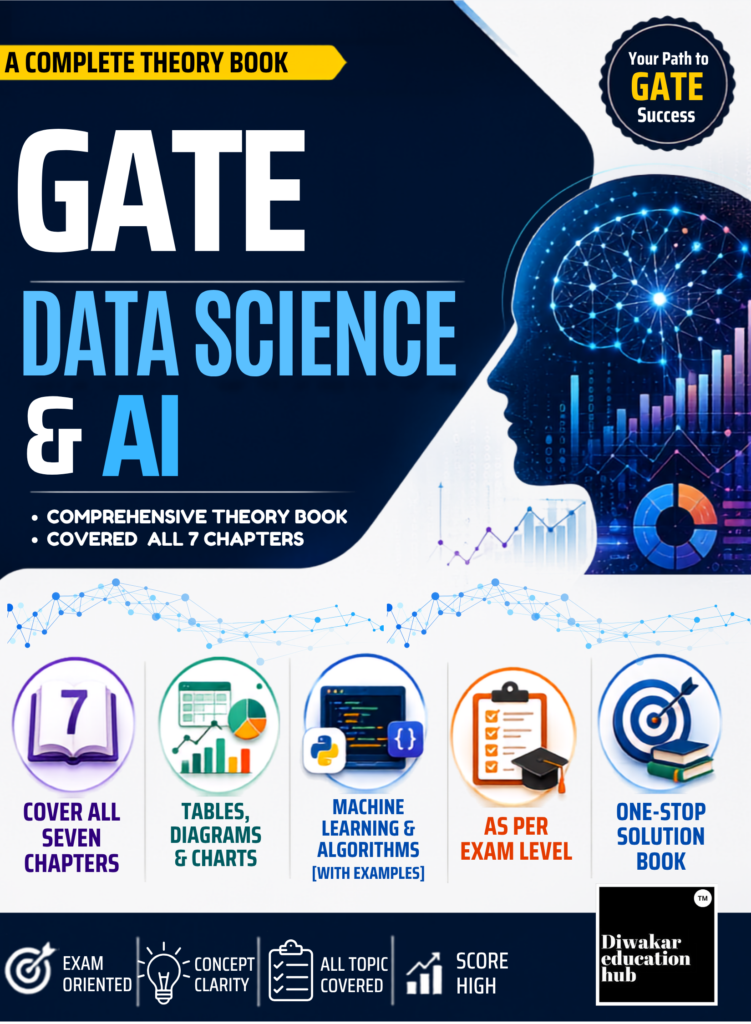
GATE Data Science and Artificial intelligence Theory Book II Cover All 7 Chapters II With Table Diagram Charts, Codes II Dedicated Theory Book II For GATE Exam II As Per Updated Syllabus
Original price was: ₹600.00.₹499.00Current price is: ₹499.00. -
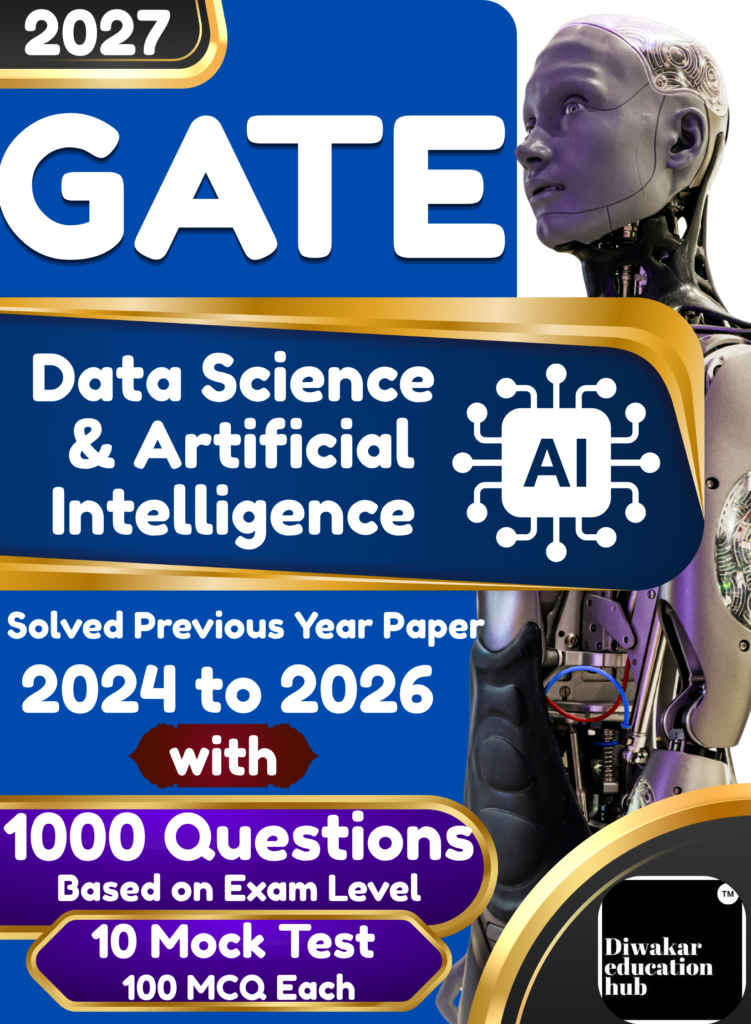
GATE Data Science and Artificial intelligence book 2027 Solved Previous Year Paper 2024 to 2026 and 10 Mock Test 100 Question Each With Detail Solution
Original price was: ₹500.00.₹450.00Current price is: ₹450.00.
GATE Data Science & Artificial Intelligence (DA) – Minimum Qualifying Score
| Year | General (UR) | OBC-NCL / EWS | SC / ST / PwD |
|---|---|---|---|
| 2026 | 26.4 | 23.7 | 17.5 |
| 2025 | 29.0 | 26.1 | 19.3 |
| 2024 | 37.1 | 33.3 | 24.7 |
GATE Closing Score 2025 for M.tech
| IIT | Programme (Examples) | Closing GATE Score (General) |
|---|---|---|
| IIT Madras | Computational Engineering | 625–700 |
| IIT Hyderabad | M.Tech Artificial Intelligence | Around 700–780 |
| IIT Hyderabad | M.Tech Data Science | Around 680–760 |
| IIT Delhi | M.Tech in Machine Intelligence and Data Science (MINDS) | Around 720 |
| IIT Guwahati | Data Science / AI-related programmes | Around 650–730 |
| IIT Kanpur | AI / CSE-related programmes | Around 720–800 |
| IIT Kharagpur | AI / Data Analytics-related programmes | Around 680–760 |
| IIT Jodhpur | Artificial Intelligence | Around 620–700 |
| IIT Palakkad | Data Science programmes | Around 550–650 |
IITs Offering Seats By GATE Data Science & AI
| Institute | M.Tech Programme | GATE DA Accepted | Approx. Seats (2025) |
|---|---|---|---|
| IIT Hyderabad | M.Tech in Artificial Intelligence (2-Year) | ✔ | 30 |
| IIT Hyderabad | M.Tech in Artificial Intelligence (Research Assistant) | ✔ | 25 |
| IIT Delhi | M.Tech in Machine Intelligence & Data Science (MINDS) | ✔ | 30 |
| IIT Guwahati | M.Tech in Data Science | ✔ | 20 |
| IIT Bhilai | M.Tech in Data Science & Artificial Intelligence | ✔ | 20 |
| IIT Jodhpur | M.Tech in Artificial Intelligence | ✔ | 20–25 |
| IIT Ropar | M.Tech in Artificial Intelligence | ✔ | 15–20 |
| IIT | Department | M.Tech Programme | Approx. Seats (2025) | GATE DA Accepted |
|---|---|---|---|---|
| IIT Bhubaneswar | School of Electrical Sciences | M.Tech in Artificial Intelligence | 20 | ✔ |
Courses Available Through GATE DA
A good GATE DA score can help secure admission into:
- M.Tech in Data Science
- M.Tech in Artificial Intelligence
- M.Tech in Machine Learning
- M.Tech in Computational Data Science
- M.Tech in Data Engineering
- M.Tech in AI & Robotics
- MS by Research
- PhD Programs
Career Opportunities After GATE Data Science & AI
Graduates with expertise in Data Science and Artificial Intelligence are in high demand across industries such as IT, finance, healthcare, e-commerce, manufacturing, and research.
Popular job roles include:
- Data Scientist
- Machine Learning Engineer
- Artificial Intelligence Engineer
- Data Engineer
- Business Intelligence Analyst
- Deep Learning Engineer
- NLP Engineer
- Computer Vision Engineer
- Analytics Consultant
- Research Scientist
- AI Product Engineer
Top Recruiters
Some of the leading recruiters hiring professionals with AI and Data Science expertise include:
- Microsoft
- Amazon
- NVIDIA
- Oracle
- IBM
- Adobe
- Intel
- Qualcomm
- TCS
- Infosys
- Wipro
- Accenture
Preparation Tips to Crack GATE DA
- Complete the entire syllabus systematically.
- Strengthen your mathematics fundamentals.
- Practice Python programming regularly.
- Solve previous years’ GATE questions.
- Attempt full-length mock tests.
- Revise formulas and concepts weekly.
- Focus on accuracy and time management.
- Analyze mock test performance to identify weak areas.
GATE Data Science & Artificial Intelligence (DA) – Frequently Asked Questions (FAQs)
1. What is GATE Data Science & Artificial Intelligence (DA)?
GATE DA is a specialized GATE paper introduced in 2024 for students interested in Data Science, Machine Learning, Artificial Intelligence, and related fields. It is conducted as one of the official GATE test papers.
2. Who can apply for GATE DA?
Candidates pursuing or having completed a bachelor’s degree (3rd year or above) in Engineering, Technology, Science, Arts, Commerce, or Humanities are eligible as per the GATE eligibility criteria.
3. What is the syllabus of GATE DA?
The syllabus consists of seven core subjects:
- Probability and Statistics
- Linear Algebra
- Calculus and Optimization
- Programming, Data Structures & Algorithms
- Database Management and Warehousing
- Machine Learning
- Artificial Intelligence
Along with General Aptitude (15 Marks).
4. What is the exam pattern of GATE DA?
- Mode: Computer-Based Test (CBT)
- Duration: 3 Hours
- Total Questions: 65
- Total Marks: 100
- General Aptitude: 15 Marks
- Core Subject: 85 Marks
- Question Types: MCQ, MSQ and NAT.
5. Is there negative marking in GATE DA?
Yes. Negative marking is applicable only for MCQs:
- 1-mark MCQ: −1/3 mark
- 2-mark MCQ: −2/3 mark
There is no negative marking for MSQ and NAT questions.
6. Which programming language is used in GATE DA?
The official syllabus includes Python Programming. Candidates should have a good understanding of Python syntax, data structures, and algorithms.
7. Which subjects carry the highest weightage in GATE DA?
Generally, the highest weightage is from:
- Programming, Data Structures & Algorithms
- Probability & Statistics
- Machine Learning
- Linear Algebra
These subjects together contribute a major portion of the paper.
8. Is Engineering Mathematics a separate section in GATE DA?
No. Unlike many other GATE papers, Engineering Mathematics is not a separate section. Mathematics topics are integrated into the DA syllabus through Probability, Statistics, Linear Algebra, and Calculus.
9. Which IITs accept GATE DA scores?
Several IITs accept GATE DA scores for admission to M.Tech programmes in Artificial Intelligence, Data Science, Machine Learning, Computer Science, Computational Engineering, and related interdisciplinary programmes. Acceptance varies by institute and programme.
10. What is a good GATE DA score for admission to IITs?
A score of 700+ is generally competitive for many IIT programmes, while 800+ significantly improves the chances of admission to top institutes and highly competitive AI/Data Science programmes.
11. How long is the GATE score valid?
A GATE score remains valid for three years from the date of the announcement of results.
12. Can I appear for two GATE papers along with DA?
Yes. Candidates may appear for up to two GATE papers, provided the chosen paper combination is permitted by the organizing institute.
13. What are the best books for GATE DA preparation?
Some highly recommended books include:
- Introduction to Linear Algebra – Gilbert Strang
- A First Course in Probability – Sheldon Ross
- Pattern Recognition and Machine Learning – Christopher Bishop
- Artificial Intelligence: A Modern Approach – Russell & Norvig
- Data Structures and Algorithms in Python – Goodrich, Tamassia & Goldwasser
14. What career opportunities are available after qualifying GATE DA?
Qualified candidates can pursue:
- M.Tech/MS in AI, Data Science, and Machine Learning
- Ph.D. programmes
- Research positions
- AI Engineer
- Machine Learning Engineer
- Data Scientist
- Data Analyst
- Business Intelligence Analyst
- Research Scientist
15. How should I prepare for GATE DA?
A good preparation strategy includes:
- Build a strong foundation in Mathematics.
- Master Python programming and Data Structures.
- Study Machine Learning and AI concepts thoroughly.
- Solve previous year questions.
- Take regular mock tests.
- Revise formulas and key concepts consistently
