
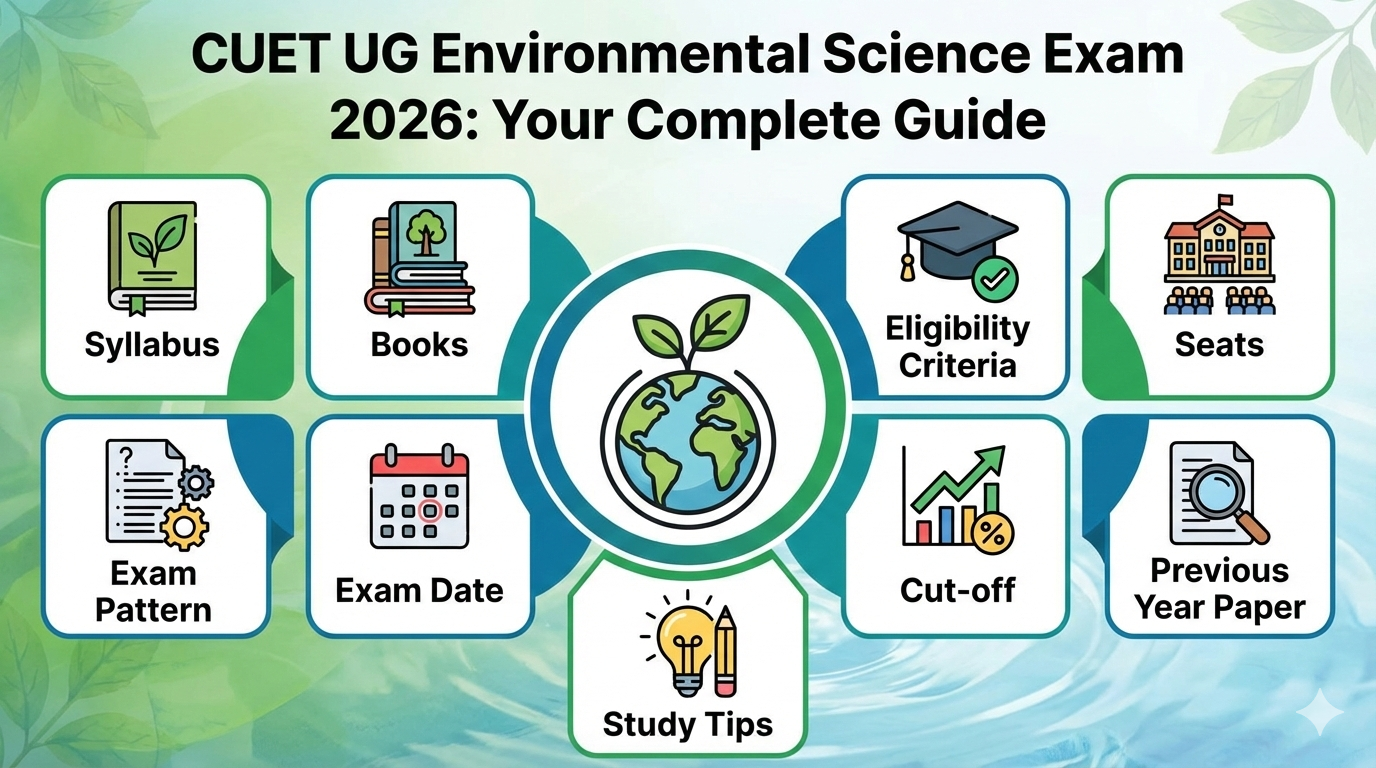
CUET UG Environmental Science Exam 2026 Syllabus,Books,eligiblity Criteria,Seats,Exam Pattern,Exam Date,Cut-off,Previous year Paper,Study Tips
The Common University Entrance Test – Undergraduate (CUET UG) has become the primary gateway for admission into undergraduate programs offered by Central Universities and many State, Deemed, and Private Universities across India. Environmental Science is an important domain subject under CUET UG, especially for students aiming for B.Sc. Environmental Science, Environmental Studies, Ecology, Sustainability, Geography, or interdisciplinary science programs.The CUET UG Environmental Science Exam 2026 evaluates a student’s understanding of environmental processes, ecosystems, biodiversity, pollution, climate change, and sustainable development, largely based on the NCERT Class XII syllabus.
Table of Contents
CUET UG Environmental Science 2026: Overview
| Feature | Details |
|---|---|
| Exam Name | CUET UG Environmental Science |
| Conducting Body | National Testing Agency (NTA) |
| Level | Undergraduate |
| Mode of Exam | Computer Based Test (CBT) |
| Medium | English & Hindi |
| Duration | 45 minutes |
| Question Type | Multiple Choice Questions (MCQs) |
| Total Questions | 50 (40 to be attempted) |
Eligibility Criteria for CUET UG Environmental Science 2026
Educational Qualification
- Candidates must have passed Class 12 (10+2) or equivalent examination from a recognized board.
- Students appearing in Class 12 in 2026 are also eligible to apply provisionally.
Subject Requirements
- Environmental Science may be chosen by students from Science, Arts, or Commerce streams, depending on the university’s admission criteria.
- Some universities may prefer Biology, Geography, or Environmental Studies background.
Age Limit
- No upper age limit for appearing in CUET UG.
- Age criteria, if any, will be decided by the participating universities.
CUET UG Environmental Science 2026 Syllabus (Detailed)
The syllabus is largely based on NCERT Class XII Environmental Studies/Environmental Science.
1. Human Beings and Nature
(i) Modern schools of ecological thought.
(ii) Definitions and basic understanding of Deep ecology (Gary Snyder, Earth First) vs. shallow ecology.
(iii) Stewardship of land (e.g. Wendell Berry).
(iv) Social ecology [Marxist environmentalism and socialist ecology (Barry Commoner)].
(v) Feminism.
(vi) Green Politics (e.g. Germany and England).
(vii) Sustainable Development: basic concepts, Brundtland Commission Report, Sustainable Development Goals, Mission LiFE.
2. Population and Conservation Ecology
I.Population dynamics: Factors causing population change (birth, death, immigration
and emigration); relation between the factors; Age structure and its significance;
Population Pyramids –interpretation and implications. Rate of change of population –
the three general shapes of Survivorship Curves, r and K strategies and differences
between the two.
II.Human populations (Malthusian model and demographic transition): Definition of
Carrying Capacity; Malthusian view: concept of ‘over-population’ and shortage of
resources; Questioning Malthus. Population Growth vs. Disparate Consumption of
resources within and amongst nations. Definition and understanding of Demographic
Transition; Factors influencing demographic transition.
III. Population Regulation: Growth without regulation (exponential); simple population
regulation (logistic growth curve); factors regulating population size (space, food and
water, territories, predators, weather and climate, parasite and diseases, disasters and selfregulation). Basic understanding of the Exponential growth curve (J – shaped) and
Logistic growth curve (S – shaped); Factors regulating population size (space, food and
water, territories, predators, weather and climate, parasite and diseases, disasters and selfregulation).
IV.Threats to the ecosystem: habitat destruction; genetic erosion; Biodiversity loss;
expanding agriculture; impound water; waste from human societies; increasing human
consumption. Only a brief understanding of the causes and consequences of threats to
provisioning and regulatory functions of the ecosystem with suitable examples.
V.Conservation: importance, the critical state of Indian forests; conflicts surrounding
forested areas – populations and tribals and their rights – tourism – poaching – roads –
development projects – dams; scientific forestry and its limitations; social forestry; the
role of the forest department; NGOs; joint forestry management; wild life – sanctuaries,
conservation and management in India; Project Tiger as a case study in conservation.
Definition of Conservation in situ and ex situ conservation, Importance of Conservation.
VI.In-situ conservation: Wildlife sanctuaries, National parks, Biosphere reserves
(definition, objectives, features, advantages and disadvantages). Ex-situ conservation:
zoos, aquaria, plant collection (objectives, features, advantages and disadvantages).
VII.Conflicts in managing and conserving Forests: India’s forest cover, issues concerning
people living in and around forests with particular reference to tribal rights; threats to
forests: poaching, developmental projects like roads and dams, over exploitation of forest
resources (direct and indirect).The role of the forest department and NGOs in managing forests.
Some management measures: scientific forestry, social forestry (various types of social
forestry), Joint Forestry Management (JFM), ecotourism.
Case study in conservation for example Project Tiger: Origin, aims, and objectives,
successes, failures.Acts and rules related to ecology, forest and biodiversity conservation
3. Environmental Pollution
Definition and concepts of pollutants, contaminant sources, sink, receptor; impacts of air, water and soil pollution on human health and ecosystem; different acts/rules related to prevention and control of air, water, soil and noise pollution in India.
I. Air pollution and its monitoring
- Structure, temperature profile and composition of atmosphere; primary and secondary pollutants; National Ambient Air Quality Standards (NAAQS); importance of monitoring of ambient air quality (gaseous and particulate).
- Industrial and vehicular pollution and various steps taken to regulate pollution – emission standards, implementation of CNG programme.
- Acid rain formation and its impact; smog; photochemical smog; ozone in troposphere.
- Monitoring at emission source and of ambient air quality; criteria for monitoring stations; types of stations; number of stations; frequency of data collection; characteristics of ambient air sampling; basic considerations for sampling (to be dealt with briefly).
- Classification of techniques – manual and instrumental.
Manual: Passive samplers, High Volume Samplers, Bubbler systems.
Instrumental: Photometric techniques – NDIR, Chemiluminescence (principle and use). - Ambient Air Quality Index; National Ambient Air Quality Monitoring (NAAQM) programme; main functions of the Central Pollution Control Board and State Pollution Control Board; National Air Monitoring Programme (NAMP) and its objectives.
II. Water pollution and its monitoring
- Distribution of water on earth; sources (quantitative/qualitative, biodegradable vs non-biodegradable, point vs non-point sources) of pollution in surface and ground water, ponds, lakes and rivers.
- Water quality indicators: pH, electrical conductivity, turbidity, salinity, alkalinity, hardness, dissolved oxygen, temperature, nitrates, sulphates, metals and pesticides, BOD and COD.
- Lake stratification; eutrophication.
III. Soil pollution and its monitoring
- Sources of soil pollution such as industries, mining, agricultural runoff, sewage water, etc.
- Soil characteristics: physical, chemical and biological attributes of soil; soil types; soil moisture; soil pH; soil acidity.
Experimental details for assessing soil respiration, soil pH, soil aggregate stability and infiltration rate.
4. Development and Environment
I. Urbanisation:
Push and pull factors; consequences on rural and urban sectors; future trends and projections.
II. Conventional paradigm of development:
Critical appraisal from the viewpoints of sustainability, environmental impact and equity.
Definition of economic development and natural resources.
Relationship between development and environment.
Overuse and exploitation of resources; diversion of scarce resources; disparate access to resources; increasing wastes and pollution.
III. Gandhian approach to development and environment:
Local self-governance – basic principles behind village policy, Antyodaya, Sarvodaya, Panchayati Raj; local self-sufficiency, local markets and environmental sustainability.
Village as the basis of development; promotion of cottage industries and intermediate technologies; focus on employment; Indian way of life and concern for environment.
IV. Urban environmental planning and management:
Problems of sanitation, water management, transport, energy, air quality and housing; constraints (economic, political).
Indigenous approaches: rainwater harvesting, garbage segregation, composting, energy from solid and liquid wastes, sewage management (dry toilets, Decentralized Water Management System – DEWATS).
Features of new urbanism and goals of smart growth with examples from the Third World:
▪ Bogota – Bolivia (traffic management)
▪ Cuba (urban agriculture using organic methods)
▪ Curitiba – Brazil (traffic planning and urban renewal)
▪ Cochabamba – water management and protests against privatization of water supply
5. Sustainable Agriculture in India
Crop varieties; techniques for maintaining soil fertility
I. Features of pre-colonial agriculture: Growing for sustenance rather than
market; multi-cropping, management of soil health, diversity in seed.
Colonial influence: Punitive taxation, commercial crops for export and British industry,
devaluation of sustainable traditional practices. Bengal famine. Comparative study of
pre-colonial, colonial and post- colonial agriculture and their impact.
II. Irrigation systems, Macro vs micro irrigation systems – Canal irrigation/dam as
compared to sprinkler/ drip/ trickle drip/dug wells. Basic features, advantages and
disadvantages of each kind. Traditional rainwater harvesting- tankas, khadins, ahar,
pynes, zings, johads and eris etc in different parts of India.
III. Green Revolution: Origin and Basic principles of Green RevolutionDevelopment of High Yielding Varieties (HYV); introduction of fertilizers and
pesticides; mono cropping, Environmental, social and economic impacts –
advantages and disadvantages (from the viewpoints of agro-bio diversity; soil
health; ecological impact of pesticides; energy use; input costs; benefits to small
and medium farmers, community level and household level food security).
IV. Elements of sustainable agriculture: Mixed farming, mixed cropping, intercropping, crop rotation, use of sustainable practices of water soil and pest
management for improving soil fertility (organic fertilizers, bio-fertilizers, green
manure, with two examples) and pest control (bio pesticides). Integrated Pest
Management (IPM); eating local foods. Traditional agriculture, natural farming,
organic agriculture, modern agriculture (use of hybrid seeds, high yielding
varieties, chemical fertilizers and pesticides), gene revolution (genetically
modified seeds) and sustainable agriculture.
V. Management of agricultural produce: Storage; Food preservation-different
methods like use of low temperatures, high temperatures, drying, canning,
preservation by salt and sugar. packaging, grading, Transportation of Food.
Food adulteration and Food additives- definitions; types and harmful effects of
adulteration.
Quality Marks – ISI (Indian Standard Institute); AGMARK (Agricultural
Marketing); FPO (Fruit Product Order).
VI. Food Security. Meaning and need, Issues related to food production, storage and
access. Integrated and sustainable approach to food security for the Third World
including working for environmental sustainability and social and economic
sustainability through land reform, credit support to farmers, market support to
farmers, inadequacies in the present marketing system, ways to improve
marketing system, improving access to food, ownership of seeds. National level
food security Act 2013
6. Environmental and Natural Resource Economics
(i) Classification of natural resources – abiotic and biotic; renewable and non-renewable; stock, potential and actual; ubiquitous and localized; scarcity and growth; natural resource accounting.
Physical accounting – definition, principles, advantages and disadvantages.
(ii) GDP and GNP – definitions; advantages and disadvantages as measures of growth.
(iii) Environmental economics – purpose; defensive expenditure; natural/ecological capital; carbon footprint and carbon credit.
(iv) Externalities – definition, types (positive and negative), examples and impacts.
(v) Cost-benefit analysis – definition, process, advantages and disadvantages; Extended Producer Responsibility (EPR) – definition, examples and advantages.
(vi) Natural capital regeneration – ecosystem services; causes of environmental degradation; ecological footprint; importance of conserving natural capital.
7. International Relations and the Environment
I. Global Impacts of pollution
Ozone depletion: Chapman’s cycle, potential effects of ozone depletion, ozone
depleting substances (halons, carbon tetrachloride, CFCs, methyl chloroform, methyl
bromide and HCFCs); Ozone thinning over Antarctica and arctic,
Steps taken to control ozone depletion. waste dumping, persistent organic pollutants,
Global warming, Greenhouse gases, Carbon footprint, Climate change: indicators and
causes;Montreal protocol, Kyoto protocol, Bamako convention, Paris agreement, Conference of
parties, carbon credits system
Case study of Amazonia – causes for forest exploitation, reasons for acceleration of
deforestation, effects of government policies, ecological value of rainforests and
possible solutions to the problem.
Case study of ivory trade in Africa – reasons for flourishing trade of ivory in the past,
steps taken to curb the trade and the consequences of ban in trade.
II.International trade: A theoretical perspective; free trade vs. protectionism; import
barriers; domestic industry vs. free trade; transnational companies – a historical
perspective; India’s international trade – characteristics and terms of trade, major
imports and exports – foreign exchange crises
The export imperative and its impact on the environment; the case study of aquaculture
in India; diversion of scarce resource from production of subsistence needs to
commercial products; toxic waste trade – extent and impact; Globalization -trade regimes
(WTO, GATT, IPR, TRIPS, TRIMS) and their impact on third world.
Definition, advantages and disadvantages of globalization, free trade, protectionism.
Transnational Companies (TNCs) – definition; TNCs and environment – conflict of
interest.
Toxic waste trade – definition, origin, factors sustaining, impact on third world countries
(example – health and environmental impacts) and Bamako and Basel Conventions.
GATT – the organization and its metamorphosis into WTO.
Principles and functions of WTO: creating a level playing field for international trade
through Most Favored Nation, tariff and non-tariff barriers and trading to comparative
advantages.
Definition of IPR and its categories: copyrights, patents, trademarks, industrial design
rights, geographical indicators and trade secrets.
A brief understanding of how these agreements impacted India’s trade, food security,
economic well-being, environmental sustainability.
III. International aid: agencies; Types of Aid: Tied and Untied Aid, advantages and
disadvantages of each
CUET UG Environmental Science Paper Analysis
| Unit (Latest 7-Unit Syllabus) | Syllabus Focus | Exact No. of Questions (2022–2025) |
|---|---|---|
| Unit-1: Human Beings & Nature | Environmental ethics, ecological schools, thinkers, green politics, SDGs | 32 |
| Unit-2: Population & Conservation Ecology | Population growth, biodiversity, extinction, conservation strategies | 38 |
| Unit-3: Monitoring Pollution | Air, water, soil pollution, BOD, eutrophication, waste, biomagnification | 46 |
| Unit-4: Development & Environment | Sustainable development, urbanisation, industrial impact | 27 |
| Unit-5: Sustainable Agriculture & Resource Economics | Agriculture, food security, resource valuation, sustainability | 19 |
| Unit-6: Environmental Laws & Natural Resources | EPA, Wildlife Act, Forest Act, resource classification | 24 |
| Unit-7: International Relations & Environment | Montreal, Kyoto, Paris Agreement, global institutions | 14 |
| TOTAL | 200 / 200 |
Exam Pattern of CUET UG Environmental Science 2026
| Component | Details |
|---|---|
| Total Questions | 50 |
| Questions to Attempt | 40 |
| Marks per Question | +5 |
| Negative Marking | −1 for each wrong answer |
| Maximum Marks | 200 |
| Time Duration | 45 minutes |
Important Note:
Only 40 questions are to be attempted out of 50. Attempting more than 40 may lead to evaluation of only the first 40 attempted responses.
CUET UG Environmental Science 2026: Exam Pattern
The CUET UG examination is conducted in Computer-Based Test (CBT) mode.
Key Features:
- Mode: Online (CBT)
- Question Type: Multiple Choice Questions (MCQs)
- Duration: 60 minutes per subject
- Total Questions: 50 compulsory questions
- Medium: Multiple languages, including English and Hindi
Marking Scheme:
- Correct answer: +1 mark
- Incorrect answer: As per official notification (generally no negative marking, subject to change)
❓ Is the Language Test (Section I) mandatory if a student chooses CUET UG Environmental Science?
✅ YES — in most cases, the Language Test is MANDATORY.
For CUET UG admissions, universities generally require:
- At least ONE Language paper (Section I A or I B)
- PLUS the Domain subject(s) required for the course
🧮 Total Marks Table
| Paper | Section | No. of Questions | Marks per Question | Maximum Marks |
|---|---|---|---|---|
| Language | Section I | 40 | +5 | 200 |
| Domain Subject | Section II | 40 | +5 | 200 |
| TOTAL | — | 100 | if attempt all | 500 Marks |
CUET UG Environmental Science 2026 Exam Date (Expected)
- CUET UG 2026 is expected to be conducted in May–June 2026.
- Environmental Science exam will be scheduled in multiple slots depending on the number of candidates.
- Exact dates will be announced in the official CUET UG notification.
Seats Available for Environmental Science Through CUET UG
| University | Programme | Approx. Seats |
|---|---|---|
| Banaras Hindu University (BHU) | B.Sc. (Hons.) Environmental Science | 40–60 |
| University of Delhi (DU) (select colleges) | B.Sc. (Hons.) Environmental Science | 20–40 per college |
| Aligarh Muslim University (AMU) | B.Sc. Environmental Science | 30–50 |
| Babasaheb Bhimrao Ambedkar University (BBAU), Lucknow | B.Sc. Environmental Science | 40 |
| Central University of Rajasthan | B.Sc. Environmental Science | 30 |
| Central University of Jharkhand | B.Sc. Environmental Science | 30 |
| Central University of South Bihar | B.Sc. Environmental Science | 30 |
| Central University of Kerala | B.Sc. Environmental Science | 30 |
B.Sc. (Hons.) Environmental Science – Eligibility & CUET Subject Combination
| Level | Programme | Language / Domain Requirement | CUET Subject Combination |
|---|---|---|---|
| Undergraduate | B.Sc. (Hons.) Environmental Science | For Language/Domain subjects, kindly refer to List A and List B | Candidates must appear in CUET in any ONE of the following combinations: Combination I: Physics + Chemistry + Biology / Biological Studies / Biotechnology / Biochemistry OR Combination II: Physics + Chemistry + Mathematics / Applied Mathematics Merit will be based on the best CUET scores obtained from the chosen combination. Candidates must appear in any one Language from List A in CUET. |
B.Sc. (Hons.) Environmental Science – University of Delhi
✅ Total Colleges Offering the Programme
7 Colleges
🎓 List of DU Colleges
- Miranda House (Women)
- Hindu College
- Daulat Ram College (Women)
- Gargi College (Women)
- Deshbandhu College
- Ramanujan College
- Dyal Singh College
University-wise Eligibility Table CUET-UG
| Central University | UG Programme Name | Eligibility (Academic + CUET Subjects) |
|---|---|---|
| University of Delhi (DU) | B.Sc. (Hons.) Environmental Science | 10+2 with Science stream. CUET subject combination: (i) Physics + Chemistry + Biology / Biotechnology / Biochemistry OR (ii) Physics + Chemistry + Mathematics / Applied Mathematics. + Any one Language from List A. |
| Guru Gobind Singh Indraprastha University (GGSIPU) (via CUET) | B.Sc. Environmental Science | 10+2 (Science) with minimum 50% marks (45% for SC/ST). CUET: English (Section IA) + any one Science domain + General Test. |
| Central University of Haryana (CUH) | B.Sc. (Hons.) Environmental Science | 10+2 with PCB / PCM from a recognized board. CUET: Physics + Chemistry + Biology/Mathematics + Language. |
| Central University of Rajasthan (CURAJ) | B.Sc. (Hons.) Environmental Science | 10+2 in Science stream (PCB/PCM). CUET subject tests in relevant science domains + Language. |
| Central University of South Bihar (CUSB) | B.Sc. (Hons.) Environmental Science | 10+2 with Science subjects. CUET: Physics, Chemistry + Biology/Mathematics. |
| Central University of Jharkhand (CUJ) | B.Sc. (Hons.) Environmental Science | 10+2 with PCB / PCM. CUET domain subjects in Science + Language. |
🔹 College-wise CUET Cut-off Scores Delhi University
| College | UR | OBC | SC | ST |
|---|---|---|---|---|
| Ramanujan College | 503 | 430 | 349 | 325 |
| Ramjas College | 503 | 430 | 349 | 325 |
Best Books for CUET UG Environmental Science 2026
| Unit No. | Unit Name | Best Core Book | Why This Book is Important for CUET |
|---|---|---|---|
| Unit-1 | Human Beings and Nature | NCERT Environmental Studies (Class 12) | Ecological schools, thinkers, SDGs, Deep vs Shallow ecology |
| Unit-2 | Population & Conservation Ecology | NCERT Biology Class 12 (Ecology) | Population growth, r/K strategies, demographic transition |
| Unit-3 | Monitoring Pollution | Environmental Studies – Anubha Kaushik | Pollution types, indices, monitoring methods |
| Unit-4 | Development & Environment | Environmental Studies – Erach Bharucha | Sustainable development, urbanisation, ethics |
| Unit-5 | Sustainable Agriculture & Resource Economics | Environmental Studies – Benny Joseph | Resource valuation, sustainable farming, economics |
| Unit-6 | Environmental Laws & Natural Resources | Environmental Studies – Erach Bharucha | Indian environmental acts, governance, conservation |
| Unit-7 | International Relations & Environment | Environmental Studies – Benny Joseph | UN bodies, global treaties, climate change agreements |
Recommended Book
-
CUET UG Envionmental Science Code 307 Solved Previous year Paper 2022 to 2025 With 1000 Chapter Wise MCQ As Per 2026 Exam pattern
Original price was: ₹600.00.₹399.00Current price is: ₹399.00.
📌 CUET-UG Environmental Science 2026 – FAQs
Q1. How many questions are there in the Environmental Science paper?
👉 50 questions are given; you must attempt 40.
Q2. How many marks is the Environmental Science paper?
👉 200 marks
- +5 for each correct answer
- −1 for each wrong answer
Q3. Is Environmental Science compulsory for B.Sc. Environmental Science in DU/JNU?
👉 Yes.
You must appear in:
- Section IA – Language paper
- Section II – Environmental Science
Q4. Is the General Test required for Environmental Science admission?
👉 No, not for DU & JNU B.Sc. Environmental Science (subject to university bulletin).
Q5. How many chapters (units) are in CUET Environmental Science syllabus?
👉 7 units, as prescribed by NTA.
Q6. Which unit has the highest weightage based on PYQs (2022–2025)?
👉 Unit-3: Monitoring Pollution
(Highest number of questions across all 4 years)
Q7. Which 3 units should be prepared first for maximum score?
👉 Priority order (data-based):
- Monitoring Pollution (Unit-3)
- Population & Conservation Ecology (Unit-2)
- Human Beings & Nature (Unit-1)
Q8. Are passage-based questions asked?
👉 Yes.
- Usually 1 passage = 5 MCQs
- Common topics: water pollution, biodiversity, sustainability
Q9. Are questions strictly from NCERT?
👉 Mostly yes (≈60–65%)
But thinkers, Acts, protocols, and applied questions go beyond NCERT.
Q10. Are Environmental Acts and International Treaties important?
👉 Extremely important.
- At least 1–2 questions every year
- Examples: EPA 1986, Wildlife Act, Paris Agreement, Montreal Protocol
Q11. What difficulty level can be expected in CUET 2026?
👉 Moderate, but concept-based and analytical
- Direct facts + interpretation questions
Q12. What is a safe score for DU B.Sc. Environmental Science?
👉 320–350+ / 400 (Language + Domain combined)
Q13. How much time is given for Environmental Science paper?
👉 45 minutes
➡️ About 1 minute per question
Q14. What is the biggest mistake students make?
❌ Ignoring:
- Environmental thinkers
- Acts & years
- Passage-based practice
Q15. Best preparation combination?
✅ NCERT + Erach Bharucha + CUET MCQ Book + PYQs
Tag:CUET syllabus for Science students, CUET UG Environmental Science Book, CUET UG Environmental Science Book PDF, Cuet ug environmental science eligibility, CUET UG Environmental Science previous year Question Paper, Cuet ug environmental science subjects, cuet ug environmental science syllabus, CUET UG syllabus 2026


