
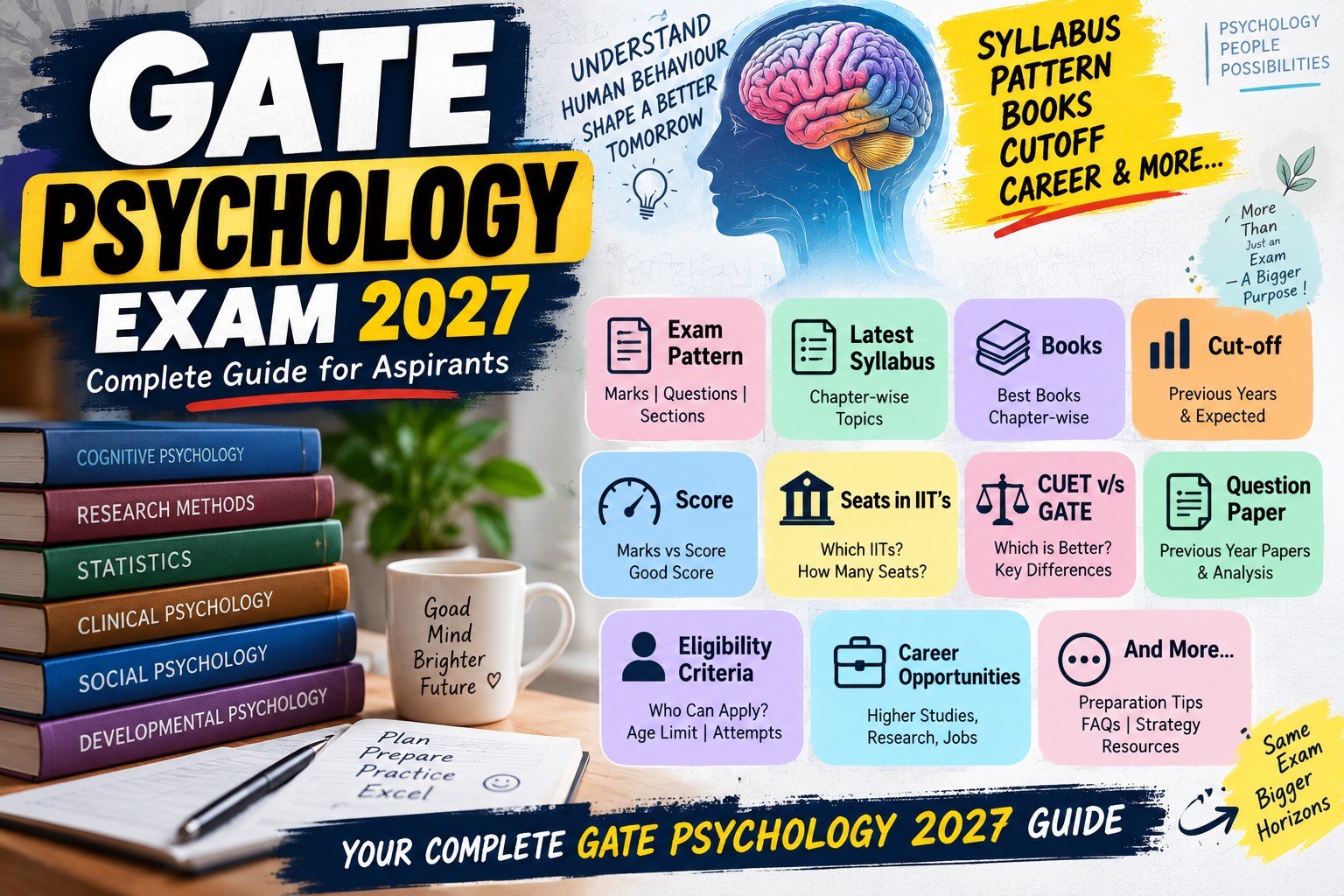
GATE Psyhoclogy Exam 2027 Exam Pattern, Latest Syllabus, Books, Cut-off, Score,Seats in IIT’s, CUET V/s GATE ,Question Paper,Eligibility criteria & More
GATE Psychology (XH-C5) is relevant for students interested in pursuing postgraduate and research opportunities in psychology at participating IITs and other institutions. The exact GATE 2027 dates, official brochure, eligibility rules, participating institutes, and admission policies will be confirmed through the official GATE 2027 information brochure, so the article below separates stable information from details that may change for 2027.
GATE Psychology 2027: Overview Table
| Particular | Details |
|---|---|
| Exam Name | Graduate Aptitude Test in Engineering (GATE) 2027 |
| Paper Name | Psychology |
| Paper Code | XH5 – Psychology |
| Paper Category | Humanities and Social Sciences (XH) |
| Conducting Institute | IIT Madras |
| Exam Level | National-Level Examination |
| Exam Mode | Computer-Based Test (CBT) |
| Exam Duration | 3 Hours |
| Total Marks | 100 Marks |
| Total Questions | 65 Questions |
| General Aptitude (GA) | 15 Marks |
| Reasoning & Comprehension (XH0) | 25 Marks |
| Psychology (XH5) | 60 Marks |
| Question Types | MCQ, MSQ |
| Negative Marking | Applicable to selected MCQs only |
| Eligibility | Students in 3rd year or higher of an eligible undergraduate programme, or graduates, subject to official criteria |
| Psychology Degree Required? | Not necessarily for appearing in GATE; institute-specific admission eligibility may differ |
| Major Syllabus Areas | Research Methods, Statistics, Psychometrics, Biological Basis of Behaviour, Sensation & Perception, Learning, Memory and other topics in the official syllabus |
| GATE Score Validity | Generally valid for 3 years from the result announcement |
| Official Website | GATE 2027 Official Website |
Table of Contents
GATE Psychology 2027: Important Dates
According to the currently available GATE 2027 schedule:
| Event | Date |
|---|---|
| Registration | 2 September 2026 |
| Regular registration closing date | 27 September 2026 |
| Extended registration closing date | 5 October 2026 |
| Examination | 6–7 February 2027 |
| Examination | 13–14 February 2027 |
| Examination | 20–21 February 2027 |
| Result announcement | 19 March 2027 |
These dates are subject to change, so candidates should regularly check the official GATE 2027 website.
GATE Psychology 2027 Exam Pattern
GATE 2027 is a 100-mark examination. The examination duration is generally 3 hours.For the Humanities and Social Sciences paper structure, Psychology candidates have:
| Section | Marks |
|---|---|
| General Aptitude (GA) | 15 |
| XH0 – Reasoning and Comprehension | 25 |
| XH5 – Psychology | 60 |
| Total | 100 |
Thus, GATE Psychology is not only a Psychology subject test. You must also prepare for:
- General Aptitude
- Reasoning and Comprehension
- Psychology
The official GATE 2027 syllabus page confirms the XH structure as a 25-mark common section plus one 60-mark optional discipline, in addition to the 15-mark General Aptitude section.
Types of Questions
The GATE examination generally includes two types of questions:
1. MCQ – Multiple Choice Questions
- Only one correct answer.
- Negative marking may apply.
2. MSQ – Multiple Select Questions
- One or more options may be correct.
- Candidates must select all correct options.
- Generally, there is no negative marking.
GATE Psychology 2027 Latest Syllabus
The GATE 2027 authorities have specifically announced that the syllabi have been revised, so candidates should download and follow the latest official XH5 Psychology syllabus.Based on the established GATE Psychology syllabus structure, preparation should cover the following major areas.
GATE 2027 Psychology (XH5): Complete Syllabus
The following table is based on the official GATE 2027 XH5 Psychology syllabus
| Section | Topic | Complete Syllabus / Subtopics |
|---|---|---|
| XH5.1 | Research Methods and Statistics | Approaches to Research: Philosophical worldviews and criteria involved in approach; Research design – Quantitative, Qualitative and Mixed methods. Designing Research: Research problems, Purpose statement, Variables and Operational Definitions, Hypothesis, Sampling. Nature of Quantitative & Qualitative Research: Interview, Self-completion questionnaires (Survey), Observation, Experiment, Quasi-experiment, Field studies, Focus group discussions, Narratives, Case studies, Ethnography. Ethics in conducting and reporting research. Statistics in Psychology: Measures of Central Tendency and Dispersion, Normal Probability Curve, Parametric and Non-parametric tests, Effect size and Power analysis. Correlational Analysis: Product Moment Correlation, Rank Order Correlation, Partial correlation, Multiple correlation. Special Correlation Methods: Biserial, Point biserial, Tetrachoric and Phi coefficient. Regression: Simple linear regression and Multiple regression. Factor Analysis: Assumptions, Methods, Rotation and Interpretation. Experimental Designs: Factorial Design, Randomized Block Designs, Repeated Measures Design, Single-subject designs, Cohort studies. Statistics for Experimental Design: ANOVA, MANOVA and ANCOVA. |
| XH5.2 | Psychometrics | Foundations of Psychological Measurement. Basic Components: Scales and items’ construction and analysis of items. Intelligence test items, Performance tests, Ability and Aptitude tests, Personality questionnaires. Method of test construction. Standardization of Measures: Reliability, Validity and Norms. Application of assessment and measurements in tests. Applications of psychological testing in various settings – Education, Counselling and Guidance, Clinical, Organizational and Developmental. |
| XH5.3 | Biological and Evolutionary Basis of Behaviour | Heredity and behaviour; Evolution and Natural Selection. Nervous System and Structures of the Brain and their functions. Neurons: Structure, Functions, Types, Neural impulse and Synaptic transmission. Neurotransmitters; Hemispheric lateralization. Endocrine System: Types and functions. Biological Basis of Motivation: Hunger, Thirst, Sleep and Sex. Biological Basis of Emotion: Limbic System. Biological basis of Memory; Hormonal regulation of behaviour. Methods of Physiological Psychology: Invasive methods – Anatomical methods, Degeneration techniques, Lesion techniques, Chemical methods and Microelectrode studies. Non-invasive methods – EEG and Scanning methods. Muscular and Glandular system. Genetics and Behaviour: Chromosomal anomalies; Nature–Nurture controversy – Twin studies and Adoption studies. |
| XH5.4 | Perception, Learning, Memory and Forgetting | Sensation: Sensory thresholds and sensory adaptations; Vision, Hearing, Touch and Pain, Smell and Taste, Kinesthesis and Vestibular sense. Perception: Role of attention, Organizing principles of perception, Gestalt perception, Depth perception and Illusions. Theories of Learning: Classical conditioning, Operant conditioning, Social learning theory and Cognitive learning. Memory: Encoding, Storage, Retrieval, Information-processing theories of memory, Retrieval in long-term memory and Reconstructive nature of long-term memory. Forgetting: Encoding failure, Interference theory and Memory trace decay theory. |
| XH5.5 | Cognition | Thinking, Intelligence and Language. Basic Elements of Thought: Concepts, Propositions and Imagery. Current Paradigms of Cognitive Psychology: Information-processing approach and Ecological approach. Problem Solving: Methods of problem solving, Strategies and Obstacles, Role of Metacognitive processing. Decision-making: Choosing among alternatives. Intelligence: Theories of Intelligence – Spearman, Thurstone, Jensen, Cattell, Gardner and Stenberg; Emotional Intelligence; Measuring intelligence; Individual differences in Intelligence; Role of heredity and environment. Difference between Intelligence, Aptitude and Creativity. |
| XH5.6 | Personality | Theories of Personality: Psychoanalytic, Behaviourist, Social, Cognitive, Humanism, Trait and Type theories. Biology of personality. Assessment of personality. |
| XH5.7 | Motivation, Emotion and Stress and Coping | Approaches to Understanding Motivation: Instinct, Drive-reduction, Arousal, Incentive, Humanistic, Achievement motivation, Intrinsic motivation, Aggression, Curiosity and Exploration. Emotions: Nature of emotions and Theories of emotions. Stress: Definition of stress, Stressors and Cognitive factors in stress. Factors in Stress Reaction: General Adaptation Syndrome and Effects of stress. Coping with Stress: Problem-focused coping and Emotion-focused coping. |
| XH5.8 | Social Psychology | Social Perception: Attribution, Impression formation, Social categorization and Implicit personality theory. Social Influence: Conformity, Compliance and Obedience. Attitudes, Beliefs and Values; Evaluating the social world. Attitude formation, Attitude change and Persuasion. Cognitive dissonance; Prejudice; Discrimination; Aggression; Power and Prosocial behaviour. Belief systems and Value patterns. Group dynamics; Theories of intergroup relations and conflicts. |
| XH5.9 | Development Across the Life Span | Nature versus nurture in human development. Prenatal Development: Chromosomes, Genes and DNA. Physical, Cognitive and Psychosocial development during Infancy, Childhood, Adolescence and Adulthood. Moral development. Theories of aging. |
| XH5.10 | Clinical Psychology and Organizational Behavior | Psychological Disorders: Conceptions of mental disorders, Assessment and Diagnosis, DSM and Other tools. Psychotherapies: Psychodynamic, Phenomenological/Experiential therapy, Behaviour therapy, Cognitive therapy, Rational Emotive Behavior Therapy (REBT), Meditation and Biological therapy. Organizational Behavior: Organizational demographic and cultural diversity; Organizational Culture; Making decisions in organizations; Power and Politics. Leadership theories; Leadership styles and effectiveness. Positive organizational behavior. Performance management by Reward and Punishment. |
| XH5.11 | Applications of Psychology | Applications of theories of Motivation and Learning in School. Factors in educational achievement. Counselling and Guidance in Schools. Application of theories of Motivation, Learning, Emotions and Perceptions in Group dynamics and Organizational setup. Issues of Personal Space, Crowding and Territoriality. Intervention for Mental Health and Wellbeing. |
GATE Psyhcology Chapter Wise & Year Wise Question Analysis 2021 to 2026
| XH5 Section | Chapter | 2021 | 2022 | 2023 | 2024 | 2025 | 2026 | Total |
|---|---|---|---|---|---|---|---|---|
| XH5.1 | Research Methods & Statistics | 6 | 7 | 6 | 7 | 6 | 7 | 39 |
| XH5.2 | Psychometrics | 3 | 4 | 3 | 4 | 4 | 4 | 22 |
| XH5.3 | Biological & Evolutionary Basis of Behaviour | 4 | 4 | 5 | 4 | 5 | 4 | 26 |
| XH5.4 | Perception, Learning, Memory & Forgetting | 5 | 4 | 4 | 5 | 4 | 4 | 26 |
| XH5.5 | Cognition | 4 | 3 | 4 | 4 | 3 | 4 | 22 |
| XH5.6 | Personality | 3 | 3 | 3 | 2 | 3 | 3 | 17 |
| XH5.7 | Motivation, Emotion, Stress & Coping | 3 | 3 | 3 | 3 | 3 | 3 | 18 |
| XH5.8 | Social Psychology | 4 | 3 | 4 | 3 | 4 | 3 | 21 |
| XH5.9 | Development Across the Life Span | 3 | 3 | 2 | 3 | 2 | 3 | 16 |
| XH5.10 | Clinical Psychology & Organizational Behavior | 4 | 4 | 4 | 4 | 4 | 4 | 24 |
| XH5.11 | Applications of Psychology | 1 | 2 | 2 | 1 | 2 | 1 | 9 |
| Total Psychology Questions | 40 | 40 | 40 | 40 | 40 | 40 | 240 |
GATE Psychology Books Chapter Wise
| XH5 Chapter | Recommended Book | Author(s) | Approx. Price (₹) |
|---|---|---|---|
| XH5.1 Research Methods & Statistics | Research Methodology: Methods and Techniques | C. R. Kothari & Gaurav Garg | ₹400–₹700 |
| Statistics for the Behavioral Sciences | Frederick J. Gravetter & Larry B. Wallnau | ₹800–₹2,500+ | |
| XH5.2 Psychometrics | Psychological Testing and Assessment | Ronald Jay Cohen & Mark E. Swerdlik | ₹800–₹2,500+ |
| XH5.3 Biological & Evolutionary Basis of Behaviour | Biological Psychology | James W. Kalat | ₹788–₹1,050 for the Indian 13th edition |
| XH5.4 Perception, Learning, Memory & Forgetting | Psychology | David G. Myers, C. Nathan DeWall & June Gruber | ₹1,500–₹7,000+ depending on edition |
| Learning and Behavior | Paul Chance | ₹1,500–₹4,000 | |
| XH5.5 Cognition | Cognitive Psychology | Robert J. Sternberg & Karin Sternberg | ₹1,000–₹3,500 |
| XH5.6 Personality | Personality | Jerry M. Burger | ₹800–₹2,500 |
| Theories of Personality | Calvin S. Hall, Gardner Lindzey & John B. Campbell | ₹600–₹2,000 | |
| XH5.7 Motivation, Emotion, Stress & Coping | Understanding Motivation and Emotion | Johnmarshall Reeve | ₹1,500–₹4,000 |
| XH5.8 Social Psychology | Social Psychology | Robert A. Baron & Nyla R. Branscombe | ₹700–₹2,500 |
| Social Psychology | David G. Myers & Jean M. Twenge | Around ₹793 in one current Indian listing | |
| XH5.9 Development Across the Life Span | Life-Span Development | John W. Santrock | ₹800–₹3,000 |
| XH5.10 Clinical Psychology | Abnormal Psychology | Ronald J. Comer | ₹1,000–₹3,500 |
| XH5.10 Organizational Behavior | Organizational Behavior | Stephen P. Robbins & Timothy A. Judge | ₹700–₹2,500 |
| XH5.11 Applications of Psychology | Psychology | David G. Myers, C. Nathan DeWall & June Gruber | ₹1,500–₹7,000+ |
Recommended products
-
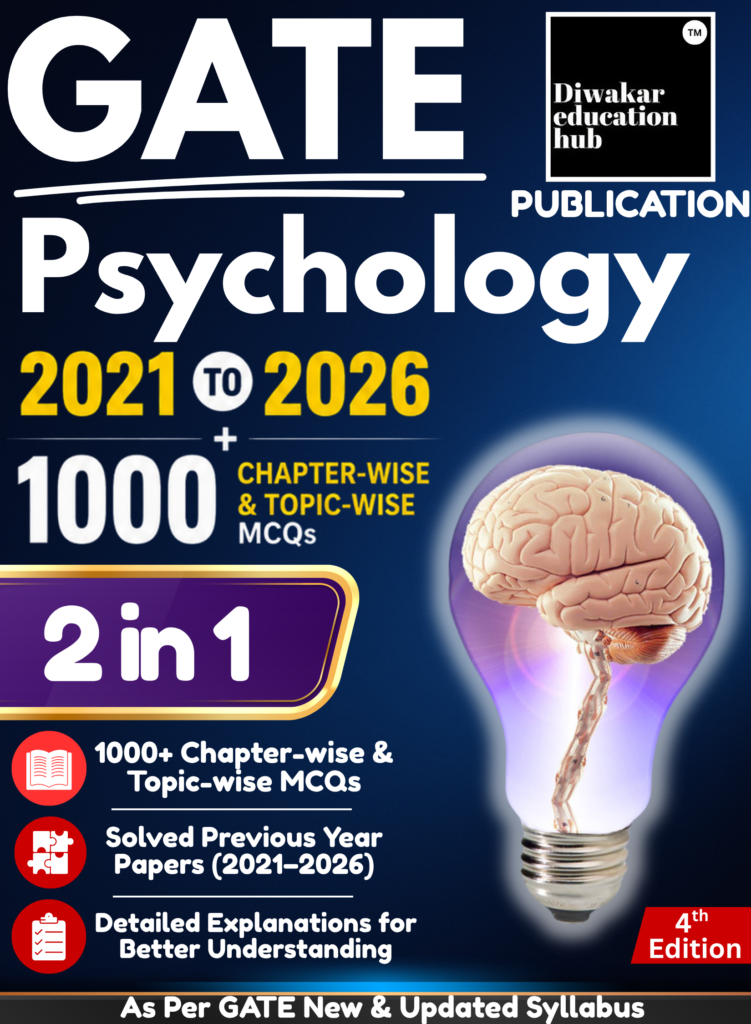
GATE Psychology Book 2027 PYQ 2021 to 2026 with 1000 Chapter Wise & Topic Wise MCQ with Detail Solution Covered all Chapters
Original price was: ₹600.00.₹499.00Current price is: ₹499.00.
GATE Psychology 2027: Chapter-wise Important Topics & Expected Weightage
Based on the GATE Psychology 2027 syllabus and the 2021–2026 PYQ trend mapping discussed above, the following table gives a practical exam-oriented priority. The weightage is trend-based, not officially prescribed, because GATE does not publish fixed chapter-wise weightage. The chapter structure follows the official XH5 syllabus.
| XH5 Section | Chapter | Very Important Topics for Exam | Expected Importance / Weightage Trend | Priority |
|---|---|---|---|---|
| XH5.1 | Research Methods & Statistics | Research design, variables, hypothesis, sampling, qualitative vs quantitative research, experimental and quasi-experimental designs, central tendency, dispersion, normal probability curve, parametric & non-parametric tests, correlation, regression, factor analysis, ANOVA, MANOVA, ANCOVA | Very High – approximately 6–7 questions/year | ⭐⭐⭐⭐⭐ |
| XH5.2 | Psychometrics | Scales of measurement, item construction, item analysis, test construction, standardization, reliability, validity, norms, intelligence tests, aptitude tests, personality tests | High – approximately 3–4 questions/year | ⭐⭐⭐⭐ |
| XH5.3 | Biological & Evolutionary Basis of Behaviour | Nervous system, brain structures and functions, neurons, neural impulse, synaptic transmission, neurotransmitters, hemispheric lateralization, endocrine system, limbic system, sleep, hunger, physiological psychology methods, EEG, scanning methods, genetics and behaviour | Very High – approximately 4–5 questions/year | ⭐⭐⭐⭐⭐ |
| XH5.4 | Perception, Learning, Memory & Forgetting | Sensory thresholds, sensory adaptation, vision, hearing, Gestalt principles, depth perception, illusions, classical conditioning, operant conditioning, social learning, encoding, storage, retrieval, information-processing theories, interference theory, trace decay theory | Very High – approximately 4–5 questions/year | ⭐⭐⭐⭐⭐ |
| XH5.5 | Cognition | Concepts, propositions, imagery, information-processing approach, problem solving, heuristics and obstacles, metacognition, decision-making, theories of intelligence, emotional intelligence, intelligence vs aptitude vs creativity | High – approximately 3–4 questions/year | ⭐⭐⭐⭐ |
| XH5.6 | Personality | Psychoanalytic theories, behaviourist theories, social and cognitive theories, humanistic theories, trait and type theories, biology of personality, personality assessment | Moderate – approximately 2–3 questions/year | ⭐⭐⭐ |
| XH5.7 | Motivation, Emotion, Stress & Coping | Instinct theory, drive-reduction theory, arousal theory, incentive theory, humanistic and achievement motivation, intrinsic motivation, theories of emotion, stressors, General Adaptation Syndrome, problem-focused and emotion-focused coping | Moderate – approximately 3 questions/year | ⭐⭐⭐ |
| XH5.8 | Social Psychology | Attribution, impression formation, social categorization, conformity, compliance, obedience, attitude formation and change, persuasion, cognitive dissonance, prejudice, discrimination, aggression, prosocial behaviour, group dynamics, intergroup relations | High – approximately 3–4 questions/year | ⭐⭐⭐⭐ |
| XH5.9 | Development Across the Life Span | Nature vs nurture, prenatal development, chromosomes, genes and DNA, physical development, cognitive development, psychosocial development, moral development, theories of aging | Moderate – approximately 2–3 questions/year | ⭐⭐⭐ |
| XH5.10 | Clinical Psychology & Organizational Behavior | Psychological disorders, assessment and diagnosis, DSM, psychodynamic therapy, behaviour therapy, cognitive therapy, REBT, biological therapy, organizational culture, power and politics, leadership theories, leadership styles, performance management | High to Very High – approximately 4 questions/year | ⭐⭐⭐⭐ |
| XH5.11 | Applications of Psychology | Motivation and learning in school, educational achievement, counselling and guidance, group dynamics, organizational applications, personal space, crowding, territoriality, mental health and wellbeing | Low but Important – approximately 1–2 questions/year | ⭐⭐ |
GATE Psychology: Minimum Qualifying Cut-off (2021–2026)
| Year | General | OBC-NCL / EWS | SC / ST / PwD |
|---|---|---|---|
| 2021 | 40.0 | 36.0 | 26.6 |
| 2022 | 48.0 | 43.2 | 32.0 |
| 2023 | 52.5 | 47.2 | 35.0 |
| 2024 | 52.5 | 47.2 | 35.0 |
| 2025 | 36.0 | 32.4 | 24.0 |
| 2026 | 39.3 | 35.3 | 26.1 |
GATE Psyhcology 2026 Topper Highest Score & Marks
| Humanities and Social Sciences (Psychology) | ROSHAN RAJESH | 73 | 1000 |
| MANSI | 73 | 1000 |
Seats in IIT’s For GATE Psyhcology
| IIT | Course / Programme | Seat Intake | Does GATE Psychology Apply? |
|---|---|---|---|
| IIT Madras | M.A. Development Studies | 2 seats specifically under the Psychology GATE paper route | Yes – Psychology was listed among the eligible XH sections for this stream in the available admission information |
| IIT Bombay | Ph.D. in Psychology / Psychology research areas | No fixed annual seat number published as a permanent intake | GATE can support eligibility for assistantship, subject to departmental admission requirements |
CUET PG Psychology vs GATE Psychology: Complete Comparison
| Comparison Point | CUET PG Psychology | GATE Psychology (XH5) |
|---|---|---|
| Full Exam Name | Common University Entrance Test – Postgraduate | Graduate Aptitude Test in Engineering |
| Conducting Body | National Testing Agency (NTA) | GATE Organising Institute |
| 2027 Conducting Institute | To be announced as per CUET PG 2027 notification | IIT Madras |
| Paper / Subject | Psychology / Applied Psychology | Psychology under Humanities & Social Sciences |
| Paper Code | HUQP20 | XH5 |
| Main Purpose | Admission to PG Psychology and related programmes | Admission/research opportunities in selected IITs and institutions, depending on programme eligibility |
| Exam Level | National-level | National-level |
| Exam Mode | Computer-Based Test (CBT) | Computer-Based Test (CBT) |
| Medium of Exam | English and Hindi | English |
| Duration | As per the applicable CUET PG notification | 3 Hours / 180 Minutes |
| Total Questions | 75 Questions | 65 Questions |
| Total Marks | As per the applicable CUET PG marking scheme | 100 Marks |
| Psychology Questions | Entire paper is Psychology-based | Psychology section carries 60 marks |
| General Aptitude | ❌ No separate section | ✅ 15 Marks |
| Reasoning & Comprehension | ❌ No separate section | ✅ 25 Marks – XH0 |
| Psychology Section | Entire 75-question paper | XH5 – 60 Marks |
| Question Type | Objective-type questions | MCQ + MSQ + NAT as per the general GATE pattern |
| Negative Marking | As per CUET PG marking rules | Applicable to selected MCQs |
| Main Focus | Broad Psychology knowledge and subject concepts | Psychology + analytical ability + research/statistics + reasoning |
| History of Psychology | ⭐ High importance | Comparatively less direct emphasis |
| Schools of Psychology | ⭐ High importance | Integrated with other topics |
| Biological Basis of Behaviour | ⭐⭐⭐⭐ | ⭐⭐⭐⭐⭐ |
| Sensation & Perception | ⭐⭐⭐⭐ | ⭐⭐⭐⭐⭐ |
| Learning | ⭐⭐⭐⭐⭐ | ⭐⭐⭐⭐⭐ |
| Memory & Forgetting | ⭐⭐⭐⭐⭐ | ⭐⭐⭐⭐⭐ |
| Cognition | ⭐⭐⭐⭐ | ⭐⭐⭐⭐ |
| Intelligence | ⭐⭐⭐⭐⭐ | ⭐⭐⭐⭐ |
| Personality | ⭐⭐⭐⭐⭐ | ⭐⭐⭐ |
| Motivation & Emotion | ⭐⭐⭐⭐ | ⭐⭐⭐ |
| Social Psychology | ⭐⭐⭐⭐ | ⭐⭐⭐⭐ |
| Developmental Psychology | ⭐⭐⭐⭐ | ⭐⭐⭐ |
| Abnormal / Clinical Psychology | ⭐⭐⭐⭐⭐ | ⭐⭐⭐⭐ |
| Organizational Psychology | Depends on syllabus coverage | Explicitly included under XH5.10 |
| Psychological Testing | ⭐⭐⭐⭐ | ⭐⭐⭐⭐⭐ |
| Psychometrics | Moderate to High | Very High importance |
| Research Methods | Moderate emphasis | Very High importance |
| Statistics | Moderate emphasis | Very High importance |
| Experimental Design | Comparatively less emphasis | High importance |
| Correlation & Regression | Basic to moderate | High importance |
| ANOVA / MANOVA / ANCOVA | May be relevant depending on preparation level | Explicitly included |
| Factor Analysis | Comparatively less important | Explicitly included and important |
| Difficulty Level | Moderate to High | Moderate to High / Analytical |
| Theory-Based Questions | More common | Moderate |
| Conceptual Questions | High | Very High |
| Application-Based Questions | Moderate | High |
| Numerical / Statistical Questions | Comparatively fewer | More important |
| Best For Students Strong in | Psychology theory and broad subject knowledge | Research methods, statistics, analytical thinking and Psychology |
| Best For Students Weak in Mathematics | Generally more comfortable | Statistics preparation is necessary |
| Dedicated M.A./M.Sc. Psychology Opportunities | ⭐⭐⭐⭐⭐ More options | ⭐⭐ Limited options |
| Number of University Opportunities | Generally much broader | More selective and programme-specific |
| Central Universities | Major opportunity | Limited as a primary admission route |
| Traditional Psychology Master’s | 🏆 Better option | Limited |
| Applied Psychology Programmes | 🏆 Strong opportunity | Limited/selective |
| IIT Opportunities | Generally not the main route | 🏆 Relevant for programmes accepting GATE XH5 |
| Interdisciplinary Programmes | Available in participating universities | Strong potential in selected programmes |
| Research-Oriented Opportunities | Available, depending on university | ⭐⭐⭐⭐ Strong relevance |
| Ph.D. Pathway | Usually separate entrance/admission criteria | Can be useful depending on institute-specific rules |
| PSU Job Opportunities | Generally not applicable | Possible only when a PSU specifically accepts the relevant GATE paper; opportunities for XH5 are limited and notification-specific |
| Score Validity | Usually applicable only for that admission cycle | Generally 3 years, subject to GATE rules |
| Financial Assistance | Depends on university/programme | Possible in eligible programmes according to institute/government rules |
| Admission Guarantee After Qualifying | ❌ No | ❌ No |
| Competition | High, with many candidates seeking university admission | Competitive, with a smaller but highly focused candidate pool |
| PYQ Importance | ⭐⭐⭐⭐ | ⭐⭐⭐⭐⭐ |
| Mock Test Importance | ⭐⭐⭐⭐ | ⭐⭐⭐⭐⭐ |
| Best Preparation Strategy | Complete the entire Psychology syllabus thoroughly | Focus strongly on Psychology + GA + Reasoning + Research Methods + Statistics |
| Major Advantage | One exam can provide access to many universities and traditional Psychology PG programmes | Adds IIT/interdisciplinary/research opportunities and develops strong analytical skills |
| Main Limitation | Does not primarily target IIT opportunities | Limited number of dedicated Psychology Master’s programmes |
| Best Choice for M.A. Psychology | 🏆 CUET PG Psychology | Secondary option |
| Best Choice for Maximum College Options | 🏆 CUET PG Psychology | More limited |
| Best Choice for Research & Statistics | Good | 🏆 GATE Psychology |
| Best Choice for IIT / Interdisciplinary Opportunities | Limited | 🏆 GATE Psychology |
| Can Both Be Prepared Together? | ✅ Yes | ✅ Yes |
| Syllabus Overlap | High overlap with GATE Psychology core topics | High overlap with CUET PG Psychology core topics |
| Extra Preparation Required | History, schools and broad Psychology theory | GA, XH0 Reasoning & Comprehension, advanced Research Methods and Statistics |
| Overall Best Strategy | Excellent as the primary exam for Psychology PG admission | Excellent as an additional exam for IIT/research/interdisciplinary opportunities |
Benefits of Qualifying GATE Psychology Apart from Limited IIT Psychology Seats
You are absolutely right: if we only look at dedicated Psychology master’s seats in IITs, the opportunities are limited. But the value of qualifying GATE Psychology (XH5) can extend beyond those seats.The official GATE 2027 framework states that a valid GATE score can be used for Master’s, direct doctoral and doctoral admissions in relevant Humanities and other disciplines, with possible financial assistance where the programme and institution permit it. It also notes that some PSUs use GATE scores for recruitment—but the specific paper accepted depends entirely on each recruitment notification.
| Benefit / Opportunity | How GATE Psychology Can Help | Important Condition |
|---|---|---|
| 1. Ph.D. Admissions | Can strengthen eligibility for Ph.D. programmes in Psychology, Humanities, Social Sciences and related interdisciplinary areas | Each university/institute decides accepted GATE papers and eligibility |
| 2. Direct Doctoral Programmes | Some institutions may consider a valid GATE score for direct doctoral/research routes | Programme-specific eligibility applies |
| 3. Financial Assistance / Fellowship | A qualifying GATE score may be used to seek financial assistance for eligible PG/direct Ph.D./Ph.D. programmes | Not automatic; institute and scholarship rules apply |
| 4. Other IIT Programmes | You are not restricted only to a degree titled “Psychology”; relevant Humanities and interdisciplinary programmes may accept XH5 | Must check the exact programme’s accepted paper list |
| 5. IISc and Other MoE-Supported Institutions | GATE scores can be considered for relevant postgraduate and doctoral opportunities beyond IITs | Subject and degree eligibility vary |
| 6. Interdisciplinary Fields | Can support applications in areas such as Human Sciences, Cognitive/Behavioural research, HSS, Development Studies, and other relevant programmes | Psychology paper acceptance must be verified individually |
| 7. University Admissions Beyond IITs | Some universities and institutions may use GATE scores for PG or research admissions | Not all universities accept XH5 |
| 8. Research Career Profile | Demonstrates competence in Psychology along with research methods, statistics, reasoning and analytical ability | This is an academic advantage, not an automatic job qualification |
| 9. Three-Year Score Validity | You can use the GATE score for up to 3 years from the result announcement | Admission notifications must fall within the validity period |
| 10. PSU / Government-Sector Recruitment | Some PSUs use GATE scores in recruitment processes | Do not assume XH5 is accepted; most technical PSU recruitments specify particular GATE papers |
| 11. Backup / Additional Entrance Qualification | Provides an additional national-level qualification alongside CUET PG or university entrance exams | It does not replace programme-specific entrance requirements |
GATE Psychology 2027 – Frequently Asked Questions (FAQs)
| No. | Frequently Asked Question | Answer |
|---|---|---|
| 1 | What is GATE Psychology? | GATE Psychology is the Psychology section (XH5) under the Humanities and Social Sciences (XH) paper of GATE. |
| 2 | What is the paper code for GATE Psychology? | The paper code is XH5 – Psychology. |
| 3 | Is GATE Psychology a separate exam? | It is part of the GATE Humanities and Social Sciences (XH) paper. Candidates select Psychology (XH5) as their optional subject section. |
| 4 | What is the exam pattern of GATE Psychology? | The paper has General Aptitude + XH0 Reasoning & Comprehension + XH5 Psychology, for a total of 65 questions and 100 marks. |
| 5 | How many marks are allotted to Psychology? | The XH5 Psychology section carries 60 marks. |
| 6 | How many marks are allotted to General Aptitude? | 15 marks are allotted to General Aptitude. |
| 7 | How many marks are allotted to XH0 Reasoning & Comprehension? | 25 marks are allotted to XH0 Reasoning & Comprehension. |
| 8 | Is there a NAT-type question in GATE Psychology? | Yes, GATE Psychology can include NAT questions under the overall GATE question pattern, depending on the paper. However, candidates should follow the specific year’s official question-paper instructions. |
| 9 | Is there negative marking in GATE Psychology? | Negative marking generally applies to certain MCQs only. MSQ and NAT questions do not have negative marking under the standard GATE pattern. |
| 10 | What is the duration of the GATE exam? | 3 hours (180 minutes). |
| 11 | What is the total number of questions? | 65 questions. |
| 12 | What is the total marks of GATE Psychology? | 100 marks. |
| 13 | Who can apply for GATE Psychology? | Eligibility depends on the official GATE rules. Generally, candidates who meet the required educational qualification criteria can apply; a specific Psychology degree is not always the only possible qualification. |
| 14 | Can a B.A. Psychology student apply for GATE Psychology? | Yes, provided the candidate meets the official GATE eligibility requirements for that examination year. |
| 15 | Can a B.Sc. Psychology student apply? | Yes, subject to the official eligibility criteria. |
| 16 | Is there an age limit for GATE Psychology? | No age limit under the standard GATE eligibility rules. |
| 17 | How many attempts are allowed? | There is generally no restriction on the number of attempts. |
| 18 | Can final-year students apply? | Yes, if they satisfy the eligibility requirements specified in the official information brochure. |
| 19 | Is GATE Psychology difficult? | The difficulty is generally moderate to high, especially because preparation involves Psychology along with Reasoning, Comprehension and General Aptitude. |
| 20 | Which topics are most important? | Research Methods & Statistics, Biological Basis of Behaviour, Perception/Learning/Memory, Psychometrics, Cognition, Social Psychology and Clinical Psychology are among the major high-priority areas. |
| 21 | Are Research Methods and Statistics important? | Yes. They are among the most important areas for GATE Psychology preparation. |
| 22 | Can I get admission to IITs through GATE Psychology? | Yes, but opportunities are limited and programme-specific. Candidates must check whether a particular IIT programme accepts XH5 Psychology. |
| 23 | Are there regular M.A./M.Sc. Psychology programmes in IITs? | Dedicated Psychology Master’s programmes are very limited. Most relevant opportunities may be interdisciplinary, Humanities, Human Sciences or research-oriented programmes. |
| 24 | Can GATE Psychology be used for Ph.D. admission? | Yes, potentially. Some institutions may consider a valid GATE score for Ph.D. or research admissions, subject to their individual eligibility criteria. |
| 25 | Can I get a PSU job through GATE Psychology? | PSU opportunities for XH5 Psychology are limited and completely notification-dependent. Never assume that a PSU accepting GATE scores accepts every GATE paper. |
| 26 | Does qualifying GATE guarantee admission? | No. Qualifying GATE does not guarantee admission to an IIT, university, fellowship or job. Each institution has its own selection criteria. |
| 27 | What is the validity of a GATE score? | A GATE score is generally valid for 3 years from the date of announcement of results, subject to the applicable GATE rules. |
| 28 | Is a high GATE score better than simply qualifying? | Yes. Merely qualifying makes you eligible for opportunities, but admission selection is usually competitive. A higher score can improve your chances where the programme uses GATE scores. |
| 29 | What is the difference between GATE marks and GATE score? | Marks are the marks obtained out of 100. The GATE score is a normalized score calculated using the official GATE methodology. |
| 30 | What is a good score in GATE Psychology? | There is no single fixed “good score.” It depends on the year’s difficulty, competition and the institute/programme you are targeting. Generally, a score significantly above the qualifying level provides a stronger competitive position. |
| 31 | What is the qualifying cut-off? | The qualifying cut-off is the minimum marks required to be declared GATE qualified. It is different from an admission cut-off. |
| 32 | Does qualifying GATE guarantee a scholarship or stipend? | No. Financial assistance depends on the institution, programme, category and applicable rules. |
| 33 | Can I prepare for CUET PG Psychology and GATE Psychology together? | Yes. There is substantial overlap in core Psychology topics. GATE additionally requires preparation for GA, Reasoning & Comprehension, Research Methods and advanced Statistics. |
| 34 | Which exam is better: CUET PG Psychology or GATE Psychology? | For maximum traditional M.A./M.Sc. Psychology options, CUET PG is generally more useful. For selected IIT/interdisciplinary/research opportunities, GATE Psychology can provide additional options. |
| 35 | Should I prepare for both CUET PG and GATE Psychology? | Yes, if your goal is to maximize opportunities. Prepare the common Psychology syllabus first and then add exam-specific topics. |
| 36 | Which books are best for GATE Psychology? | Useful standard references include David Myers, James W. Kalat, Gravetter & Wallnau, C.R. Kothari, Cohen & Swerdlik, Sternberg, Santrock, Comer, and Robbins & Judge, depending on the chapter. |
| 37 | Are previous-year questions important? | Yes, extremely important. PYQs help you understand the level, concepts, repeated areas and question style. |
| 38 | From which years should I solve PYQs? | Solve all available GATE Psychology/XH5 previous-year papers, especially the most recent papers, and practise relevant GA and XH0 questions separately. |
| 39 | How should I start preparing? | Start with the official syllabus, divide it chapter-wise, complete high-weightage topics, make short notes, solve PYQs and then take mock tests. |
| 40 | What is the best strategy for GATE Psychology 2027? | Complete the syllabus → focus on Research Methods/Statistics + Biological Psychology + Learning/Memory → solve PYQs → practise GA and XH0 → revise repeatedly → take full-length mock tests. |
