
GATE 2027 Robotics & Automation (RA): Complete Guide, Syllabus, Exam Pattern, Books, IIT Seats & Admission
The Graduate Aptitude Test in Engineering (GATE) 2027 has introduced a completely new test paper Robotics & Automation (RA). The new paper has been added by IIT Madras, the organizing institute for GATE 2027, taking the total number of GATE test papers to 30.The introduction of RA is significant because Robotics & Automation is an interdisciplinary field combining Mechanical Engineering, Electrical Engineering, Electronics, Control Systems, Mechatronics, Programming and Robotics The new GATE paper is therefore designed around this multidisciplinary nature However, candidates should understand one important point: GATE introducing the RA paper does not automatically mean that all IITs will offer a separate M.Tech. seat under the RA paper. Admission to M.Tech. programmes is decided independently by each IIT, and the accepting GATE paper codes and seat matrix can change from one admission cycle to another.
What is GATE Robotics & Automation (RA) 2027?
GATE RA is the new Robotics & Automation paper introduced for GATE 2027 The paper code is RA and it is designed to test knowledge of:
- Engineering Mathematics
- Basics of Mechatronics
- Robotics
- Automation
- Sensors and Actuators
- Engineering Mechanics
- Programming and Data Structures
- Electrical Engineering
- Mechanical Engineering
- Industrial Automation and Manufacturing Systems
GATE 2027 will have 30 test papers, including the newly introduced RA paper.
GATE 2027 Robotics & Automation: Important Dates
| Event | Date |
|---|---|
| GATE 2027 Registration Begins | 2 September 2026 |
| Regular Registration Last Date | 27 September 2026 |
| Extended Registration with Late Fee | 5 October 2026 |
| Application Rectification | 14–21 October 2026 |
| City Allotment Notification | 4 January 2027 |
| Admit Card | To be announced |
| GATE 2027 Examination | 6–7, 13–14 & 20–21 February 2027 |
| GATE 2027 Result | 19 March 2027 |
Dates are subject to change by the GATE 2027 organizing institute.
GATE 2027 RA Exam Pattern
The Robotics & Automation paper follows the overall GATE CBT format.
| Particular | Details |
|---|---|
| Paper Code | RA |
| Paper Name | Robotics & Automation |
| Mode | Computer Based Test |
| Duration | 3 Hours |
| Language | English |
| Total Questions | 65 |
| Total Marks | 100 |
| General Aptitude | 15 Marks |
| RA Subject | 85 Marks |
| Question Types | MCQ, MSQ and NAT |
| Part A | Common for all RA candidates |
| Part B1 | Electrical Engineering |
| Part B2 | Mechanical Engineering |
The RA paper consists of General Aptitude (15 marks), Part A (60 marks) and Part B (25 marks). Candidates select either Part B1 – Electrical or Part B2 – Mechanical during the examination.
| Paper Code | Section / Part | General Aptitude (GA) | Common Section (A) | Option Section (B) | Total Marks | Total Time (Minutes)* |
|---|---|---|---|---|---|---|
| RA | General Aptitude (GA)+ Part A (Common)+ Part B1 (Electrical) or Part B2 (Mechanical) | 15 | 60 | 25 | 100 | 180 |
| RA | Part B (to be selected during the exam)B1 – Electrical OR B2 – Mechanical | – | – | 25 | 25 | – |
| Total Marks | 15 | 60 | 25 | 100 | 180 |
Marking Scheme
- 1-mark MCQ: 1/3 mark negative marking
- 2-mark MCQ: 2/3 mark negative marking
- No negative marking for MSQ
- No negative marking for NAT
- No partial marking in MSQ
GATE RA 2027 Syllabus
GATE 2027 Robotics and Automation (RA) Syllabus
| Section | Subject | Topics Covered |
|---|---|---|
| Part A: Common Section | A.1 Engineering Mathematics | Linear Algebra: Matrices, transpose, determinant, rank, eigenvalues and eigenvectors, trace, adjoint, solutions of systems of linear equations. Calculus: Functions of a single variable, limits, continuity and differentiability, mean value theorems, indeterminate forms, definite and improper integrals, double and triple integrals, partial and total derivatives, Taylor series in one and two variables, maxima and minima, gradient, divergence, curl and vector identities. Differential Equations: First-order linear and nonlinear equations, higher-order linear differential equations with constant coefficients, Euler-Cauchy equation, initial and boundary value problems, Laplace transforms, heat, wave and Laplace equations, Fourier series. Probability and Statistics: Axioms of probability, conditional probability, mean, median, mode, standard deviation, random variables, expectation, binomial, Poisson and normal distributions, hypothesis testing, Probability Density Function (PDF), Cumulative Distribution Function (CDF). Numerical Methods: Solutions of linear and nonlinear algebraic equations, trapezoidal and Simpson’s rules, finite differences, explicit single-step and multi-step methods for differential equations. |
| Part A: Common Section | A.2 Basics of Mechatronics | Network Elements: Ideal voltage and current sources, dependent sources, R, L, C and M elements. Network Solution Methods: Kirchhoff’s laws (KCL and KVL), nodal and mesh analysis. Network Theorems: Thevenin’s, Norton’s, Superposition and Maximum Power Transfer theorems. AC/DC Networks: Transient response, sinusoidal steady-state analysis, resonance, two-port networks, balanced three-phase circuits, complex power and power factor. Digital Circuits: Boolean algebra, combinational circuits including multiplexers, encoders and decoders; sequential circuits including flip-flops and counters. Sensors: Resistive, capacitive, inductive, piezoelectric and Hall-effect sensors; signal conditioning circuits; industrial instrumentation transducers for displacement, velocity, acceleration, force, torque and pressure. Actuators: Principles of operation and torque-speed characteristics of hydraulic and pneumatic actuators, DC motors, stepper motors and servo motors. Engineering Mechanics: Free-body diagrams, equilibrium, friction and applications, rolling friction, belt-pulley systems, trusses and frames, kinematics and dynamics of rigid bodies in plane motion. Programming: Flowcharts and pseudocode; Python data types, operators, expressions, conditional statements, loops, break and continue, functions, arrays, dictionaries, strings and recursion. Data Structures: Stack, queue, linked list, binary search tree, binary heap and graph. |
| Part A: Common Section | A.3 Principles of Robotics and Automation | Robotics: Classification of robots, serial and parallel manipulators, geometrical configuration, links and joints, coordinate systems and degrees of freedom, rotation matrices in 2D and 3D, homogeneous transformations and forward kinematics. Robot Applications: Point-to-point and continuous-path control, types of end-effectors, robot accuracy and repeatability. Computer Integrated Manufacturing: Automation in manufacturing, Programmable Logic Controllers (PLCs), automated material handling systems, Automated Storage and Retrieval Systems (ASRS), automated identification/detection/capture systems, Computer Numerical Control (CNC), single- and multi-axis positioning systems, concurrent design and manufacturing planning for automation. |
| Part B1: Electrical Engineering | B1.1 Analog Circuits and Embedded Systems | Analog filters: low-pass, high-pass, band-pass and band-reject. Amplifiers: biasing, equivalent circuits, frequency response, feedback amplifiers, operational amplifiers and their characteristics and applications. Oscillators, Voltage Controlled Oscillators (VCOs), timers, Schmitt triggers, sample-and-hold circuits, A/D and D/A converters, Switched Mode Power Supplies (SMPS). Microprocessor and microcontroller applications, microcontroller components including CPU, memory, I/O ports and timers, interrupt handling, memory and I/O interfacing, basics of data acquisition systems. |
| Part B1: Electrical Engineering | B1.2 Signals and Systems | Representation of continuous- and discrete-time signals, shifting and scaling properties, linear time-invariant and causal systems, Fourier series representation of continuous- and discrete-time periodic signals, Shannon’s sampling theorem, Fourier Transform, Laplace Transform and Z-transform definitions and properties, RMS value and average value calculations. |
| Part B1: Electrical Engineering | B1.3 Control Systems | Mathematical modelling and representation of systems, feedback principle, transfer functions, block diagrams and signal-flow graphs, transient and steady-state analysis of linear time-invariant systems, stability analysis using Routh-Hurwitz and Nyquist criteria, Bode plots, root locus, lag, lead and lead-lag compensators, P, PI and PID controllers. |
| Part B2: Mechanical Engineering | B2.1 Mechanics of Materials | Stress and strain, elastic constants, Poisson’s ratio, Mohr’s circle for plane stress and plane strain, thin cylinders, shear force and bending moment diagrams, bending and shear stresses, shear centre, deflection of beams, torsion of circular shafts, Euler’s theory of columns, Castigliano’s theorems, thermal stresses, strain gauges and rosettes, material testing using Universal Testing Machine (UTM), hardness and impact strength testing. |
| Part B2: Mechanical Engineering | B2.2 Kinematics and Dynamics | Displacement, velocity and acceleration analysis of plane mechanisms, dynamic analysis of linkages, gears and gear trains, balancing of reciprocating and rotating masses, gyroscope, vibrations, free and forced vibration of single-degree-of-freedom systems, effect of damping, vibration isolation, resonance and critical speeds of shafts. |
| Part B2: Mechanical Engineering | B2.3 Machine Design and Computer Integrated Manufacturing | Design for static and dynamic loading, failure theories, fatigue strength and S-N diagram, design principles of bolted, riveted and welded joints, shafts, rolling and sliding contact bearings, brakes and clutches, springs. Basic concepts of Computer-Aided Design (CAD), Computer-Aided Manufacturing (CAM), CAD/CAM integration tools and additive manufacturing. |
Who Can Apply for GATE 2027 RA?
The general GATE eligibility rules apply.
Candidates who are currently studying in the 3rd year or higher of an eligible undergraduate programme, or candidates who have already completed a government-approved degree programme in Engineering, Technology, Architecture, Science, Commerce, Arts or Humanities, can appear for GATE 2027.
There is:
- No age limit
- No restriction on the number of attempts
However, qualifying for GATE and being eligible for a particular M.Tech. programme are two different things. IITs and other institutes independently determine which qualifying degrees and GATE papers they accept for admission.
Can You Appear for GATE RA Along With Another GATE Paper?
Yes, candidates can choose Robotics and Automation (RA) as one of their GATE 2027 papers and may also appear for one additional GATE paper, provided the combination is permitted under the official GATE 2027 two-paper combination list.
This option allows candidates to appear for two papers in the same GATE examination, giving them an opportunity to demonstrate their knowledge across related engineering disciplines. However, candidates should check the official GATE 2027 information brochure for the permitted paper combinations, examination sessions, and applicable additional fee before applying.
| Primary Paper | Permitted Second Paper |
|---|---|
| RA – Robotics & Automation | CS, DA, EC, EE, IN, ME |
GATE 2027 RA Books
Recommended Books for GATE Robotics & Automation (RA) 2027
| RA Syllabus Chapter | Recommended Book | Author | Publisher | Approx. Price |
|---|---|---|---|---|
| A.1 Engineering Mathematics – Linear Algebra, Calculus, Differential Equations, Probability & Statistics, Numerical Methods | Higher Engineering Mathematics | B. S. Grewal | Khanna Publishers | ₹700–₹1,000 |
| A.2 Network Elements, Network Theorems & AC Circuits | Engineering Circuit Analysis | William H. Hayt, Jack E. Kemmerly & Steven M. Durbin | McGraw Hill | ₹800–₹1,500 |
| A.2 Digital Circuits | Digital Design | M. Morris Mano & Michael D. Ciletti | Pearson | ₹700–₹1,200 |
| A.2 Sensors & Signal Conditioning | Mechatronics: Electronic Control Systems in Mechanical and Electrical Engineering | W. Bolton | Pearson | ₹740 approx. |
| A.2 Actuators & Mechatronics | Mechatronics: Electronic Control Systems in Mechanical and Electrical Engineering | W. Bolton | Pearson | ₹740 approx. |
| A.2 Engineering Mechanics | Engineering Mechanics: Statics & Dynamics | R. C. Hibbeler | Pearson | ₹900–₹1,500 |
| A.2 Python Programming | Python Crash Course | Eric Matthes | No Starch Press | ₹500–₹1,000 |
| A.2 Data Structures | Data Structures and Algorithms Made Easy | Narasimha Karumanchi | CareerMonk Publications | ₹500–₹800 |
| A.3 Robot Classification, Links, Joints & Degrees of Freedom | Introduction to Robotics: Mechanics and Control | John J. Craig | Pearson | ₹6,497 approx. |
| A.3 Rotation Matrices & Homogeneous Transformations | Introduction to Robotics: Mechanics and Control | John J. Craig | Pearson | ₹6,497 approx. |
| A.3 Forward Kinematics | Introduction to Robotics: Mechanics and Control | John J. Craig | Pearson | ₹6,497 approx. |
| A.3 Robot Applications & End-Effectors | Industrial Robotics: Technology, Programming, and Applications | Mikell P. Groover, Mitchell Weiss, Roger N. Nagel & Nicholas G. Odrey | McGraw Hill | ₹1,000–₹2,000 |
| A.3 Robot Accuracy & Repeatability | Industrial Robotics: Technology, Programming, and Applications | Mikell P. Groover et al. | McGraw Hill | ₹1,000–₹2,000 |
| A.3 Automation in Manufacturing & CIM | Automation, Production Systems, and Computer-Integrated Manufacturing | Mikell P. Groover | Pearson | ₹1,000–₹2,000 |
| A.3 PLCs, Material Handling & AS/RS | Automation, Production Systems, and Computer-Integrated Manufacturing | Mikell P. Groover | Pearson | ₹1,000–₹2,000 |
| A.3 CNC, Positioning Systems & Manufacturing Planning | Automation, Production Systems, and Computer-Integrated Manufacturing | Mikell P. Groover | Pearson | ₹1,000–₹2,000 |
| B1.1 Analog Circuits & Embedded Systems | Microelectronic Circuits | Adel S. Sedra & Kenneth C. Smith | Oxford University Press | ₹1,000–₹2,000 |
| B1.1 Microprocessors & Microcontrollers | The 8051 Microcontroller and Embedded Systems | Muhammad Ali Mazidi, Janice Gillispie Mazidi & Rolin D. McKinlay | Pearson | ₹600–₹1,000 |
| B1.2 Signals & Systems | Signals and Systems | Alan V. Oppenheim, Alan S. Willsky & S. Hamid Nawab | Pearson | ₹900–₹1,500 |
| B1.3 Control Systems | Control Systems Engineering | Norman S. Nise | Wiley | ₹800–₹1,500 |
| B2.1 Mechanics of Materials | Mechanics of Materials | R. C. Hibbeler | Pearson | ₹900–₹1,500 |
| B2.2 Kinematics & Dynamics | Theory of Machines | S. S. Rattan | McGraw Hill | ₹600–₹1,000 |
| B2.3 Machine Design | A Textbook of Machine Design | R. S. Khurmi & J. K. Gupta | S. Chand | ₹600–₹1,000 |
| B2.3 CAD/CAM & CIM | CAD/CAM: Computer-Aided Design and Manufacturing | Mikell P. Groover & Emory W. Zimmers Jr. | Pearson | ₹1,000–₹2,000 |
| B2.3 Additive Manufacturing | Additive Manufacturing Technologies | Ian Gibson, David Rosen & Brent Stucker | Springer | ₹3,000+ |
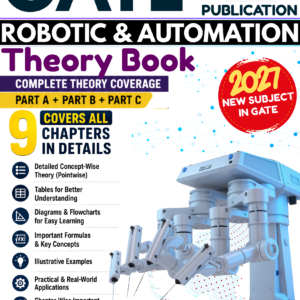
Recommended Book
-
GATE Robotics & Automation Theory Book 2027 Covered all 9 Chapters in Detail With Diagram Charts & Table
Original price was: ₹800.00.₹650.00Current price is: ₹650.00.
GATE RA 2027:IIT M.Tech Opportunities
Because RA is being introduced for GATE 2027, candidates should not assume that every IIT’s existing M.Tech programme will automatically accept the RA paper. Admission eligibility is determined separately by each institute and programme. The official GATE website explicitly states that admission based on a GATE score is subject to the individual institute’s eligibility and selection criteria.
IITs Offering Robotics/Automation-Related M.Tech Programmes
| IIT | Robotics/Automation-Related M.Tech Programme | Relevant Areas | GATE Paper / Admission Note |
|---|---|---|---|
| IIT Madras | M.Tech in Robotics | Robot kinematics & dynamics, mechanism design, sensors & actuators, robot motion planning, control, computer vision, AI/ML, autonomous systems | The programme launched in July 2026. The current programme page lists ME / EE / EC / CS as GATE papers; candidates should check the 2027 admission portal for the applicable list. |
| IIT Delhi | Interdisciplinary M.Tech in Robotics (JRB) | Robotics, AI, control, perception, mechanical design, embedded systems, autonomous vehicles, industrial robotics | The current programme material lists CS/ME/EE/EC/Aerospace/IN for GATE-based institute fellowship. The programme also involves a programming test/interview. |
| IIT Bombay | M.Tech in Systems & Control Engineering | Robotics, path planning, embedded control, autonomous vehicles, robust/nonlinear control | Robotics is a major research area of the Systems & Control group. The programme is broader than robotics alone. |
| IIT Bombay | M.Tech in Mechanical Engineering – Design/related areas | Robotics, kinematics and control of manipulators, mobile robots, mechatronics, automation | IIT Bombay’s Mechanical Engineering programme identifies Robotics, kinematics and control, mobile robots, microprocessor-based control and automation, and mechatronics among its research areas. |
| IIT Roorkee | Mechanical & Industrial Engineering – robotics-related coursework/research | Advanced robotics, robot vision, trajectory planning, manipulator control, mobile and space robots | IIT Roorkee’s academic material includes Advanced Robotics covering kinematics, dynamics, parallel mechanisms, robot vision and control. Exact GATE-RA eligibility should be checked in the relevant year’s admission brochure |
| IIT | Current Programme | Robotics/Automation Core? |
|---|---|---|
| IIT Delhi | M.Tech in Robotics (JRB) | Yes — very strong |
| IIT Madras | M.Tech in Robotics | Yes — very strong |
| IIT Roorkee | M.Tech Mechanical & Industrial Engineering, with Robotics & Automation specialization | Yes |
| IIT Bombay | M.Tech programmes/research in Systems & Control / Mechanical Engineering with robotics-related research | Yes, but not a dedicated current M.Tech titled Robotics |
GATE RA 2027: Frequently Asked Questions
Is Robotics & Automation a new GATE paper?
Yes. RA is a new GATE test paper introduced in GATE 2027.
What is the paper code?
The paper code is RA.
How many marks is GATE RA?
The paper is of 100 marks, including 15 marks for General Aptitude.
How many questions are there?
The standard GATE pattern has 65 questions: 10 General Aptitude + 55 subject questions.
Can I choose Electrical or Mechanical?
Yes. In RA, Part B can be selected during the examination:
- B1 – Electrical
- B2 – Mechanical
Is there a separate rank for Electrical and Mechanical sections?
No. GATE 2027 states that there will be no separate score or rank for candidates based on whether they attempt Part B1 Electrical or Part B2 Mechanical.
Can RA be combined with Mechanical Engineering?
Yes. RA and ME are among the permitted two-paper combinations.
Can RA be combined with Computer Science or Data Science?
Yes. RA can currently be combined with CS and DA, subject to the official two-paper combination rules.
Are there previous-year GATE RA papers?
No. GATE 2027 is the first year of the RA paper.
Will every IIT accept GATE RA?
Not necessarily. Each IIT independently decides its eligible GATE paper codes and admission criteria.
How many IIT seats are available through GATE RA?
There is currently no common all-IIT RA seat matrix. Individual IITs publish their own programme-wise seat matrices and accepted GATE papers.
Final Takeaway
GATE 2027 Robotics & Automation (RA) is a completely new interdisciplinary GATE paper covering Engineering Mathematics, Mechatronics, Robotics, Automation and either Electrical or Mechanical Engineering.
The paper provides a dedicated GATE route for students interested in robotics and automation, but candidates should not assume that a GATE RA score automatically guarantees eligibility for every IIT Robotics or Automation programme.
The safest preparation strategy is to follow the official GATE 2027 RA syllabus, build strong fundamentals in Mathematics, Mechatronics and Robotics, prepare one Part B specialization thoroughly, and simultaneously track the 2027–28 admission brochures of individual IITs for RA acceptance and seat availability.
For book preparation, a comprehensive GATE Robotics & Automation Theory + MCQ + Mock Test book based strictly on the new 2027 syllabus can serve as the central preparation resource, supplemented by standard ME/EE/Robotics references and previous questions from overlapping subjects.
Official GATE 2027 website: GATE 2027 – IIT Madras
