

BET DBT JRF Biotechnology Eligibility Test Latest Book 2026 Chapter Wise
Introduction
DBT JRF, also known as the Biotechnology Eligibility Test [BET], is an important national-level examination for biotechnology and life sciences students. The exam is conducted to select candidates for the DBT-Junior Research Fellowship [DBT-JRF].
A well-designed DBT JRF book should follow the official syllabus, cover every important chapter, explain concepts clearly, and provide chapter-wise MCQs, previous year questions [PYQs], and full-length mock tests.
Table of Contents
DBT JRF Book Chapter Wise Structure According to Syllabus
| Chapter / Unit | Recommended Book | Author | Publication |
|---|---|---|---|
| General Aptitude | Quantitative Aptitude | R. S. Aggarwal | S. Chand |
| Biomolecules / Biochemistry | Lehninger Principles of Biochemistry | David L. Nelson, Michael M. Cox, Aaron Hoskins | W. H. Freeman / Macmillan Learning |
| Cell Biology | Molecular Biology of the Cell | Bruce Alberts et al. | Garland Science / W. W. Norton |
| Cell Biology | Karp’s Cell and Molecular Biology | Gerald Karp, Janet Iwasa, Wallace Marshall | Wiley |
| Molecular Biology | Molecular Biology of the Gene | James D. Watson et al. | Pearson |
| Recombinant DNA Technology | Principles of Gene Manipulation and Genomics | S. B. Primrose, R. M. Twyman | Wiley-Blackwell |
| Genetics | Principles of Genetics | D. Peter Snustad, Michael J. Simmons | Wiley |
| Genomics and Proteomics | Principles of Gene Manipulation and Genomics | S. B. Primrose, R. M. Twyman | Wiley-Blackwell |
| Methods in Biotechnology | Principles and Techniques of Biochemistry and Molecular Biology | Keith Wilson, John Walker | Cambridge University Press |
| Immunology | Kuby Immunology | Jenni Punt, Sharon Stranford, Patricia Jones, Judy Owen | W. H. Freeman / Macmillan Learning |
| Microbiology | Prescott’s Microbiology | Joanne Willey, Kathleen Sandman, Dorothy Wood | McGraw Hill |
| Bioinformatics | Introduction to Bioinformatics | Arthur M. Lesk | Oxford University Press |
| Biostatistics | Biostatistical Analysis | Jerrold H. Zar | Pearson |
| Plant / Agricultural Biotechnology | Plant Biotechnology and Genetics | C. Neal Stewart Jr. | Wiley |
| Animal Biotechnology | Animal Cell Culture | R. Ian Freshney | Wiley-Blackwell |
| Industrial Biotechnology | Industrial Microbiology | L. E. Casida | New Age International |
| Environmental Biotechnology | Environmental Biotechnology | Alan Scragg | Oxford University Press |
| Medical Biotechnology | Biotechnology in Medical Sciences | Firdos Alam Khan | CRC Press |
| IPR, Biosafety and Bioethics | Biotechnology and Safety Assessment | John A. Thomas, Roy L. Fuchs | Academic Press / Elsevier |
| Practice / PYQ MCQs | DBT JRF BET Life Sciences & Biotechnology Previous Years / Practice Book | Diwakar Education Hub | Diwakar Education Hub |
Recommended products
-
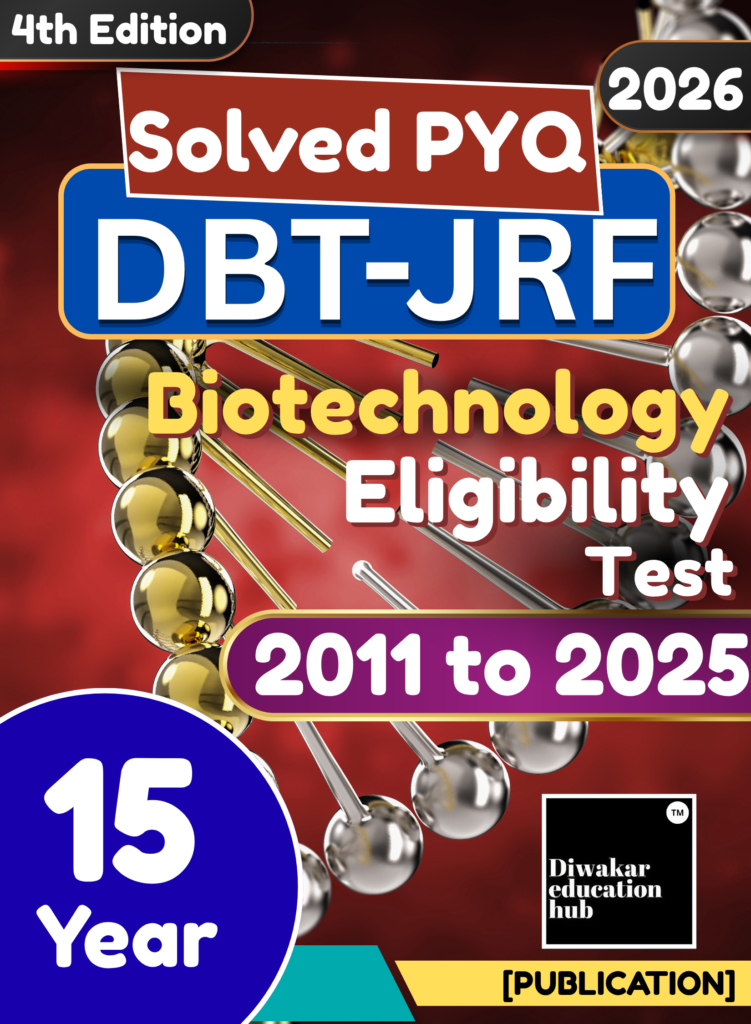
DBT JRF Biotechnology Eligibility Test Books 2026 | DBT JRF Solved Previous Year Paper PYQ Book | 15 Years 2011–2025 with Detail Solution
Original price was: ₹650.00.₹599.00Current price is: ₹599.00.
Why a Chapter-Wise DBT JRF Book Is Important
The DBT JRF syllabus is broad and multidisciplinary. It includes molecular biology, cell biology, genetics, biotechnology techniques, bioinformatics, immunology, agricultural biotechnology, medical biotechnology, environmental biotechnology, and industrial biotechnology.
A chapter-wise DBT JRF book helps students study in a systematic way. It allows aspirants to track syllabus completion, revise important topics easily, and practice questions topic by topic.
What Should a Good DBT JRF Book Include?
A proper DBT JRF preparation book should include:
- Complete syllabus coverage
- Chapter-wise theory
- Important definitions and key points
- Flow charts and tables
- Previous year questions [PYQs]
- Chapter-wise MCQs
- Assertion-reason questions
- Match-the-following questions
- Numerical-based questions
- Full-length mock tests with explanations
Biotechnology is a concept-based and application-oriented subject. Therefore, students should not depend only on theory. They must also practice experimental techniques, molecular biology tools, genetics problems, biostatistics, and bioinformatics-based questions.
DBT JRF Preparation Strategy Using a Chapter-Wise Book
Students should start with the core chapters because these topics are frequently asked in the exam. The most important chapters for DBT JRF preparation are:
| Priority | Chapters |
|---|---|
| High Priority | Biomolecules, Cell Biology, Molecular Biology, Recombinant DNA Technology, Genetics |
| Medium Priority | Methods in Biotechnology, Genomics, Proteomics, Immunology, Bioinformatics |
| Selective Priority | Agricultural Biotechnology, Animal Biotechnology, Environmental Biotechnology, Medical Biotechnology, Industrial Biotechnology |
First, complete the high-priority chapters and solve chapter-wise MCQs. After that, move to advanced and specialized topics. Since Part-B usually allows candidates to attempt selected questions, students should prepare their strongest subject areas deeply.
Best Way to Use a DBT JRF Chapter-Wise Book
To get maximum benefit from a DBT JRF book, follow this approach:
- Read one chapter completely.
- Highlight important concepts and definitions.
- Make short notes for quick revision.
- Solve chapter-wise MCQs.
- Practice PYQs from the same topic.
- Revise weak areas again.
- Attempt mock tests after completing major units.
This method helps improve accuracy, speed, and confidence before the final exam.
Important Chapters for DBT JRF/BET Exam
Although students should cover the complete syllabus, some chapters are more important from the exam point of view:
| Important Chapter | Why It Is Important |
|---|---|
| Molecular Biology | Frequently asked in both concept and application-based questions |
| Recombinant DNA Technology | High-scoring and technique-based chapter |
| Cell Biology | Core chapter for biotechnology and life sciences |
| Genetics | Important for numerical and conceptual questions |
| Methods in Biotechnology | Covers instruments, techniques, and experimental methods |
| Immunology | Important for medical and animal biotechnology sections |
| Bioinformatics | Scoring if databases and tools are revised properly |
| Biostatistics | Useful for numerical and analytical questions |
Conclusion
A DBT JRF book chapter wise according to syllabus is one of the best resources for BET preparation. It helps students complete the syllabus in an organized manner and practice important questions topic by topic.
For better results, students should choose a book that includes complete theory, chapter-wise MCQs, PYQs, mock tests, answer keys, and detailed explanations. A syllabus-based and exam-oriented DBT JRF book can make preparation easier, faster, and more effective.
FAQs on DBT JRF Book and Syllabus
Q1. Which book is best for DBT JRF preparation?
The best DBT JRF book is one that follows the official BET syllabus and includes chapter-wise theory, MCQs, PYQs, mock tests, and detailed explanations.
Q2. Is DBT JRF syllabus similar to CSIR NET Life Science?
Some topics overlap, such as molecular biology, cell biology, genetics, biotechnology, and immunology. However, DBT JRF is more focused on biotechnology and applied life sciences.
Q3. Are PYQs important for DBT JRF?
Yes, PYQs are very important because they help students understand the question pattern, difficulty level, and frequently repeated topics.
Q4. Which chapters are most important for DBT JRF?
Molecular Biology, Cell Biology, Biomolecules, Recombinant DNA Technology, Genetics, Methods in Biotechnology, Immunology, and Bioinformatics are among the most important chapters.
Q5. Can I prepare for DBT JRF with a chapter-wise book?
Yes, a chapter-wise DBT JRF book is very useful because it helps students study according to the syllabus, revise easily, and practice questions topic by topic.

You may also like