
UGC NET Social Medicine & Community Health Latest Syllabus, Eligibility Criteria, Exam Pattern, Latest Books, Previous year paper & Cut-off [Complete Details]
The UGC NET Social Medicine & Community Health examination (Subject Code 81) is a specialized UGC-NET subject covering public health, social medicine, community health, epidemiology, biostatistics, health policies, healthcare systems, and related areas. The subject syllabus is organized into 10 units, providing comprehensive coverage of both theoretical concepts and their application in community and public-health practice This article provides a complete guide for UGC NET Social Medicine & Community Health including the latest syllabus, eligibility criteria, examination pattern, preparation strategy, recommended books, previous year question papers (PYQs), and previous cut-off marks. Candidates can use this information to understand the examination requirements and plan their preparation systematicall
Table of Contents
UGC NET Social Medicine & Community Health – Overview
| Particular | Details |
|---|---|
| Examination | UGC NET |
| Conducting Agency | National Testing Agency (NTA) |
| Subject | Social Medicine & Community Health |
| Subject Code | 81 |
| Examination Mode | Computer Based Test (CBT) |
| Papers | Paper 1 & Paper 2 |
| Paper 1 | Teaching & Research Aptitude |
| Paper 2 | Social Medicine & Community Health |
| Total Questions | 150 |
| Total Marks | 300 |
| Duration | 3 Hours |
| Negative Marking | No |
| Question Type | Multiple Choice Questions (MCQs) |
| Medium | English & Hindi |
| Main Eligibility Outcomes | JRF, Assistant Professor & Ph.D. |
The UGC NET examination is conducted in CBT mode. The two papers are held in a single three-hour session without a break.
Latest UGC NET Social Medicine & Community Health Syllabus
| Unit | Section / Topic |
|---|---|
| Unit-I Evolution and Basic Concepts of Public Health/ Social Medicine and Community Health | History of Social Medicine and Community Health |
| History of Public Health and Its Milestones | |
| Comprehensive Health Care | |
| Social Development and Health | |
| Dimensions and Determinants of Health | |
| Concepts and Indicators of Health and Wellbeing | |
| Natural History of Disease | |
| Levels of Prevention | |
| Globalisation and Its Impact on Health | |
| Roles and Responsibility of State, Community and Private Sector in Health | |
| Unit-II Evolution of Health Policies and Health Services in India | Health Committees and Development of Health Services in Independent India |
| Constitutional Provisions, Federal Structure and Social Security | |
| National Health Policies (1983, 2002, 2017), Population Policy, Nutrition Policy, | |
| Policy on Indian Systems of Medicine and Homeopathy, 2002 | |
| Important Health Legislations in India | |
| Health Infrastructure in India—Public, Private, and Charitable, Public Private Partnership(PPP) | |
| Health financing and Health insurance, Out of Pocket expenditure | |
| Civil society and Social Movements in Health | |
| Unit-III General Epidemiology and Bio-statistics | Basic concepts and definitions in Epidemiology |
| Types of epidemiology | |
| Uses of epidemiology | |
| Measurements in epidemiology | |
| Epidemiological Study Designs | |
| Screening and surveillance | |
| Validity of Screening and Diagnostic tests | |
| Causation , Association and Biases | |
| Investigation of an epidemic | |
| Basic concepts in Bio statistics | |
| Types of data and data sources for Public Health | |
| Sampling techniques and sample size estimation | |
| Probability and Tests of significance | |
| Data analysis, presentation and interpretation | |
| Unit-IV Social Sciences and Health | Definition, Scope, Concepts and Significance of Social, Economic, Cultural and Behavioral factors on Health and Disease |
| Social Theories of Causation of Disease | |
| Implications of Social Structure and Socio-economic Status for Health | |
| Political and Economic Aspects of Health | |
| Health Perceptions and Behavior | |
| Health Economics | |
| Qualitative Research Methodology | |
| Social Work Approach in Health Care | |
| Unit-V Epidemiology of Common Health Problems In India and National Health Programmes | Communicable Diseases—Common, Emerging and Re-emerging diseases, Hospital acquired infections, Antimicrobial resistance |
| Non-Communicable Diseases—Cardio-vascular diseases, Diabetes, Cancers, Rheumatic heart disease, Blindness, Mental Health, Occupational Diseases, Genetic diseases | |
| Accidents , Injuries and Disasters | |
| All National Health Programs and data sources. | |
| Unit-VI Basic Determinants of Health | a. Environment and Health |
| Water and sanitation | |
| Environmental pollution and Health impacts | |
| Built environment and Housing | |
| Climate change and impact on health | |
| Waste management | |
| Hospital waste management | |
| b. Nutrition | |
| Ecology of malnutrition | |
| Assessment of Nutritional status | |
| Nutritional diseases and their management | |
| Food and nutrition security and related legislations | |
| National Nutrition programs | |
| Socio cultural aspects of nutrition | |
| Food safety, Food standards and related legislations | |
| c. Social determinants of Health | |
| Unit-VII Demography, Family Welfare and RCH | a. Demography and Family Planning |
| Definition, concepts and indicators related to demography and family planning | |
| Demographic cycle | |
| Size, composition and distribution of India’s population | |
| Approaches and methods of contraception | |
| Evolution of National Family Welfare Program | |
| Social issues related to Family Planning | |
| Felt need and unmet need in Family planning | |
| Social marketing in family planning | |
| Counseling in Family planning | |
| PC and PNDT Act-1994 | |
| MTP Act 1971 | |
| b. Reproductive and Child Health | |
| Evolution of Maternal/ Reproductive and child Health programs | |
| Safe motherhood and essential newborn care with related schemes and programs | |
| Gender issues in women’s health | |
| Major health problems of children in India and related National Health Programs | |
| Adolescent health and related schemes and programs | |
| Rights of child and related schemes and Programs | |
| School Health Programme | |
| Unit-VIII Health Education/ IEC/ BCC and Information Technology in Health | Concepts, objectives and approaches of health education |
| Methods , modes and barriers of communication | |
| Planning, Management and Organization of health education programs | |
| E-medicine, Distance education and associated legal issues | |
| Role of media in Health Education | |
| E Health and m Health | |
| Unit-IX Health Systems Research, Planning and Management and Recent Advances in Public Health | Health planning and management |
| Health systems research- Operations Research, System analysis, Health Technology assessment, Monitoring and Evaluation | |
| Health Management Information System | |
| Medical and Social Audits | |
| Health teams and their management | |
| Human Resources in Health | |
| Role of Ayush in local Health traditions | |
| Health policy studies | |
| Quality assessment of Health Services- parameters and standards | |
| Ethics in Health Care | |
| National Institutes of Public Health Research and Training | |
| Unit-X International Health | Health problems of developed and developing countries |
| Health problems of South East Asia region | |
| International agencies in Health | |
| Emporiatrics | |
| Health for All approaches- Primary Health Care (1978) to Universal Health Coverage | |
| Millennium Development Goals (MDG) and Sustainable Development Goals (SDG) |
UGC NET Social Medicine & Community Health Exam Pattern
The examination consists of two papers.
| Paper | Subject | Questions | Marks |
|---|---|---|---|
| Paper 1 | Teaching & Research Aptitude | 50 | 100 |
| Paper 2 | Social Medicine & Community Health | 100 | 200 |
| Total | — | 150 | 300 |
UGC NET Social Medicine & Community Health Marking Scheme
- Correct answer: +2 marks
- Incorrect answer: 0 marks
- Unattempted question: 0 marks
- Negative marking: No
- Maximum marks: 300
Paper 1 contributes 100 marks, while Paper 2 contributes 200 marks. Since Paper 2 contains twice the marks of Paper 1, candidates should devote substantial preparation time to the subject-specific syllabus.
UGC NET Social Medicine & Community Health Eligibility Criteria
According to the latest UGC-NET eligibility rules, candidates belonging to the General/Unreserved/General-EWS category generally require at least 55% marks in a Master’s degree or equivalent examination from a recognized institution.
Candidates belonging to OBC-NCL, SC, ST, PwD/PwBD and Third Gender categories require at least 50% marks in the Master’s degree or equivalent examination.
Candidates who are currently pursuing their Master’s degree or have appeared in their final examination and are awaiting results may also apply provisionally, subject to the conditions prescribed by NTA.
Candidates are generally advised to appear in the subject of their postgraduate qualification. If their postgraduate subject is not among the listed NET subjects, they may appear in a related subject as permitted by the rules.
Four-Year Bachelor’s Degree Candidates
| PG Degree / Subject | Social Medicine & Community Health – Code 81 |
|---|---|
| MD – Community Medicine / Preventive & Social Medicine | ✅ Directly relevant |
| MD – Community Health Administration | ✅ Directly relevant |
| Master of Public Health (MPH) | ✅ Closely/directly relevant |
| M.Sc. Public Health | ✅ Closely relevant |
| M.Sc. Community Health | ✅ Closely relevant |
| M.Sc. Social Medicine | ✅ Directly relevant |
| Master of Community Medicine | ✅ Directly relevant |
| Master of Health Administration (MHA) | ⚠️ Related subject; not explicitly named by NTA for Code 81 |
| M.Sc. Epidemiology | ⚠️ Related subject; not explicitly named by NTA for Code 81 |
| M.Sc. Health Sciences | ⚠️ Depends on the exact programme/curriculum |
| M.Sc. Medical & Social Psychology / Health Psychology | ⚠️ Related, but not automatically Code 81 |
| M.A./M.Sc. Sociology | ⚠️ Not automatically eligible for Code 81; normally Sociology is its own NET subject |
| M.A. Social Work / MSW | ⚠️ Not automatically Code 81; Social Work has its own NET subject |
| M.Sc. Nursing / M.Sc. Nursing-related PG | ⚠️ Not automatically Code 81 |
| M.Pharm. | ⚠️ Not automatically Code 81 |
| M.Sc. Biotechnology / Microbiology / Life Sciences | ⚠️ Not automatically Code 81 |
Age Limit for UGC NET
For the June 2026 examination, the upper age limit for JRF was 30 years as on 1 June 2026, subject to the prescribed age relaxations Relaxations are available for specified categories, including OBC-NCL, SC, ST, PwD/PwBD, Third Gender and women candidates, as well as certain candidates with research experience and other specified conditions. For Assistant Professor -There is no upper age limit for applying for UGC NET for Assistant Professor eligibility. For Ph.D. Admission – There is no upper age limit for UGC NET when applying for the Ph.D.-admission category.
UGC NET Social Medicine & Community Health Latest Cut-Off 2025 to 2026
| Exam Session | Category | JRF Cut-Off | Assistant Professor Cut-Off | Difference |
|---|---|---|---|---|
| June 2025 | General (UR) | 212 | 182 | 30 |
| OBC-NCL | 202 | 162 | 40 | |
| SC | 186 | 156 | 30 | |
| ST | 178 | 154 | 24 | |
| December 2025 | General (UR) | 200 | 176 | 24 |
| OBC-NCL | 188 | 160 | 28 | |
| SC | 172 | 144 | 28 | |
| ST | 158 | 148 | 10 | |
| June 2026 | General (UR) | 196 | 170 | 26 |
| OBC-NCL | 180 | 150 | 30 | |
| SC | 182 | 140 | 42 | |
| ST | 162 | 146 | 16 |
UGC NET Social Medicine Paper Analysis 10 Year
| Year / Exam | Unit 1 | Unit 2 | Unit 3 | Unit 4 | Unit 5 | Unit 6 | Unit 7 | Unit 8 | Unit 9 | Unit 10 |
|---|---|---|---|---|---|---|---|---|---|---|
| 2017 Dec | 8 | 7 | 19 | 11 | 40 | 18 | 19 | 0 | 1 | 2 |
| 2018 Jun | 6 | 6 | 14 | 2 | 39 | 21 | 8 | 1 | 1 | 2 |
| 2018 Dec | 1 | 10 | 19 | 6 | 24 | 15 | 15 | 4 | 3 | 3 |
| 2019 Jun | 8 | 9 | 14 | 6 | 19 | 5 | 16 | 8 | 7 | 8 |
| 2019 Dec | 0 | 10 | 16 | 5 | 34 | 8 | 17 | 2 | 3 | 4 |
| 2020 Jun | 11 | 3 | 13 | 3 | 21 | 17 | 16 | 5 | 3 | 8 |
| 2021 Dec / 2022 Jun | 5 | 11 | 16 | 6 | 22 | 15 | 14 | 0 | 9 | 2 |
| 2022 Dec | 6 | 5 | 20 | 3 | 13 | 16 | 18 | 3 | 8 | 8 |
| 2023 Jun | 4 | 5 | 26 | 3 | 19 | 19 | 17 | 1 | 3 | 1 |
| 2023 Dec | 3 | 5 | 15 | 12 | 19 | 11 | 23 | 3 | 4 | 5 |
| 2024 Jun | 2 | 9 | 17 | 12 | 10 | 12 | 20 | 5 | 9 | 4 |
| 2025 Jun | 7 | 11 | 12 | 5 | 12 | 15 | 14 | 11 | 9 | 4 |
| 2025 Dec | 2 | 6 | 14 | 10 | 14 | 13 | 14 | 12 | 9 | 6 |
UGC NET Social Medicine & Community Health Previous Year Papers
Previous Year Question Papers (PYQs) are one of the most important resources for preparation.
Candidates should ideally solve papers from multiple examination cycles rather than relying only on one or two recent papers.
A good PYQ collection should include:
- Year-wise questions
- Complete answer keys
- Detailed explanations
- Topic-wise classification
- Unit-wise classification
- Important repeated concepts
- Questions from recent examination cycles
- Practice questions based on the latest syllabus
| Year | Link to Downlaod |
|---|---|
| Year 2024 June | Click Here |
| Year 2024 Dec | Click Here |
| Year 2025 June | Click Here |
| Year 2025 Dec | Click Here |
| Year 2025 June | Updated Soon |
Why Previous Year Questions are Important
PYQs help candidates understand the actual examination better than simply reading the syllabus.
By solving PYQs, candidates can identify:
- Frequently repeated concepts
- Important units
- Question difficulty
- Conceptual versus factual questions
- Numerical questions from epidemiology and biostatistics
- Important health programmes
- Repeated questions related to policies and legislation
- Important terminology
- Areas requiring additional revision
- Time-management requirements
For Social Medicine & Community Health, PYQs are particularly useful because many questions are based on specific concepts, definitions, programmes, policies, indicators and epidemiological principles.
Latest Books for UGC NET Social Medicine & Community Health
| Unit | Chapter / Main Topics | Recommended Books |
|---|---|---|
| Unit 1 | Evolution & Basic Concepts of Public Health / Social Medicine & Community Health | 1. Park’s Textbook of Preventive & Social Medicine 2. Textbook of Public Health & Community Medicine – Rajvir Bhalwar 3. Textbook of Community Medicine – Sunder Lal, Adarsh & Pankaj 4. NTA UGC NET Social Medicine & Community Health Paper-II – Kakuli Chakraborty |
| Unit 2 | Evolution of Health Policies & Health Services in India | 1. National Health Programmes of India – J. Kishore 2. Park’s Textbook of Preventive & Social Medicine 3. Textbook of Public Health & Community Medicine – Rajvir Bhalwar 4. NTA UGC NET Social Medicine & Community Health Paper-II – Kakuli Chakraborty |
| Unit 3 | General Epidemiology & Biostatistics | 1. Park’s Textbook of Preventive & Social Medicine 2. Gordis Epidemiology – Leon Gordis 3. Clinical Epidemiology: The Essentials – Fletcher 4. Methods in Biostatistics – B.K. Mahajan 5. NTA UGC NET Social Medicine & Community Health Paper-II – Kakuli Chakraborty |
| Unit 4 | Social Sciences & Health | 1. Textbook of Community Medicine – Sunder Lal, Adarsh & Pankaj 2. Textbook of Public Health & Community Medicine – Rajvir Bhalwar 3. Oxford Textbook of Global Public Health 4. NTA UGC NET Social Medicine & Community Health Paper-II – Kakuli Chakraborty |
| Unit 5 | Epidemiology of Common Health Problems in India & National Health Programmes | 1. Park’s Textbook of Preventive & Social Medicine 2. National Health Programmes of India – J. Kishore 3. Textbook of Public Health & Community Medicine – Rajvir Bhalwar 4. NTA UGC NET Social Medicine & Community Health Paper-II – Kakuli Chakraborty |
| Unit 6 | Basic Determinants of Health – Environment, Nutrition & Social Determinants | 1. Park’s Textbook of Preventive & Social Medicine 2. Textbook of Community Medicine – Sunder Lal, Adarsh & Pankaj 3. Textbook of Public Health & Community Medicine – Rajvir Bhalwar 4. Oxford Textbook of Global Public Health |
| Unit 7 | Demography, Family Welfare & Reproductive and Child Health | 1. Park’s Textbook of Preventive & Social Medicine 2. National Health Programmes of India – J. Kishore 3. Textbook of Community Medicine – Sunder Lal, Adarsh & Pankaj 4. NTA UGC NET Social Medicine & Community Health Paper-II – Kakuli Chakraborty |
| Unit 8 | Health Education, IEC, BCC & Information Technology in Health | 1. Textbook of Public Health & Community Medicine – Rajvir Bhalwar 2. Park’s Textbook of Preventive & Social Medicine 3. Textbook of Community Medicine – Sunder Lal, Adarsh & Pankaj 4. NTA UGC NET Social Medicine & Community Health Paper-II – Kakuli Chakraborty |
| Unit 9 | Health Systems Research, Planning & Management & Recent Advances in Public Health | 1. Textbook of Public Health & Community Medicine – Rajvir Bhalwar 2. Park’s Textbook of Preventive & Social Medicine 3. Oxford Textbook of Global Public Health 4. NTA UGC NET Social Medicine & Community Health Paper-II – Kakuli Chakraborty |
| Unit 10 | International Health | 1. Oxford Textbook of Global Public Health 2. Park’s Textbook of Preventive & Social Medicine 3. Maxcy-Rosenau-Last Public Health & Preventive Medicine 4. NTA UGC NET Social Medicine & Community Health Paper-II – Kakuli Chakraborty |
Recommended products
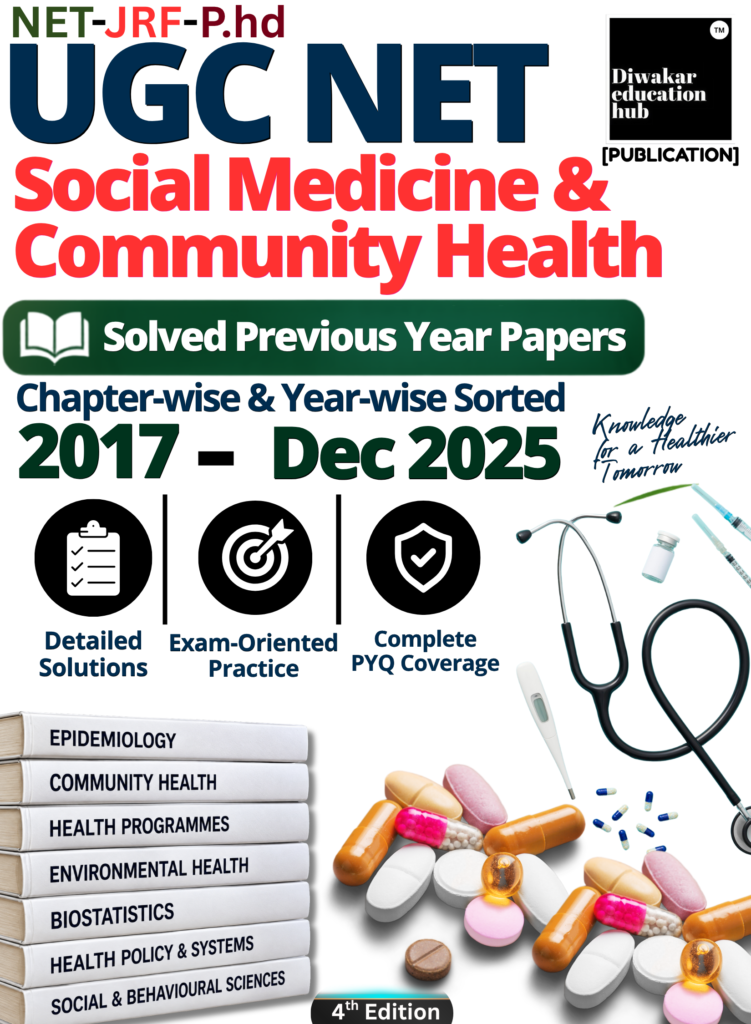
Important Topics for UGC NET Social Medicine & Community Health
While every topic in the syllabus should be prepared, candidates should give special attention to the following areas:
Public Health
- Determinants of health
- Levels of prevention
- Health indicators
- Natural history of disease
Health Policies
- National Health Policy
- Health committees
- Health infrastructure
- Health financing
- Health insurance
Epidemiology
- Incidence
- Prevalence
- Mortality
- Morbidity
- Study designs
- Screening
- Surveillance
- Bias
- Causation
- Epidemic investigation
Biostatistics
- Sampling
- Probability
- Tests of significance
- Data presentation
- Interpretation
Disease Epidemiology
- Communicable diseases
- NCDs
- Emerging diseases
- Antimicrobial resistance
Nutrition
- Malnutrition
- Nutritional assessment
- Food security
- Food safety
- Nutrition programmes
RCH
- Family planning
- Contraception
- Maternal health
- Newborn care
- Child health
- Adolescent health
Health Systems
- HMIS
- Monitoring and evaluation
- Health technology assessment
- Quality assessment
- Healthcare ethics
International Health
- WHO and other international agencies
- Primary Health Care
- Health for All
- UHC
- MDGs
- SDGs
Tips to Score Higher in UGC NET Social Medicine & Community Health
1. Study the official syllabus first
Do not prepare randomly. Keep the 10-unit syllabus in front of you during preparation.
2. Give special importance to PYQs
PYQs reveal the actual nature of the examination.
3. Revise factual information regularly
Health policies, programmes, legislation, indicators and international organizations require repeated revision.
4. Practise numerical questions
Do not ignore biostatistics and epidemiological calculations.
5. Prepare Paper 1 alongside Paper 2
Paper 1 contributes 100 marks and can significantly improve the overall score.
6. Attempt mock tests
Mock tests help identify weak areas and improve speed.
7. Analyse every incorrect answer
Simply taking tests is not enough. Candidates should understand why an answer was incorrect.
8. Aim above the previous cut-off
The cut-off changes from session to session. Therefore, preparation should target a safe margin rather than the minimum expected sco
