
![UGC NET Ayurveda Biology Latest Syllabus, Eligibility Criteria, Exam Pattern, Latest Books, Previous year paper & Cut-off [Complete Details]](https://www.diwakareducationhub.in/wp-content/uploads/2026/09/ChatGPT-Image-Sep-25-2026-03_39_46-PM.png)
UGC NET Ayurveda Biology Latest Syllabus, Eligibility Criteria, Exam Pattern, Latest Books, Previous year paper & Cut-off [Complete Details]
UGC NET Ayurveda Biology is a specialized subject introduced under the UGC-NET examination with Subject Code 105. The National Testing Agency (NTA) conducts UGC-NET to determine eligibility for Assistant Professor and Junior Research Fellowship (JRF) + Assistant Professor in Indian universities and colleges. Ayurveda Biology is officially listed as one of the UGC-NET subjects For candidates preparing for Ayurveda Biology, understanding the latest syllabus, eligibility requirements, examination pattern, previous year question papers and category-wise cut-off is essential. Since this is a relatively specialized UGC-NET subject, preparation should focus on the prescribed subject syllabus along with regular practice of previous year questions and concept-based MCQs The Ayurveda Biology paper has been conducted in recent UGC-NET cycles, including December 2024 and June 2025. NTA has also published the official final answer keys for Ayurveda Biology, making these papers useful resources for understanding the actual question pattern. In this article, we will cover all the important information about UGC NET Ayurveda Biology 2026, including:
UGC NET Ayurveda Biology 2026
The UGC-NET examination is conducted by the National Testing Agency (NTA) on behalf of the University Grants Commission (UGC). The examination is conducted in Computer Based Test (CBT) mode. UGC-NET is generally conducted twice a year, in the June and December cycles.Ayurveda Biology is subject code 105. Candidates selecting this subject are assessed on their knowledge of Ayurveda Biology in Paper 2, while Paper 1 evaluates general teaching and research aptitude.
| Particular | Details |
|---|---|
| Examination | UGC-NET |
| Conducting Body | National Testing Agency (NTA) |
| Subject | Ayurveda Biology |
| Subject Code | 105 |
| Mode | Computer Based Test (CBT) |
| Papers | Paper 1 & Paper 2 |
| Paper 1 | Teaching & Research Aptitude |
| Paper 2 | Ayurveda Biology |
| Total Questions | 150 |
| Total Marks | 300 |
| Duration | 3 Hours |
| Negative Marking | No negative marking |
| Medium | English & Hindi, except language papers |
UGC NET Ayurveda Biology Eligibility Criteria
Candidates planning to appear for UGC NET Ayurveda Biology should satisfy the eligibility conditions prescribed by UGC/NTA for the relevant examination cycle.
1. Educational Qualification
55% for General/EWS and 50% for OBC-NCL/SC/ST/PwD/PwBD/Third Gender candidates. It also lists Ayurveda Biology as Subject Code 105 and includes Master of Ayurvedacharya (Ayurvedacharya) and Master of Acharya (Acharya) in its PG-course list
UGC NET Ayurveda Biology Eligibility – All-in-One List
- MD/MS in Ayurveda – Eligible under the Master’s-degree route, subject to the applicable percentage and subject-selection rules.
- M.Sc. Life Sciences (Ayurveda Biology) – Eligible, provided the degree is from a recognized institution and the candidate satisfies the prescribed marks requirement.
- M.Sc. Ayurveda Biology – Eligible as a relevant Master’s-level qualification, subject to recognition and the applicable UGC-NET subject rules.
- Master of Ayurvedacharya (Ayurvedacharya) – The UGC-NET June 2026 Information Bulletin specifically lists “Master of Ayurvedacharya (Ayurvedacharya)” (Code 01) under Post-Graduation Courses.
- Master of Acharya (Acharya) – Also specifically listed by NTA as a Post-Graduation Course (Code 02).
- Other relevant M.Sc. degrees in Life Sciences/Biological Sciences – Candidates holding a relevant Master’s degree may be eligible, but the relationship between their PG subject and Ayurveda Biology (105) should satisfy NTA’s subject-selection rules.
2. Final-Year / Result-Awaiting Candidates
Candidates who are appearing in their final year of the qualifying Master’s programme or whose result is awaited may also be eligible under the conditions specified by NTA However, such candidates must satisfy the required qualification within the prescribed period mentioned in the relevant notification.
3. Age Limit for Assistant Professor
There is no upper age limit for applying for Assistant Professor eligibility through UGC-NET, subject to the applicable UGC/NTA rules.
4. Age Limit for JRF
The JRF category has an upper age limit, along with prescribed relaxations for eligible categories. Since the age limit and relaxation provisions can be updated through examination notifications, candidates should check the information bulletin for their particular UGC-NET cycle before applying.
UGC NET Ayurveda Biology Exam Pattern
Paper-wise structure
| Paper | Subject | Questions | Marks |
|---|---|---|---|
| Paper 1 | General Teaching & Research Aptitude | 50 | 100 |
| Paper 2 | Ayurveda Biology | 100 | 200 |
| Total | — | 150 | 300 |
The June 2025 UGC-NET information bulletin specifies 50 questions/100 marks for Paper 1 and 100 questions/200 marks for Paper 2, with a total examination duration of three hours.
Marking Scheme
Each correct answer carries 2 marks There is no negative marking for incorrect answers. Therefore, candidates should attempt questions strategically rather than leaving a large number of questions unanswered.
UGC NET Ayurveda Biology Latest Syllabus
Ayurveda Biology is an interdisciplinary subject combining traditional Ayurvedic knowledge with biological and scientific perspectives.The syllabus should be prepared according to the official UGC syllabus applicable to Subject Code 105. NTA’s information bulletin directs candidates to the prescribed UGC syllabus for the detailed subject-wise syllabus For preparation, candidates should organize the syllabus into major conceptual areas such as:
| Unit | Topic | Detailed Syllabus |
|---|---|---|
| Unit 1 | History and Development of Ayurveda | 1. Vedic origin & chronological development of Āyurveda 2. Āyurveda and various schools 3. Understanding and relevance of aṣṭāṅga āyurveda 4. Basic Texts and commentaries of Āyurveda 5. Contribution of commentators to Āyurveda 6. Introduction to bṛhattrayī and its importance 7. Introduction to laghutrayī and its importance 8. Basic understanding of nighaṇṭu and kośa of Āyurveda 9. Contribution of contemporary publications in Āyurveda 10. Government initiatives for development of Āyurveda |
| Unit 2 | Philosophy and Fundamental Principles of Ayurveda | 1. āyu – lakṣaṇa, paryāya, paribhāṣā and pramāṇa 2. Definitions of śarīra, jñānendriya, karmendriya, mana, buddhi, citta, ahaṃkāra, ātmā 3. lokapuruṣa sāmya siddhānta, ekadhātu puruṣa, ṣaḍdhātuja puruṣa, caturviṃśati tatvātmaka puruṣa and their relevance 4. Definitions of Ayurveda – hitāyu – ahitāyu, sukhāyu – dukhāyu, trisūtra āyurveda – hetu-liṅga-auṣadha-jñāna svastha ātura 5. svāsthya lakṣaṇa – Dimensions of Health Corresponding to nature, prakṛti, ṛtucaryā, dinacaryā, svasthavṛtta 6. paṃcamahābhūta – ākāśa-vāyu-agni-jala-pṛthvī and their specific properties 7. Theories of sāmānya and viśeṣa 8. padārtha – theories of dravya-guṇa-karma-sāmānya-viśeṣa-samavāya 9. doṣa – śarīrika and mānasika 10. Introduction to dhātu, mala, agni and srotas |
| Unit 3 | Sharira Rachna and Kriya | 1. Introduction to śarīra racanā kriyā 2. garbhaśarīra (fetal development) – śukra, ārtava, garbhādhāna, garbha and māsānumāsika garbha 3. Introduction to śarīra pramāṇa, saṃkhyā śarīra, aṅga-pratyaṅga-koṣṭhāṅga and āśaya 4. Introduction to deha prakṛti and mānasa prakṛti 5. Introduction to doṣa, sapta dhātu and mala vijñāna 6. Definition and types of – asthi, sandhi, snāyu, peśī, parva and kaṇḍarā 7. Definition, types and numbers of srotas, dhamanī, śirā and nāḍī 8. ojas and its importance 9. Definition of agni and types – jaṭharāgni, dhātvāgni and bhūtāgni 10. marma – Definition and types |
| Unit 4 | Padartha Vijnana and Dravya Vijnana | 1. padārtha – Definition and types – saptapadārtha 2. Definition and types of pramā, prameya, pramātā, pramāṇa and pramāṇa catuṣṭaya 3. pramāṇa – Definition and types – āptopadeśa, pratyakṣa, anumāna and yukti pramāṇa 4. Origin of dravya, Definition and types – kāraṇa and kārya dravya 5. auṣadha and āhāra dravya, āyuṣya – anāyuṣya dravya 6. Basic concept of rasa pañcaka 7. dravya – nāma-rūpa-guṇa-karma-yoga-prayoga-saṃyoga vijñāna 8. Basic concept, classification, and application guṇa, vīrya and vipāka 9. Basic concept of karma and its classification 10. dravya in accordance with karma and its uses in health and disease |
| Unit 5 | Rasa Shastra, Bheshajya Kalpana and Ayurvedic Pharmacopeia | Rasa Shastra and Bhaiṣajya Kalpanā: 1. Origin and Development of rasa śāstra and bhaiṣajya kalpanā 2. rasa – Definition, Types of rasa śodhana prakāra and saṃskāra 3. uparasa sādhāraṇa rasa, ratna, and uparatna – Definition; Types of śodhana and māraṇa 4. Principles of auṣadha nirmāṇa, jāraṇa, māraṇa, satvapātana, nirvāpa and āvāpa 5. Basic concept of bhaiṣajya kalpanā 6. rasaśālā – Conventional and Contemporary aspects, Good Collection Practices and Good Manufacturing Practices 7. Basic Pharmaceutical dosage forms and Secondary dosage forms of āyurveda 8. Definition of puṭa, its types and use in various pharmaceutical forms 9. auṣadha sevana kāla and auṣadha sevana mārga Pharmacopeia:10. Āyurvedic Pharmacopoeia of India (API) – Introduction, development and importance 11. Āyurvedic Formulary of India (AFI) – Introduction, development and importance 12. Drugs and Cosmetics Act, 1940 in relation to ASU Drugs and Standardization of ASU drugs 13. Extra-pharmacopoeial drugs (Anukta dravya) not finding place in Ayurvedic Classics 14. Knowledge of pharmaco-vigilance in Āyurveda and conventional system of medicine 15. Pharmacogenomics of active compounds of Āyurveda and multi-omics approach |
| Unit 6 | Disease Biology, Microbiology and Immunology | Disease Biology:1. Definition of disease, Etiology and Pathology 2. Congenital and Acquired diseases 3. Communicable and Non-communicable diseases 4. Genetic and Epigenetic factors in health and diseases 5. Autoimmune diseases and Lifestyle disorders 6. Deficiency and Metabolic diseases 7. Psychological disorders 8. Benign tumors and various types of cancersMicrobiology 9. Historical perspectives of Microbiology, Immunization, Epidemics and Pandemics 10. Antimicrobial resistance, Immune response by microorganisms, Sterilization and disinfection 11. Microbial Diversity and Physiology 12. Gut-Brain axis (GBA) and Microbiome 13. Microorganisms isolation and characterization, culture media 14. Environmental microflora, Bio-remediation, Dairy microbiology, Indicator organisms and tests and water borne diseases 15. Genetic Recombination, Transformation, Conjugation and TransductionImmunology:16. Role of RBCs, WBCs, platelets and plasma proteins in immune mechanisms 17. Biophysics of Immune System, Structure of antigen and antibody molecules, Antigen recognition by T cell and B cells, B-cell receptors, TCR gene rearrangement, antigen presentation and MHC/HLA complex 18. Antigen antibody reactions, Innate immune cells, Pathogen-associated molecular pattern (PAMP), Pathogen recognition receptors (PRR) and Complement system 19. Natural and Acquired immunity, cell-mediated immunity and toxicity and cytokines 20. Immunopathology and autoimmune diseases, transplant rejection and allergy, Immunomodulators 21. Antibody isolation and purification, ELISA, immunoblotting, immunohistochemistry, immunoprecipitation, immune cell isolation, flow cytometry and Immunotherapy 22. History of vaccines, attenuated vaccine, heat-killed vaccine, subunit vaccine, recombinant vaccine, DNA vaccine, RNA vaccine, dendritic cell-based vaccine, Virus-Like Particles, adjuvants and their role in vaccine |
| Unit 7 | Genetics, Ayurgenomics, Cell and Molecular Biology | Genetics and Ayurgenomics:1. Principles of Inheritance and Variation, Historical Perspectives of Genetics 2. Human genome and its evolution 3. Exploring genotype to phenotype correlation, Multi-OMIC and its correlation with doṣa-prakṛti and medicinal plants 4. Basics of human genomics, regulatory mechanisms of genetic variation, its role in health, diseases and adaptation including drug response 5. Population genomics, Disease genomics, Pharmaco-genomics, Nutrigenomics, and scientific approaches and initiatives towards discovery of biomarkers 6. Approach, limitation and challenges in discovery, development and delivery of P4 and P5 (Predictive, Preventive, Personalized, Participatory and Promotive) medicinal aspects of Āyurveda Cell and Molecular Biology:7. Plant and animal cells – Structure and Function 8. Early evidences and Experiments of DNA as the genetic material, Chemistry of Nucleic acids, Nucleotides, Chargaff’s rule 9. Watson-Crick model and forms of DNA; types of RNAs, Concept of gene and genome, difference between prokaryotes and eukaryotic genes, C-value paradox, Triplexes, quadruplexes and aptamers 10. DNA replication – conservative, semi-conservative and dispersive models, DNA replicative enzymes and mechanisms of DNA replication 11. Types of gene mutations – base substitution, frame shift mutation, insertion, deletion, missense, nonsense, reverse, suppressor and lethal mutations; DNA damage and repair mechanisms 12. Gene expression and regulation in prokaryotes, structure of prokaryotic gene, structure and functions of RNA polymerase and its subunits 13. Mechanism of Gene Transcription and Translation, Genetic code, Gene structure, expression and regulation in eukaryotes, RNA polymerases, Post-transcriptional modifications and Operon concept 14. Basic concepts of Genetic Engineering and Biotechnology |
| Unit 8 | Physiology, Biochemistry and Nanotechnology | Physiology:1. Fundamentals of human physiology and cellular function 2. Digestive System – Digestion, Absorption and Metabolism 3. Respiratory and Circulatory Systems – Breathing and exchange of gases, Body fluids and circulation 4. Nervous Systems – Central and Autonomic nervous system, Neurophysiology and Cerebrospinal fluids 5. Excretory and Endocrine Systems – Excretory products and their elimination from the body, acid-base regulation, Endocrine glands and Hormonal functions 6. Reproductive System – Human reproductive physiology and Embryonic development 7. Voluntary and Involuntary movements and their coordination Biochemistry:8. Concept of atoms and molecules, molecular interactions, stereochemistry and their importance in biological systems 9. Carbohydrate chemistry and metabolism, Disorders associated with carbohydrate metabolism 10. Lipid chemistry and metabolism, Disorders associated with lipid metabolism, Lipidomics 11. Chemistry and metabolism of Proteins and Amino acids, Ramachandran plot, primary, secondary, tertiary and quaternary structure of proteins, Mechanisms and specificity of Enzymes, Coenzymes and Cofactors, Disorders associated with protein and amino acid metabolism, proteomics 12. Heme synthesis and disorders 13. Structure, function and metabolisms of nucleic acids, DNA and RNA Nanotechnology:14. Physical properties and types of the nanoparticles, Nanoparticles of various basic pharmaceutical forms of Āyurveda and Green nanotechnology 15. Synthesis of nanomaterials using different methods, Molecular basis of biosynthesis of nanomaterials, assessment of plant, animal and mineral-based drugs for nanomaterials 16. Characterizations of nanoparticles – transmission electron microscope (TEM), scanning electron microscope (SEM), fluroscence microscopy, atomic force microscope (AFM), Energy-dispersive X-ray spectroscopy (EDX), UV–visible absorption; photoluminescence; Fourier-transform infrared spectroscopy (FTIR), Atomic absorption spectroscopy (AAS) and dynamic light scattering spectroscopy (DLS) 17. Nanomaterials in bio-sensors and other applications and Interaction of nanomaterials 18. Molecular basis of nano-formulations |
| Unit 9 | Biodiversity and Environmental Health, IPR and Entrepreneurship | Biodiversity and Environmental Health:1. Biodiversity of Medicinal plants and animals, Concept and Practices of environmental health, Pathways for synthesis of primary and secondary metabolites and their uses 2. Pharmacological properties of secondary and active metabolites of medicinal plants used in Āyurveda 3. Concept of ecosystem, structure, function and types of ecosystem, energy flow in an ecosystem: food chain, food web and ecological succession 4. Biodiversity and its conservation, Levels of biological diversity, biogeography zones of India, biodiversity patterns and global biodiversity hot spots, India as a mega-biodiversity nation 5. Renewable and non-renewable biological resources and their importance in longevity of life 6. Degradation of biodiversity, loss of medicinal plants and animal life, and its impact on indigenous knowledge Intellectual Property Rights (IPR):7. Concept, meaning and types of Intellectual Property (IP), Origin, nature, philosophy and importance of Intellectual Property Rights (IPR), Current Best Practices (CBP) and legal framework of IPR 8. Protection of Traditional Knowledge System (TKS), prevention of bio-piracy and bio-prospecting, benefits to national economy, conservation of environment, protection of livelihood of TK stake-holders, TKS and innovation in Indian medicine system 9. Introduction to the Indian patent office and National Biodiversity Authority and their role in the protection of TKS, Different types of IPR protection in India, Indian Legislations – Patents Act of India (1970); Biological Diversity Act (2002), Convention of Biological Diversity (1992), Plant Protection Variety and Farmers Rights Act (2001) and Geographical Indication Act 1999 etc. with respect to TKS 10. The role of databases and registers in the legal protection of TKS – Traditional Knowledge Digital Library (TKDL) through World Intellectual Property Organisation (WIPO)11. WTO, TRIPS, World Intellectual Property Organisation (WIPO), Convention on Biological Diversity (CBD); FAO; Nagoya Protocol on access and benefit-sharingEntrepreneurship:12. Definition of Entrepreneur, Entrepreneurial traits, and Entrepreneur versus Manager, Entrepreneurial decision processes, Ethical, Legal and Socio-cultural responsibilities 13. Opportunities for Entrepreneurs in relation to food and drugs of Ayurveda for wellness 14. Innovations and new ideas in Āyurveda R&D, Product planning, development and troubleshooting, Types of Āyurveda industries and manufacturing, and Competitive dynamics between the sub-industries 15. Entrepreneurship development programs of public and private agencies (MSME, Ministry of Ayush, Make in India), Challenges in Āyurveda industry and decision-making, Patenting and Commercialization strategies 16. Laboratory to market – strategies and processes of negotiation with financiers, government and regulatory authorities, Pricing strategy, challenges in marketing in Āyurveda business, Distribution channels, supply chain, Analysis and management of customer needs17. Business preparation including statutory and legal requirements, business feasibility study, Financial management in capital procurement and cost management, Collaborations and partnership |
| Unit 10 | Research Methodology, Biostatistics and Ayurveda-informatics | Research Methodology:1. Research Methodologies and Bioethics in Āyurveda 2. Fundamental principles-based research in Āyurveda 3. Food and drug-based research in Ayurveda 4. Pre-clinical and Clinical trials – types, protocol designing and data management in accordance with the principles of Āyurveda 5. Various extraction methods of plant materials, Concept of polarity for extraction and Solvents used for the extraction 6. Purification of bioactive compounds through various chromatographic methods 7. Identification of Functional Groups in Phytochemicals Biostatistics:8. Average, Mean, Mode, Median; Descriptive statistics, Various Statistical tests of significance and Analysis of variance9. Power and sample size calculation and Basic Principles of Statistical Inference 10. Correlation analysis, Regression analysis and Survival analysis 11. Genome Mapping Statistics and Bioinformatics 12. Types of data and its classification, multi-dimensional data, big data, meta data, linear algebraic treatment to data, matrices, eigen values and eigenvectors, and singular value decomposition 13. Exploratory data analysis, descriptive statistics and inferential statistics Ayurveda-informatics:14. Chronological Development of Āyurvedic drug manufacturing industries 15. Government policies and initiatives for the development of Āyurveda as traditional System of Medicine of India for the wellbeing of the world 16. Ordinance, Rules and Regulations in the manufacturing of quality, safety and efficacy of Āyurvedic drugs for the consumers 17. Review of important modern works on classical medicinal plants published by Ministry of AYUSH and ICMR, Govt of India 18. Important organizations of Ayurveda – National Commission for Indian System of Medicine (NCISM), Central Council for Research in Āyurvedic Sciences (CCRAS), Āyurvedic Pharmacopeia commission, National Medicinal Plants Board and Traditional Knowledge Digital Library (TKDL), etc 19. Research publication portals in Āyurveda and contemporary medical science – DHARA, PubMed, Ayush Research Portal, Bioinformatics Centre and Research Management Informatic System20. Use of modern technology to confirm the various fundamental principles, drug research and development for communicable and non-communicable diseases 21. Health informatics in Āyurveda in present global scenario |
June & December 2025 Paper Analysis – UGC NET Ayurveda Biology
| Unit | Unit Name | 2025 June | 2025 December |
|---|---|---|---|
| Unit-1 | History and Development of Ayurveda | 4 | 6 |
| Unit-2 | Philosophy and Fundamental Principles of Ayurveda | 14 | 13 |
| Unit-3 | Sharira Rachna and Kriya | 10 | 14 |
| Unit-4 | Padartha Vijnana and Dravya Vijnana | 13 | 7 |
| Unit-5 | Rasa Shastra, Bheshajya Kalpana and Ayurvedic Pharmacopeia | 7 | 11 |
| Unit-6 | Disease Biology, Microbiology and Immunology | 12 | 16 |
| Unit-7 | Genetics, Ayurgenomics, Cell and Molecular Biology | 15 | 6 |
| Unit-8 | Physiology, Biochemistry and Nanotechnology | 10 | 8 |
| Unit-9 | Biodiversity and Environmental Health, IPR and Entrepreneurship | 5 | 7 |
| Unit-10 | Research Methodology, Biostatistics and Ayurveda-informatics | 10 | 12 |
UGC NET Ayurveda Biology Previous Year Papers
Previous year papers are one of the most useful resources for understanding the actual examination.NTA has published official final answer keys for Ayurveda Biology for recent examinations.For example, the UGC-NET June 2025 Ayurveda Biology examination was conducted on 28 June 2025 in the second shift, and NTA published the official final answer key for Subject Code 105 Similarly, NTA published the December 2024 Ayurveda Biology final answer key, with the examination held on 9 January 2025.
| Year | Link |
|---|---|
| UGC NET June 2025 | Click Here |
| UGC NET December 2025 | Click Here |
| UGC NET June 2026 | Coming Soon |
UGC NET Ayurveda Biology Cut-Off 2025 to 2026
| Exam Session | Category | Assistant Professor Cutoff | JRF Cutoff | Difference (JRF − AP) |
|---|---|---|---|---|
| June 2025 | General / UR | 178 | 198 | 20 |
| EWS | 158 | 184 | 26 | |
| OBC-NCL | 170 | 194 | 24 | |
| SC | 158 | 178 | 20 | |
| December 2025 | General / UR | 196 | 228 | 32 |
| EWS | 168 | 200 | 32 | |
| OBC-NCL | 188 | 218 | 30 | |
| SC | 172 | 188 | 16 | |
| June 2026 | General / UR | 208 | 236 | 28 |
| EWS | 192 | 222 | 30 | |
| OBC-NCL | 186 | 222 | 36 | |
| SC | 188 | 200 | 12 |
Best Books for UGC NET Ayurveda Biology
| Unit | UGC NET Ayurveda Biology Unit | Recommended Book | Author | Approx. Price |
|---|---|---|---|---|
| Unit 1 | History and Development of Ayurveda | Caraka Samhita | Dr. K. R. Srikantha Murthy | ₹440+ |
| A Comprehensive Guide on Charaka Samhita | Vaidya Vasant Patil | — | ||
| Unit 2 | Philosophy and Fundamental Principles of Ayurveda | Ayurvediya Moulik Siddhanta | V. J. Thakkar | ₹300 approx. |
| Caraka Samhita | Dr. K. R. Srikantha Murthy | ₹440+ | ||
| Unit 3 | Sharira Rachna and Kriya | A Text Book of Ayurvedic Human Anatomy | Dr. Giridhar M. Kanthi | ₹270 approx. |
| Caraka Samhita | Dr. K. R. Srikantha Murthy | ₹440+ | ||
| Unit 4 | Padartha Vijnana and Dravya Vijnana | A Text Book of Dravyaguna Vijnana – Vol. 1 | Dr. J. L. N. Sastry & Dr. Tanuja M. Nesari | ₹270 |
| Introduction to Dravyaguna | Prof. P. V. Sharma | ₹170 | ||
| Unit 5 | Rasa Shastra, Bheshajya Kalpana & Ayurvedic Pharmacopeia | Ayurvediya Rasashastra | Prof. Siddhi Nandan Mishra | ₹338 |
| Rasaratnasamuchay | Prof. Siddhi Nandan Mishra | ₹490 approx. | ||
| Unit 6 | Disease Biology, Microbiology & Immunology | Textbook of Microbiology | R. Ananthanarayan & C. K. J. Paniker | ₹500–700 approx. |
| Immunology | Ivan M. Roitt et al. | ₹800+ | ||
| Unit 7 | Genetics, Ayurgenomics, Cell & Molecular Biology | Cell and Molecular Biology | E. D. P. De Robertis & E. M. F. De Robertis | ₹600–900 approx. |
| Genetics | P. K. Gupta | ₹500–700 approx. | ||
| Unit 8 | Physiology, Biochemistry & Nanotechnology | Textbook of Medical Physiology | Guyton & Hall | ₹900+ |
| Biochemistry | U. Satyanarayana & U. Chakrapani | ₹700–900 approx. | ||
| Unit 9 | Biodiversity, Environmental Health, IPR & Entrepreneurship | Environmental Studies | Erach Bharucha | ₹200–300 approx. |
| Intellectual Property Rights | P. Narayanan | ₹500+ | ||
| Unit 10 | Research Methodology, Biostatistics & Ayurveda-informatics | Research Methodology and Bio-Statistics | Dr. Vasant C. Patil | ₹1,500+ |
| Text Book of Biostatistics – Basics to Advances | CCRAS, Ministry of AYUSH | ₹312 |
-
UGC NET Ayurveda Biology Question Bank 1000 Question With Detail Explanation Also 2025 June & December Paper II Topic Wise & Chapter Wise
Original price was: ₹600.00.₹460.00Current price is: ₹460.00.
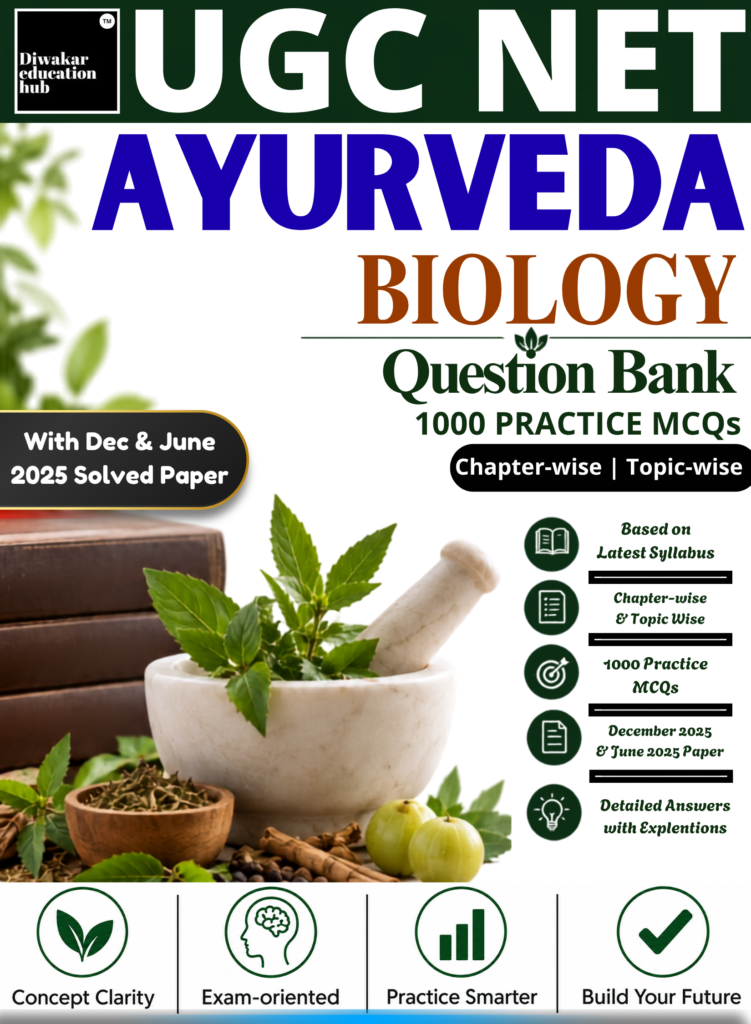
Recommended Book
-
UGC NET Ayurveda Biology Question Bank 1000 Question With Detail Explanation Also 2025 June & December Paper II Topic Wise & Chapter Wise
Original price was: ₹600.00.₹460.00Current price is: ₹460.00.
UGC NET Ayurveda Biology: How to Prepare?
A structured preparation strategy can make the syllabus easier to manage.
Step 1: Complete the Syllabus
Start by downloading the official Ayurveda Biology syllabus and divide it into smaller topics.
Make a checklist of every unit and track your preparation.
Step 2: Build Strong Concepts
Do not depend only on memorization. Ayurveda Biology contains interdisciplinary concepts, so candidates should understand the connection between traditional Ayurvedic concepts and modern biological sciences.
Step 3: Prepare Short Notes
Prepare concise notes for:
- Definitions
- Important concepts
- Medicinal plants
- Ayurvedic terminology
- Biological processes
- Research methods
- Important scientists and discoveries
- Pharmaceutical concepts
- Important factual information
Step 4: Solve Previous Year Questions
After completing each topic, solve relevant PYQs.
Instead of simply checking the correct answer, understand why the option is correct and why the other options are incorrect.
Step 5: Practice MCQs
Regular MCQ practice is essential because Paper 2 contains 100 objective-type questions.
A good practice schedule can include:
Concept → Topic-wise MCQs → PYQs → Mock Test → Revision
Step 6: Prepare Paper 1 Alongside Paper 2
Paper 2 carries 200 marks, but Paper 1 contributes another 100 marks. Candidates should therefore avoid ignoring Paper 1 during subject preparation.
UGC NET Ayurveda Biology Preparation Strategy
A practical preparation plan can be divided into three stages.
Phase 1 – Concept Building
Complete the syllabus systematically and make short notes.
Focus:
Theory + concepts + important facts
Phase 2 – Question Practice
Start solving topic-wise MCQs and previous year questions.
Focus:
PYQs + MCQs + error analysis
Phase 3 – Mock Tests & Revision
Attempt full-length tests under examination conditions.
Focus:
Speed + accuracy + revision + weak areas
A useful weekly cycle is:
Monday–Thursday: New topics
Friday: Revision
Saturday: PYQs + MCQs
Sunday: Mock test + analysis
How Many Marks Should You Target in UGC NET Ayurveda Biology?
There is no fixed score that guarantees qualification in every future examination because cut-offs change from one examination cycle to another.
However, the June 2025 official Ayurveda Biology cut-off for JRF + Assistant Professor was 198 marks for Unreserved candidates, 194 for OBC-NCL, 184 for EWS, 178 for SC and 152 for ST.
Candidates should therefore aim for a score comfortably above recent cut-off levels rather than preparing only to reach the previous year’s minimum.
UGC NET Ayurveda Biology: Important Tips
- Complete the official syllabus before starting intensive MCQ practice.
- Give special attention to frequently tested concepts.
- Solve official previous year papers.
- Maintain a separate notebook for incorrect questions.
- Revise factual information regularly.
- Do not ignore Paper 1.
- Take full-length mock tests.
- Analyze every mock test after completion.
- Focus on accuracy because every correct answer carries 2 marks.
- Since there is no negative marking, make effective use of the opportunity to attempt questions.
- Keep checking the official NTA website for the latest notification, syllabus, answer key and result updates.
Frequently Asked Questions (FAQs)
Q1. What is the subject code of UGC NET Ayurveda Biology?
The subject code for Ayurveda Biology is 105.
Q2. How many papers are there in UGC NET Ayurveda Biology?
There are two papers: Paper 1 and Paper 2. Paper 1 contains 50 questions for 100 marks, while Paper 2 contains 100 questions for 200 marks.
Q3. What is the total duration of UGC NET?
The examination duration is 3 hours (180 minutes) without a break.
Q4. Is there negative marking in UGC NET?
No. UGC-NET does not have negative marking for incorrect answers.
Q5. Where can I find Ayurveda Biology previous year papers?
NTA publishes examination-related answer keys and other material through the official UGC-NET website. Ayurveda Biology is listed as Subject Code 105 in the official answer-key section.
Q6. What was the June 2025 Ayurveda Biology cut-off?
For Unreserved candidates, the June 2025 cut-off was 198 marks for JRF + Assistant Professor, 178 marks for Assistant Professor and 164 marks for PhD Only. Category-wise cut-offs were different.
Q7. Is Paper 1 important for Ayurveda Biology?
Yes. The final UGC-NET result/qualification depends on the combined performance in Paper 1 and Paper 2, so candidates should prepare both papers seriously
