
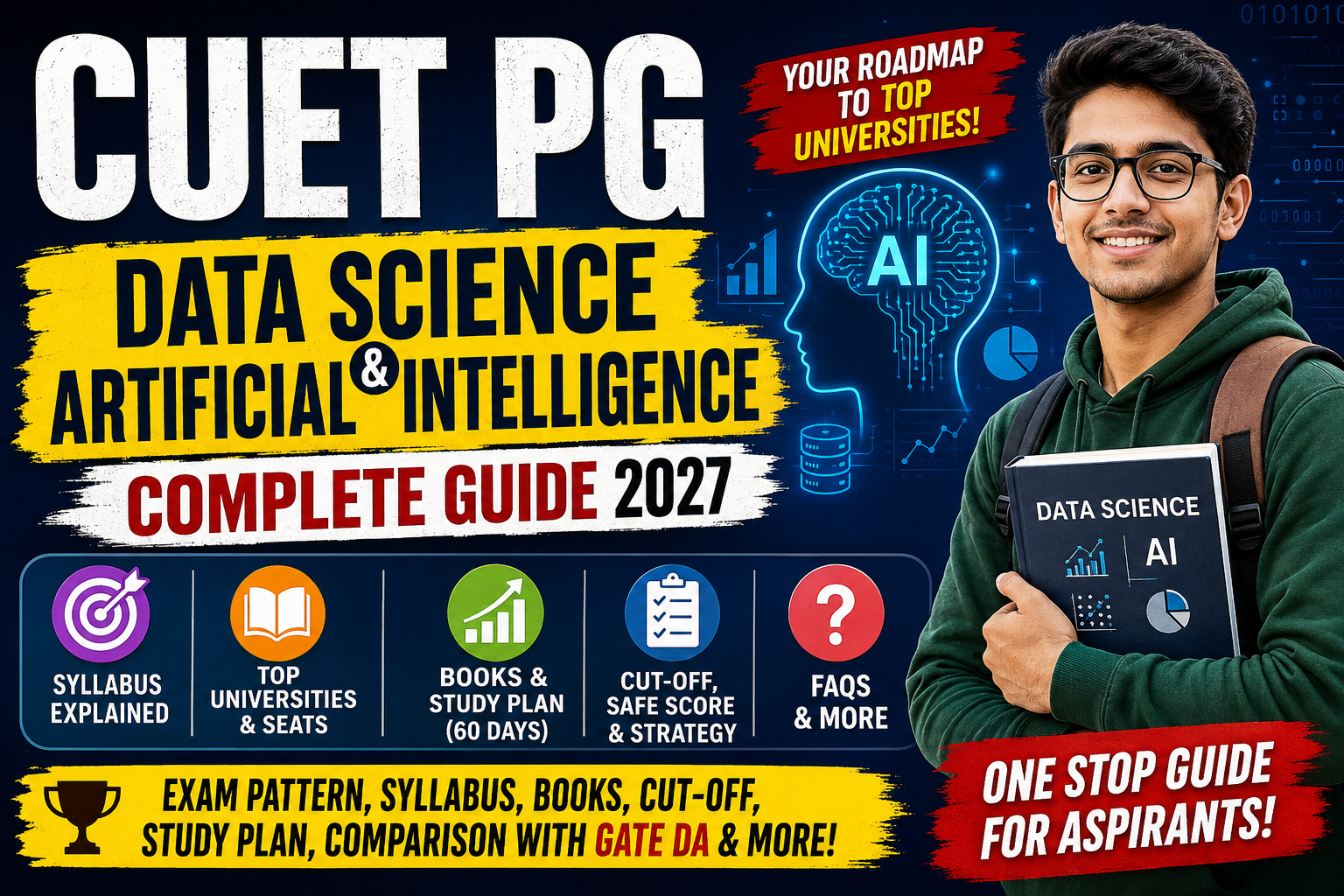
CUET PG Data Science & Artificial Intelligence [MTQP04] 2027: Complete Guide, Syllabus, Exam Pattern,Eligiblity University wise Paper Analysis, Seats, Cut-off & Best Books
The CUET PG Data Science & Artificial Intelligence (MTQP04) 2027 examination is one of the fastest-growing postgraduate entrance tests for candidates aspiring to pursue M.Tech., M.Sc., and other PG programmes in Data Science, Artificial Intelligence, Machine Learning, Cyber Security, Computer Science, and related disciplines offered by Central, State, Deemed, and Participating Universities across India. As industries rapidly adopt AI-driven technologies, cloud computing, cybersecurity, big data analytics, and intelligent systems, the demand for skilled professionals continues to increase, making MTQP04 an excellent gateway to higher education and rewarding career opportunities
Table of Contents
CUET PG MTQP04 2027 Highlights
| Particular | Details |
|---|---|
| Exam Name | CUET PG 2027 |
| Conducting Body | National Testing Agency (NTA) |
| Paper Code | MTQP04 |
| Paper Name | Data Science, Artificial Intelligence, Cyber Security & Computer Science |
| Exam Level | National |
| Exam Mode | Computer-Based Test (CBT) |
| Question Type | Multiple Choice Questions (MCQs) |
| Language | English |
| Admission Level | PG Programmes |
CUET PG Data Science & AI Syllabus 2027
| Unit | Topics |
|---|---|
| Unit 1: Set Theory & Algebra | Sets; Relations; Functions; Compositions of Functions and Relations; Group; Partial Orders; Boolean Algebra |
| Unit 2: Theory of Computations | Finite Automata and Regular Expressions; Non-determinism and NFA; Properties of Regular Sets; Context Free Grammar (CFG); Chomsky Normal Form (CNF); Griebach Normal Form (GNF); Push-down Automata (PDA); Moore Machines; Mealy Machines; Turing Machines |
| Unit 3: Digital Logic | Number Representations; Computer Arithmetic (Fixed Point and Floating Point); Logic Functions; Logic Minimization; Design and Synthesis of Combinational Circuits; Design and Synthesis of Sequential Circuits; A/D Converters; D/A Converters |
| Unit 4: Computer Organization & Architecture | Machine Instructions; Addressing Modes; Arithmetic Logic Unit (ALU); Data Path; CPU Control Design; Memory Interface; I/O Interface (Interrupt and DMA Mode); Instruction Pipelining; Cache Memory; Main Memory; Secondary Storage |
| Unit 5: Microprocessors & Interfacing | Instruction Sets; Addressing Modes; Memory Interfacing; Interfacing Peripheral Devices; Interrupts; Microprocessor Architecture; 8085 Instruction Set; 8085 Programming; Microprocessor Applications; Direct Memory Access (DMA); Interrupt; Timer |
| Unit 6: Programming & Data Structures | Programming in C; Functions; Recursion; Parameter Passing; Definition of Data Structure; Arrays; Stacks; Queues; Linked Lists; Trees; Priority Queues; Heaps; Binary Search Trees (BST) |
| Unit 7: Algorithms | Algorithm Concepts; Algorithm Analysis; Algorithm Design; Asymptotic Notations and Their Properties; Worst Case Analysis; Average Case Analysis; Greedy Approach; Dynamic Programming; Divide and Conquer; Tree Traversals; Graph Traversals; Spanning Trees; Shortest Path Algorithms; Hashing; Sorting; Searching |
| Unit 8: Operating Systems | Functions of Operating Systems; Processes; Threads; Interprocess Communication (IPC); Concurrency; Synchronization; Deadlock; CPU Scheduling; I/O Scheduling; Resource Scheduling; Deadlock Algorithms; Banker’s Algorithm; Memory Management; Virtual Memory; File Systems; I/O Systems; DOS; UNIX; Windows |
| Unit 9: Computer Networks | OSI Model; TCP/IP Model; LAN Technologies (Ethernet, Token Ring); Transmission Media (Twisted Pair, Coaxial Cable, Fiber Optic Cable); Flow Control; Error Control Techniques; Routing Algorithms; Congestion Control; IPv4; Application Layer Protocols (ICMP, DNS, SMTP, POP, FTP, HTTP); Sliding Window Protocols; Internetworking; Switch; Hub; Bridge; Router; Gateway; Concatenated Virtual Circuits; Firewalls; Network Security; Cryptography (Public Key, Secret Key); Domain Name System (DNS); Electronic Mail; World Wide Web (WWW) |
| Unit 10: Artificial Intelligence | Basic Concepts of Artificial Intelligence; Intelligent Agents; Problem Solving by Searching; Uninformed Search; Informed Search; Logical Agents; First Order Logic (FOL); Knowledge Representation |
| Unit 11: Cryptography & Network Security | Computer Security Concepts; Network Security Concepts; Classical Encryption Techniques; Symmetric Cipher Model; Caesar Cipher; Playfair Cipher; Hill Cipher |
| Unit 12: Data Science | Basic Concepts of Data Science; Data; Types of Data (Structured, Unstructured); Data Representation; Machine Learning Algorithms; Supervised Learning; Unsupervised Learning; Reinforcement Learning; Clustering; Classification; Regression Problems; Data Preprocessing; Normalization; Smoothing; Data Visualization |
Important Topics Unit Wise
| Unit | Important Topics | Exam Importance |
|---|---|---|
| Unit 1: Set Theory & Algebra | Sets & Operations, Relations & Functions, Composition of Functions, Groups, Partial Orders, Boolean Algebra | High |
| Unit 2: Theory of Computation | Finite Automata (DFA/NFA), Regular Expressions, Context-Free Grammar (CFG), Chomsky Normal Form (CNF), Griebach Normal Form (GNF), Pushdown Automata (PDA), Turing Machines, Moore & Mealy Machines | High |
| Unit 3: Digital Logic | Number Systems, Binary Arithmetic, Boolean Algebra, Karnaugh Maps (K-Map), Logic Gates, Combinational Circuits, Sequential Circuits, Flip-Flops, A/D & D/A Converters | High |
| Unit 4: Computer Organization & Architecture | Addressing Modes, ALU, CPU Control Unit, Instruction Pipelining, Cache Memory, Memory Hierarchy, DMA, Interrupts | High |
| Unit 5: Microprocessors & Interfacing | 8085 Architecture, Instruction Set, Addressing Modes, Memory Interfacing, Interrupts, DMA, Timers | High |
| Unit 6: Programming & Data Structures | C Programming, Functions, Recursion, Arrays, Linked Lists, Stack, Queue, Trees, Binary Search Tree (BST), Heaps, Pointers | Very High |
| Unit 7: Algorithms | Time Complexity, Asymptotic Notations, Sorting, Searching, Greedy Algorithms, Dynamic Programming, Divide & Conquer, Graph Algorithms, Spanning Trees, Shortest Path Algorithms, Hashing | Very High |
| Unit 8: Operating Systems | Processes & Threads, CPU Scheduling, Deadlocks, Banker’s Algorithm, Synchronization, Memory Management, Virtual Memory, File Systems | Very High |
| Unit 9: Computer Networks | OSI Model, TCP/IP Model, IPv4, Ethernet, Token Ring, Routing Algorithms, DNS, HTTP, FTP, SMTP, POP, Firewalls, Sliding Window Protocol, Network Devices (Hub, Switch, Bridge, Router, Gateway) | Very High |
| Unit 10: Artificial Intelligence | Intelligent Agents, Problem Solving by Searching, Uninformed Search, Informed Search, First Order Logic (FOL), Knowledge Representation | High |
| Unit 11: Cryptography & Network Security | Symmetric Cipher Model, Caesar Cipher, Playfair Cipher, Hill Cipher, Network Security Concepts | High |
| Unit 12: Data Science | Structured & Unstructured Data, Data Representation, Data Preprocessing, Normalization, Machine Learning, Supervised Learning, Unsupervised Learning, Reinforcement Learning, Classification, Regression, Clustering, Data Visualization | Very High |
CUET PG Data Science & AI 2026 Paper Analysis
| Unit | Total Questions |
|---|---|
| Unit 1 – Set Theory & Algebra | 8 |
| Unit 2 – Theory of Computation | 5 |
| Unit 3 – Digital Logic | 6 |
| Unit 4 – Computer Organization & Architecture | 5 |
| Unit 5 – Microprocessors & Interfacing | 6 |
| Unit 6 – Programming & Data Structures | 7 |
| Unit 7 – Algorithms | 7 |
| Unit 8 – Operating System | 7 |
| Unit 9 – Computer Networks | 9 |
| Unit 10 – Artificial Intelligence | 5 |
| Unit 11 – Cryptography & Network Security | 5 |
| Unit 12 – Data Science | 5 |
Seats for M.tech in Top University
| University | Programme | Approx./Official Seats |
|---|---|---|
| Jawaharlal Nehru University (JNU) | M.Tech. Data Science | 20 |
| Delhi Technological University (DTU) [Only Applicable for Gate] | M.Tech in Artificial Intelligence (AI) & M.Tech in Data Science (DS) | 60 |
| Banaras Hindu University (BHU) | M.Tech./M.Sc. Artificial Intelligence / Data Science-related Programme* | 30–40 (Approx.) |
| Central University of South Bihar (CUSB) | Master in Data Science & Applied Statistics | 45 (Official) |
| Central University of Andhra Pradesh (CUAP) | M.Sc. Artificial Intelligence & Data Science | 30 |
| Tezpur University | M.Tech. Data Science | 30 |
| Central University of Punjab (CUPB) | M.Tech. Artificial Intelligence | 24–30 (Approx.) |
| Central University of Karnataka (CUK) | AI / Data Science-related PG Programme | 30–40 (Approx.) |
| Central University of Haryana (CUH) | Artificial Intelligence / Data Science-related PG Programme | 30–40 (Approx.) |
| Central University of Jammu (CUJ) | Artificial Intelligence / Data Science-related PG Programme | 25–30 (Approx.) |
CUET PG Data Science & Artificial intelligence Books
| Unit | Recommended Book | Author(s) | Approx. Price (₹) |
|---|---|---|---|
| Unit 1: Set Theory & Algebra | Discrete Mathematics and Its Applications | Kenneth H. Rosen | 850–1,100 |
| Unit 2: Theory of Computation | Introduction to Automata Theory, Languages, and Computation | John E. Hopcroft, Rajeev Motwani & Jeffrey D. Ullman | 750–1,100 |
| Unit 3: Digital Logic | Digital Logic and Computer Design | M. Morris Mano | 650–900 |
| Unit 4: Computer Organization & Architecture | Computer Organization and Architecture | William Stallings | 850–1,200 |
| Unit 5: Microprocessors & Interfacing | Microprocessor Architecture, Programming and Applications with the 8085 | Ramesh S. Gaonkar | 700–950 |
| Unit 6: Programming & Data Structures | The C Programming Language | Brian W. Kernighan & Dennis M. Ritchie | 500–700 |
| Unit 7: Algorithms | Introduction to Algorithms (CLRS) | Thomas H. Cormen, Charles E. Leiserson, Ronald L. Rivest & Clifford Stein | 900–1,400 |
| Unit 8: Operating Systems | Operating System Concepts | Abraham Silberschatz, Peter B. Galvin & Greg Gagne | 900–1,300 |
| Unit 9: Computer Networks | Computer Networking: A Top-Down Approach | James F. Kurose & Keith W. Ross | 850–1,300 |
| Unit 10: Artificial Intelligence | Artificial Intelligence: A Modern Approach | Stuart Russell & Peter Norvig | 900–1,600 |
| Unit 11: Cryptography & Network Security | Cryptography and Network Security: Principles and Practice | William Stallings | 850–1,200 |
| Unit 12: Data Science | Data Mining: Concepts and Techniques | Jiawei Han, Micheline Kamber & Jian Pei | 900–1,400 |
Recommended products
-
CUET PG Data Science & Artificial Intelligence Solved Previous Year Paper 2022 to 2026 With 1000 Chapter & Topic Wise Questions As Per Updated Syllabus
Original price was: ₹600.00.₹499.00Current price is: ₹499.00.
Overall Safe Score Analysis CUET PG Data Science & AI (MTQP04)
| Score (Out of 300) | Admission Chances |
|---|---|
| 220+ | Excellent chance of admission in JNU, DU, BHU and almost all participating Central Universities |
| 200–219 | Very good chance in DU, BHU, Tezpur University and most Central Universities |
| 180–199 | Good chance in CUSB, CUPB, CUAP, CUK, CUH and several other Central Universities |
| 160–179 | Moderate chance; admission possible in later rounds or depending on category and seat availability |
| Below 160 | Admission depends on category, counselling rounds, vacant seats and university-specific cut-offs |
| Category | Safe Score |
|---|---|
| General (UR) | 200+ |
| EWS | 190+ |
| OBC-NCL | 185+ |
| SC | 165+ |
| ST | 155+ |
| PwD | 140+ |
GATE VS CUET PG Data Science
| Parameter | CUET PG Data Science & AI (MTQP04) | GATE Data Science & AI (DA) |
|---|---|---|
| Conducting Body | National Testing Agency (NTA) | Indian Institute of Technology (IIT) |
| Exam Purpose | Admission to PG programmes in Central & Participating Universities | Admission to M.Tech./Ph.D. in IITs, IISc, NITs, IIITs and selected PSUs |
| Exam Level | National Level PG Entrance | National Level Engineering Entrance |
| Programme Offered | M.Tech., M.Sc., MCA and related PG programmes | M.Tech., M.S., Ph.D., Research Programmes |
| Eligibility | Bachelor’s degree as per university eligibility | Bachelor’s degree in Engineering/Technology/Science or equivalent |
| Exam Mode | Computer-Based Test (CBT) | Computer-Based Test (CBT) |
| Exam Duration | 90 Minutes | 180 Minutes (3 Hours) |
| Total Questions | 75 MCQs | 65 Questions (MCQ, MSQ & NAT) |
| Maximum Marks | 300 | 100 |
| Question Types | Multiple Choice Questions (MCQs) | MCQ, Multiple Select Questions (MSQ), Numerical Answer Type (NAT) |
| Language | English | English |
| Negative Marking | Yes | Yes (MCQs only) |
| Difficulty Level | Moderate | High |
| Mathematics Level | Basic to Moderate | Advanced |
| Programming Level | Moderate | Moderate to Advanced |
| Machine Learning Level | Basic to Intermediate | Advanced |
| Artificial Intelligence Level | Basic to Intermediate | Advanced |
| Computer Science Fundamentals | Very High Weightage | Moderate Weightage |
| Probability & Statistics | Basic | Advanced |
| Data Science Coverage | Moderate | Very High |
| Syllabus Focus | Core Computer Science + AI + Data Science + Cyber Security | Mathematics + Statistics + Machine Learning + AI |
| Operating Systems | Included | Not Included |
| Computer Networks | Included | Not Included |
| Digital Logic | Included | Not Included |
| Theory of Computation | Included | Not Included |
| Microprocessors | Included | Not Included |
| Programming & Data Structures | Included | Included |
| Algorithms | Included | Included |
| Artificial Intelligence | Included | Included |
| Data Science | Included | Included |
| Machine Learning | Basic Coverage | Detailed Coverage |
| General Aptitude | Not Included | Included (15 Marks) |
| Top Institutes | JNU, DU, BHU, CUSB, CUAP, Tezpur University, CUPB, CUK, CUH, CUJ and other participating universities | IITs, IISc, NITs, IIITs, IISERs, Research Institutes |
| Scholarship Opportunities | University-specific scholarships | Institute scholarships, Teaching Assistantships (TA), Fellowships |
| PSU Recruitment | Generally Not Applicable | Accepted by several PSUs (where applicable) |
| Career Scope | AI Engineer, Data Analyst, Software Engineer, Cyber Security Analyst, Data Scientist | AI Engineer, Data Scientist, ML Engineer, Research Scientist, R&D Engineer, PSU Opportunities |
| Preparation Time | 4–6 Months | 8–12 Months |
| Competition Level | High | Very High |
| Best For | Students seeking admission to Central Universities | Students targeting IITs, IISc, NITs, IIITs and Research Institutes |
| Overall Difficulty | Moderate | High |
CUET PG MTQP04 – 60 Days Study Plan
| Days | Topics to Cover | Daily Practice |
|---|---|---|
| Day 1–5 | Unit 1: Set Theory & Algebra | 50 MCQs + Short Notes |
| Day 6–10 | Unit 2: Theory of Computation | 50 MCQs + PYQs |
| Day 11–14 | Unit 3: Digital Logic | 60 MCQs + Numerical Practice |
| Day 15–18 | Unit 4: Computer Organization & Architecture | 50 MCQs + PYQs |
| Day 19–22 | Unit 5: Microprocessors & Interfacing | 50 MCQs + Revision |
| Day 23–28 | Unit 6: Programming & Data Structures | 80 MCQs + Coding Concepts |
| Day 29–34 | Unit 7: Algorithms | 80 MCQs + PYQs |
| Day 35–40 | Unit 8: Operating Systems | 70 MCQs + Revision |
| Day 41–46 | Unit 9: Computer Networks | 70 MCQs + PYQs |
| Day 47–50 | Unit 10: Artificial Intelligence | 60 MCQs |
| Day 51–53 | Unit 11: Cryptography & Network Security | 50 MCQs |
| Day 54–56 | Unit 12: Data Science | 70 MCQs + PYQs |
| Day 57 | Revision of Units 1–4 | Full Revision + 100 MCQs |
| Day 58 | Revision of Units 5–8 | Full Revision + 100 MCQs |
| Day 59 | Revision of Units 9–12 | Full Revision + 100 MCQs |
| Day 60 | Full-Length Mock Test + Analysis | 1 Mock Test + Error Analysis |
Daily Study Schedule (6–7 Hours)
| Time | Activity |
|---|---|
| 2 Hours | Learn Theory & Concepts |
| 1.5 Hours | Solve Chapter-wise MCQs |
| 1 Hour | Previous Year Questions (PYQs) |
| 1 Hour | Revision of Previous Topics |
| 1–1.5 Hours | Practice Test / Weak Topics |
Weekly Targets
| Week | Target |
|---|---|
| Week 1 | Units 1–2 |
| Week 2 | Units 3–4 |
| Week 3 | Units 5–6 |
| Week 4 | Units 7–8 |
| Week 5 | Units 9–10 |
| Week 6 | Units 11–12 |
| Week 7 | Complete Revision + PYQs |
| Week 8 | Mock Tests + Final Revision |
Practice Plan
| Activity | Target |
|---|---|
| Theory Revision | Daily |
| Chapter-wise MCQs | 50–80 per day |
| Previous Year Questions | 20–30 per day |
| Topic-wise Revision | Daily (30–45 minutes) |
| Weekly Mock Test | 1 |
| Final Week Mock Tests | 3–5 Full-Length Tests |
Subject-wise Preparation Priority
| Priority | Units |
|---|---|
| Very High | Programming & Data Structures, Algorithms, Operating Systems, Computer Networks, Data Science |
| High | Set Theory & Algebra, Theory of Computation, Digital Logic, Computer Organization & Architecture, Microprocessors |
| Moderate | Artificial Intelligence, Cryptography & Network Security |
Final 10-Day Execution Strategy
| Days | Focus |
|---|---|
| Day 51–53 | Data Science + AI + Cryptography |
| Day 54 | Programming & Data Structures Revision |
| Day 55 | Algorithms + Operating Systems Revision |
| Day 56 | Computer Networks + Digital Logic Revision |
| Day 57 | Theory of Computation + Set Theory Revision |
| Day 58 | Full-Length Mock Test 1 + Analysis |
| Day 59 | Full-Length Mock Test 2 + Revision of Weak Areas |
| Day 60 | Final Mock Test + Formula & Short Notes Revision |
Frequently Asked Questions (FAQs) – CUET PG Data Science & Artificial Intelligence (MTQP04) 2027
1. What is CUET PG MTQP04?
Answer:
CUET PG MTQP04 is the Common University Entrance Test paper for admission to postgraduate programmes in Data Science, Artificial Intelligence, Cyber Security, Computer Science, and related disciplines offered by Central Universities and other participating universities.
2. Who conducts the CUET PG MTQP04 examination?
Answer:
The examination is conducted by the National Testing Agency (NTA) on behalf of participating universities.
3. Which programmes can I get admission to through MTQP04?
Answer:
Depending on the university, you can apply for:
- M.Tech. Data Science
- M.Tech. Artificial Intelligence
- M.Sc. Data Science
- M.Sc. Artificial Intelligence
- M.Tech./M.Sc. Cyber Security
- Data Analytics and other related postgraduate programmes.
4. What is the exam pattern of CUET PG MTQP04?
Answer:
The examination is conducted in Computer-Based Test (CBT) mode and generally consists of 75 multiple-choice questions (MCQs) carrying a total of 300 marks.
5. How many units are included in the MTQP04 syllabus?
Answer:
The syllabus consists of 12 units, covering Set Theory, Theory of Computation, Digital Logic, Computer Organization, Microprocessors, Programming, Algorithms, Operating Systems, Computer Networks, Artificial Intelligence, Cryptography, and Data Science.
6. Which units carry the highest weightage?
Answer:
Based on previous paper analysis, the most important units are:
- Programming & Data Structures
- Algorithms
- Operating Systems
- Computer Networks
- Data Science
- Set Theory & Algebra
7. Is Mathematics compulsory for MTQP04?
Answer:
Yes. Candidates should have a basic understanding of Discrete Mathematics, Set Theory, Boolean Algebra, and fundamental mathematical concepts relevant to Computer Science.
8. Which programming language should I prepare?
Answer:
The syllabus primarily focuses on C Programming, along with programming fundamentals, functions, recursion, arrays, linked lists, stacks, queues, trees, and binary search trees.
9. What is a good score in CUET PG MTQP04?
Answer:
A score of 200+ out of 300 is generally considered a safe score for admission to many top participating universities, although actual cut-offs vary each year.
10. Which are the top universities accepting MTQP04?
Answer:
Some leading universities include:
- Jawaharlal Nehru University (JNU)
- University of Delhi (DU)
- Banaras Hindu University (BHU)
- Central University of South Bihar (CUSB)
- Central University of Andhra Pradesh (CUAP)
- Tezpur University
- Central University of Punjab (CUPB)
- Central University of Karnataka (CUK)
11. Is MTQP04 easier than GATE Data Science & AI?
Answer:
Yes. CUET PG MTQP04 is generally considered easier than GATE DA. CUET PG focuses more on Computer Science fundamentals, whereas GATE DA includes advanced Mathematics, Statistics, Machine Learning, and Optimization.
12. Can B.Sc. or BCA students apply for MTQP04?
Answer:
Yes, provided they meet the eligibility criteria prescribed by the respective university for the desired postgraduate programme.
13. Are previous year question papers important?
Answer:
Yes. Solving previous year papers helps candidates understand the exam pattern, difficulty level, frequently asked topics, and improve time management.
14. Which books are best for MTQP04 preparation?
Answer:
Some standard reference books include:
- Kenneth H. Rosen – Discrete Mathematics and Its Applications
- M. Morris Mano – Digital Logic and Computer Design
- William Stallings – Computer Organization and Architecture
- Ramesh S. Gaonkar – 8085 Microprocessor
- Kernighan & Ritchie – The C Programming Language
- Cormen et al. (CLRS) – Introduction to Algorithms
- Silberschatz – Operating System Concepts
- Kurose & Ross – Computer Networking: A Top-Down Approach
- Russell & Norvig – Artificial Intelligence: A Modern Approach
- Jiawei Han – Data Mining: Concepts and Techniques
